Quick Summary
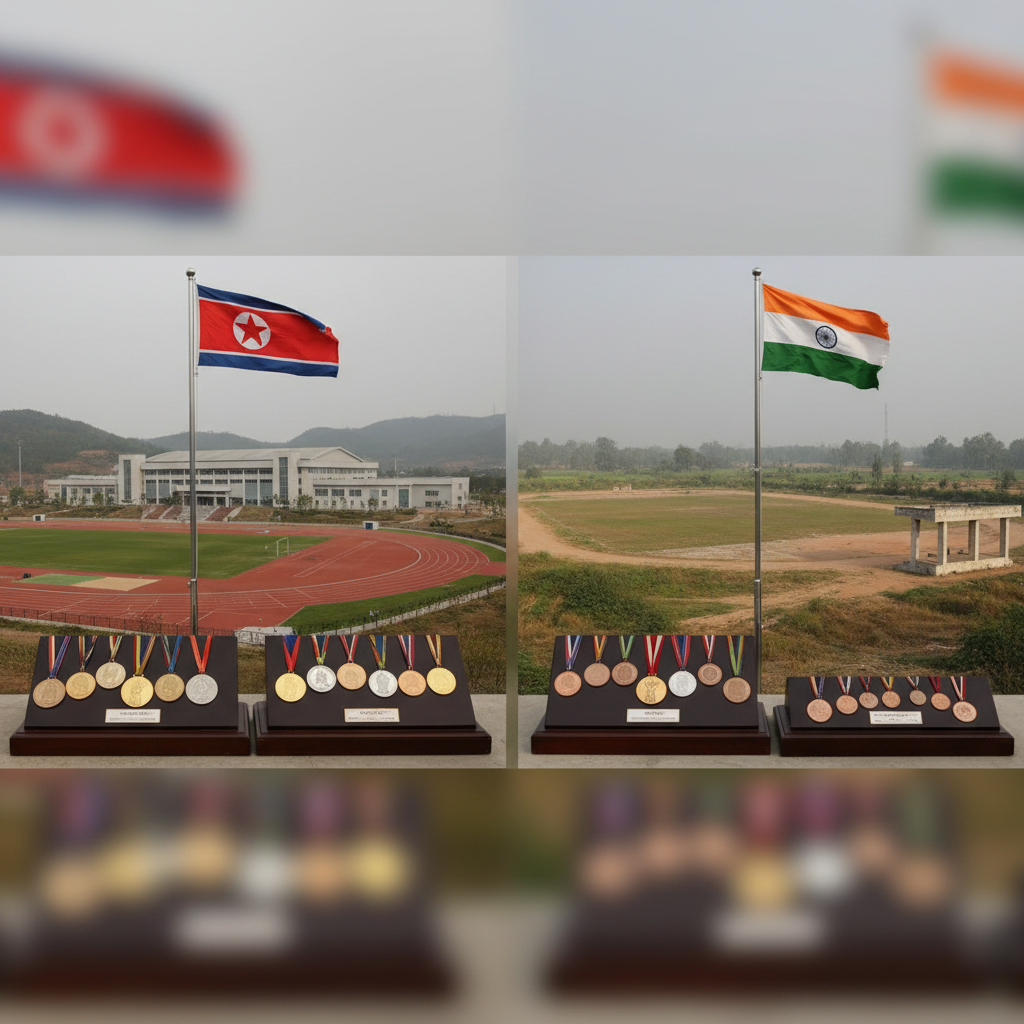
North Korea, with 26 million people, has won more Olympic medals than India (1.4 billion) by implementing a state-controlled sports system. Promising young athletes are identified and enrolled in elite academies from a young age, living and training in a highly disciplined environment focused solely on achieving international success. This talent funnel, driven by national prestige and intensive training, prioritises producing champions over widespread participation.
In a hurry? TL;DR
- 1North Korea, with a smaller population, has won more Olympic medals than India by design.
- 2Talent is identified young and funnelled into state-controlled academies with intense training.
- 3This system prioritises elite results as a tool of national prestige and propaganda.
- 4India's approach is more decentralised and often underfunded, with talent emerging despite the system.
Why It Matters
North Korea's Olympic success despite its population highlights how strategic talent development and incentives can outperform sheer numbers, offering vital lessons for other nations.
The numbers seem to defy logic: a nation of 1.4 billion people against one of just 26 million, yet the smaller state boasts a more impressive Olympic medal haul. India, the world's most populous democracy, has thus far accrued a modest 35 Summer Olympic medals, including 10 gold. North Korea, a reclusive, authoritarian state, has achieved 56 medals, with 16 golds, since its Olympic debut in 1972. This stark contrast is more than a mere statistical curiosity; it offers a penetrating look into how national priorities, state control, and the ruthless efficiency of a purpose-built athletic apparatus can triumph over the amorphous potential of sheer demographic might.
The Spartan Pursuit of Sporting Glory
North Korea's Olympic achievements are not an accident but the deliberate outcome of a system designed to extract and hone athletic talent with an unwavering focus. Unlike nations where sport is often a grassroots endeavour or a product of individual aspiration, in North Korea, it is a state enterprise, a tool of national projection.
A Funnel of Talent
From a young age, children displaying any physical prowess are identified and channelled into specialised sports academies. These institutions are not merely training grounds; they are total environments where promising athletes live, study, and train under intense scrutiny. The system is less about nurturing a wide base of participation and more about creating a highly selective, relentless funnel aimed at producing elite competitors.
India, by contrast, operates with a far more decentralised and often underfunded sporting infrastructure. While individual brilliance shines through, it is often despite the system, not because of it. Talent identification is sporadic, coaching standards vary wildly, and access to world-class facilities and nutrition remains a luxury for many. Only in recent years has there been a more concerted effort to professionalise and nationalise specific sporting disciplines, driven often by private initiatives or focused government programmes rather than a pervasive, integrated system.
Incentive Design: Glory and Survival
For a North Korean athlete, success on the international stage, particularly at the Olympics, carries immense personal and national significance. Winning a medal can transform an athlete's life, granting privileges and status unattainable for the average citizen. Failure, however, can have severe repercussions, ranging from public reprimand to reassignment to less desirable work. This creates a high-stakes environment where an athlete's performance is intimately tied to their personal well-being and their family's standing. :::pullquote[“He who fears death will never do anything worthy of a living man.”]::: This chilling quote, though not North Korean in origin, perfectly encapsulates the mentality cultivated within such a system, where the pursuit of glory is paramount, and the consequences of failure are dire.
For India, the incentives are different. While Olympic success brings national pride and individual accolades, it is not often a matter of survival. The path to sporting excellence is one of many avenues for success, and for a vast majority, it is a path of extreme hardship with no guaranteed reward. This is not to gainsay the dedication of Indian athletes, but to highlight the fundamental difference in the societal superstructure that underpins athletic ambition. The motivation for an Indian athlete is usually personal ambition and national pride, rather than the monolithic ideological imperative found in North Korea.
Specialisation and Resource Allocation
North Korea’s strategy is highly selective. Instead of attempting to compete across a broad spectrum of sports, it focuses its limited resources on disciplines where a combination of natural talent and rigorous training can yield results. Weightlifting, gymnastics, judo, and wrestling are often areas of strength — sports that require immense personal discipline, strength, and technique, attributes that can be honed even with comparatively modest financial outlays if the training is sufficiently intense.
:::keyfact[North Korea’s first Olympic medal was a bronze in wrestling at the 1972 Munich Games, followed by a gold in the same discipline.]:::
India’s approach, perhaps inevitably given its size, is more diffuse. While hockey once dominated, the nation now contends in cricket (a non-Olympic sport where it excels), athletics, shooting, wrestling, and badminton. The sheer variety means resources are spread thin, and consistently high-level performance across many disciplines is difficult to sustain. There is no singular, guiding hand directing all sporting investment towards the most "efficient" medal-winning sports in a utilitarian manner.
:::insight[A 2012 article in the New York Times highlighted North Korea's strategy of focusing on sports that require precision and strength, often overlooking team sports where individual glory might be less pronounced.]:::
The Role of Ideology and Image
North Korea views Olympic medals not just as sporting achievements but as propaganda victories. Each gold medal is a testament to the superiority of its system and a symbol of national strength against perceived external threats. This revanchist desire to prove its legitimacy on the world stage fuels the intense dedication to state-sponsored sport. Every athlete is, in essence, an ambassador, carrying the hopes and ideological weight of the nation.
For India, Olympic success, while celebrated, is not deeply intertwined with the nation's political legitimacy in the same way. The democratic process provides other avenues for national expression and pride. Sporting achievements are a welcome bonus, but not a fundamental pillar of national identity or political stability.
A Different Measure of Success
The comparison highlights that population size alone is not a determinant of athletic success. While a larger population theoretically offers a wider talent pool, this potential must be effectively tapped and cultivated. What matters more is the efficiency of the talent identification system, the quality and intensity of training, the incentives for success, and the strategic allocation of resources.
In India, sports culture is rapidly evolving. The success of individual athletes and the economic liberalisation process are bringing more resources into sports. Leagues such as the Indian Premier League in cricket and similar ventures in other sports are creating professional pathways and hero figures. However, these developments are still nascent compared to the deep, state-controlled infrastructure found in North Korea.
Consider the dedication of someone like Irv Gordon, who drove his Volvo over 3.2 million miles. His singular focus, chronicled in "The Man Who Drove 3.2 Million Miles in One Volvo", exemplifies a dedication to a single purpose. [Irv Gordon drove more than 3.2 million miles in his 1966 Volvo P1800, setting the record for the most miles driven in a single-owner car.] This kind of singular, unwavering pursuit, whether it is driving a car or winning a medal, is often what defines exceptional achievement. North Korea has successfully engineered a system that instils this level of singular, nationalistic focus into its athletes.
While India’s democratic and diverse society offers freedoms and opportunities that North Korea cannot, it faces the challenge of translating its vast human potential into structured, consistent athletic excellence on the global stage. The journey is ongoing, and its trajectory is upwards, but it is a distinct path from the one forged by the meticulously engineered, authoritarian state.
The paradox of North Korea’s Olympic success versus India’s sprawling potential is a clear reminder that in the arena of elite sport, quality of system often trumps quantity of people. It is a harsh calculus, but one that undeniably yields results, albeit at a human cost many would deem too high to pay.
Frequently Asked Questions
Sources & References



Learn something new each day
Daily words, facts and quotes delivered to your phone.
