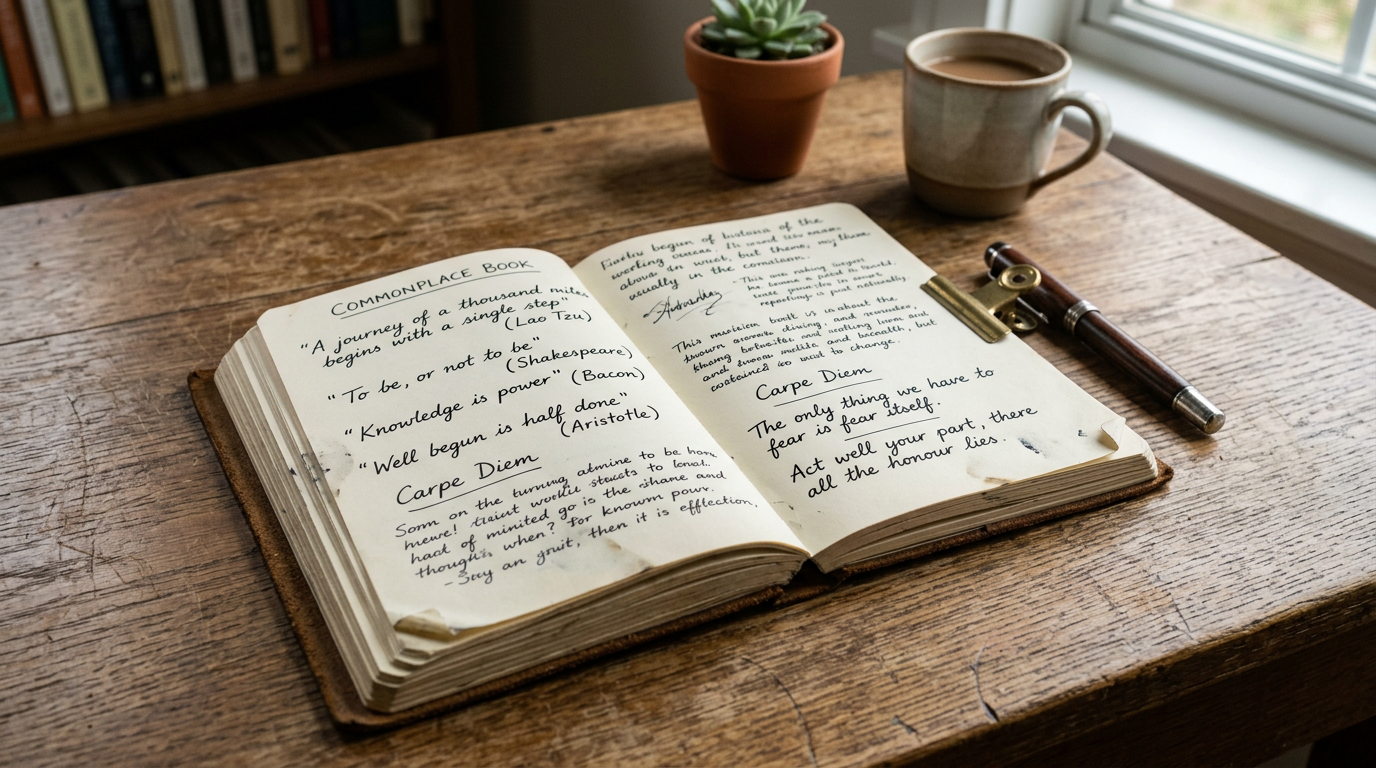
Quick Summary
Famous lines survive not primarily for their beauty, but because they prove consistently useful. They offer adaptable frameworks for thought, decision-making, and coping with life's challenges. These quotes provide concise summaries of complex ideas, aiding resilience, self-correction, and offering comfort or impetus when needed, allowing them to be reapplied across generations and diverse situations, hence their enduring popularity and practical value.
In a hurry? TL;DR
- 1Quotes endure through utility, not just beauty.
- 2They act as practical tools for life's challenges.
- 3Help with decision-making and self-correction.
- 4Offer concise, portable wisdom.
- 5Adaptable across different contexts and times.
- 6Resilience and perspective are key functions.
- 7Their 'usefulness' makes them survive.
Why It Matters
In a world saturated with information, understanding why certain ideas persist is crucial for effective communication and decision-making. This article explores how the practical utility of a phrase, rather than just its eloquence, determines its enduring power and relevance across generations. By dissecting the DNA of lasting expressions, we can better appreciate how language shapes our thoughts and actions.
We all carry a mental rolodex of famous phrases. Perhaps it's a line from Shakespeare that seems to perfectly capture a moment, or a pithy saying from a historical figure that resonates with your current dilemma. These aren't just pretty words; they are tools.
Indeed, the most enduring quotes aren't those that are merely eloquent or clever. Their longevity is less about their original brilliance and more about their ongoing utility. They survive because successive generations find new ways to apply them, to guide their decisions, steady their resolve, or simply offer a useful lens through which to view the world.
This isn't about memorising aphorisms for the sake of sounding profound. It's about understanding how certain combinations of words transcend their initial context to become portable wisdom – small, powerful engines for thought and action that keep on giving, long after their author is forgotten outside specialist circles.
The Practical Power of the Proverb
Think about it: why do some lines live forever while others, arguably just as well-crafted, fade into obscurity? The answer, more often than not, lies in their applicability. A truly useful quote is like a well-designed implement; it can be picked up and used for a myriad of tasks, often far removed from its intended purpose.
Take the often-quoted, "The only thing we have to fear is fear itself." Franklin D. Roosevelt spoke these words in 1933, amidst the Great Depression, specifically addressing economic paralysis. Yet, its utility extends far beyond national crises. How many times has that phrase helped someone overcome stage fright, tackle a daunting personal challenge, or simply push past procrastination? Its power isn't in its historical context, but in its adaptable blueprint for facing any internal barrier.
Similarly, "It is better to light a candle than to curse the darkness" – often attributed to either Confucius or Peter Benenson (Amnesty International's founder) – is a masterclass in useful advice. Is it about literally lighting candles? Of course not. It's a call to action, a reminder that agency and positive contribution, however small, are always preferable to passive complaint. This isn't just a feel-good statement; it's a practical guide for problem-solving, a lesson in proactive engagement that has been employed in uncountable situations from community activism to personal growth.
Quotes as Decision-Making Frameworks
Many enduring quotes offer a concise framework for making difficult choices. Consider "Look before you leap." Simple, direct, and universally applicable. It's not just a quaint saying; it's a fundamental principle of risk assessment and considered action. It's the micro-version of a full risk management strategy, portable and instantly deployable. Its survival across centuries speaks to its indispensable utility in preventing rash decisions.
Or consider "This too shall pass." Its origin is murky, often attributed to Persian Sufi poets or Jewish folklore, but its function is crystal clear: resilience. When faced with overwhelming difficulty or fleeting triumph, it offers perspective. It's a psychological tool, a mental anchor that prevents despair in bad times and hubris in good. It doesn't offer a solution, but it offers something arguably more important: a shift in outlook that enables you to endure or stay grounded.
The Role of Authors Who Earned Wisdom
It’s worth noting that many of these enduring lines come from authors who earned wisdom through hardship. Their words often carry the weight of lived experience, lending them an authenticity and practical edge that mere philosophical musings might lack. These aren't ivory tower sentiments; they're distilled truths forged in the furnace of reality.
The lines from Victor Frankl, for instance – such as "When we are no longer able to change a situation, we are challenged to change ourselves" – resonate precisely because of his experiences in concentration camps. This isn't just a clever turn of phrase; it's a survival mechanism, a profound psychological insight forged in the most extreme circumstances. Its usefulness as a guide for self-reflection and adaptation in adversity is undeniable, making it a cornerstone for anyone grappling with unchangeable circumstances.
How to Actually Use This
Instead of merely appreciating quotes, treat them as mental tools. When you encounter a phrase that resonates, ask yourself:
- What problem does this quote solve? Does it offer a new perspective on a challenge? Does it suggest a course of action? For instance, "Grant me the serenity to accept the things I cannot change, courage to change the things I can, and wisdom to know the difference" (the Serenity Prayer) directly addresses the challenge of distinguishing between manageable and unmanageable problems.
- How can I apply this today? Don't just nod. Actively seek opportunities to integrate the quote's wisdom. If "Practice makes perfect" comes to mind, use it as impetus to repeat that difficult task. If "Measure twice, cut once" occurs, use it as a prompt to double-check your work.
- Does it challenge my assumptions? Sometimes, a useful quote can play the role of a critical friend. "The unexamined life is not worth living" (Socrates) isn't just a statement; it's an invitation to introspection, a challenge to avoid complacency.
- Can I rephrase it for clarity? To truly internalise a quote's utility, try to explain it in your own words. If you can articulate its practical application without using the original phrase, you've likely grasped its true function.
Useful quotes are not decorative; they are functional. They are shortcuts to hard-won wisdom, enabling us to navigate complex situations with greater clarity and resilience. The reason why some lines live forever is simple: they keep proving their worth.
Related Small Talk Reading
For more insights into the power of words that shape our understanding and actions, feel free to browse our quote archive. You might find another useful tool for your mental toolkit. And for a dose of daily curiosity, don't forget to check out today's daily Small Talk.
Frequently Asked Questions
Learn something new each day
Daily words, facts and quotes delivered to your phone.
