Quick Summary
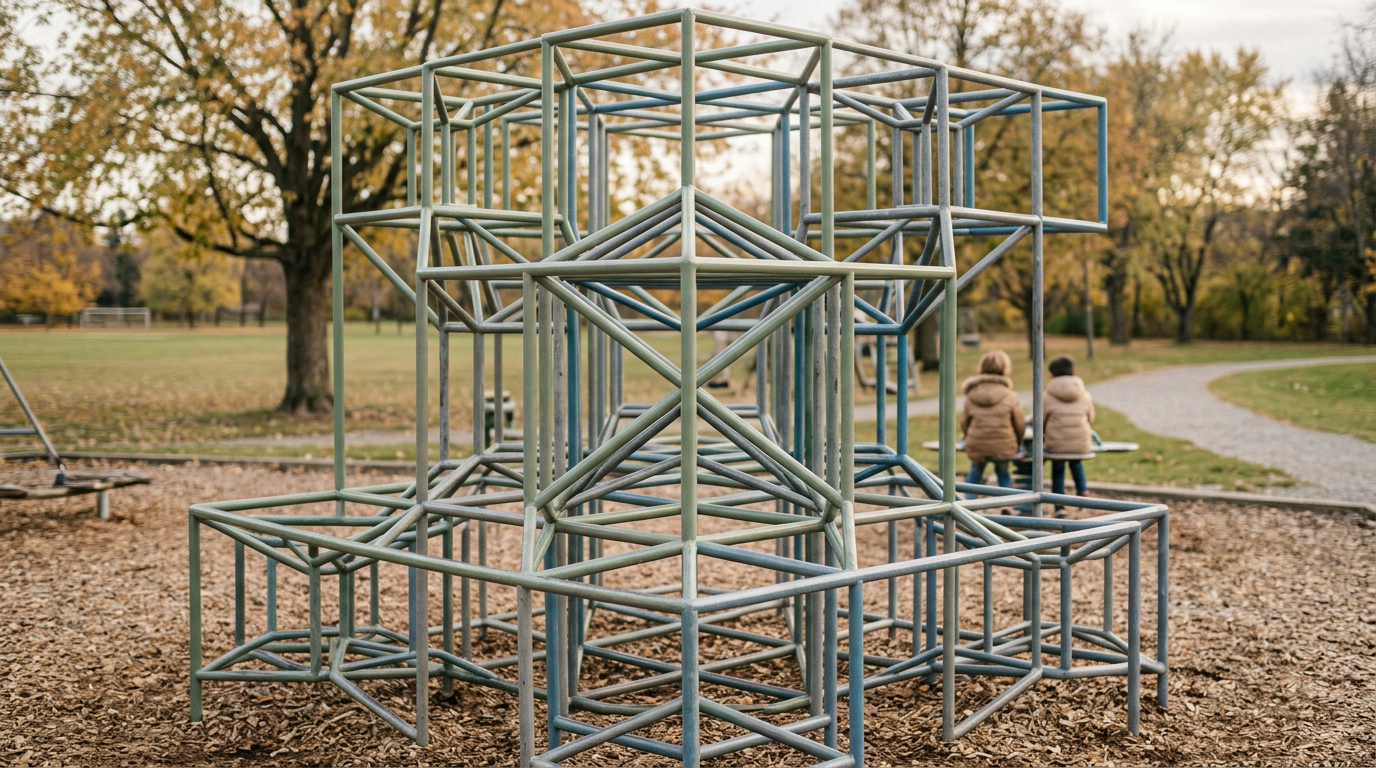
The weirdest proof that play can teach serious things lies in the original jungle gym. Invented by mathematician L. Charles Stewart, it was explicitly designed to help children visualise and comprehend the fourth dimension through physical interaction and imaginative spatial reasoning, demonstrating how tangible play can unlock abstract, complex concepts far more effectively than rote instruction. It is not just about fun; it is about building neural pathways through embodied experience.
In a hurry? TL;DR
- 1Original jungle gym (monkey gym) was for learning, not just play.
- 2Inventor: mathematician L. Charles Stewart.
- 3Purpose: Teach children the fourth dimension.
- 4Method: Embodied, physical interaction to grasp abstract concepts.
- 5Example of play fostering deep, intuitive understanding.
- 6Learning isn't just mental; it's physical and experiential.
Why It Matters
This article explores the unexpected origins of the playground jungle gym, revealing its inventor's ambitious goal of teaching children advanced mathematical concepts through physical play. It challenges the conventional view of play as merely recreational, demonstrating its profound potential as a sophisticated tool for learning and understanding complex, abstract ideas. The story highlights how innovative design can transform seemingly simple objects into powerful educational instruments, fostering a deeper appreciation for the interplay between creativity, education, and childhood development.
Picture a children's playground. What's the first thing that springs to mind? Swings, slides, perhaps a roundabout. And, inevitably, the climbing frame. A tangle of bars, a playground staple. Fun, athletic, a bit chaotic. That's the common perception.
Now, imagine that same climbing structure as a sophisticated educational tool, designed to impart knowledge so abstract, so mind-bending, that most adults struggle to grasp it. Specifically, the fourth dimension. Sounds preposterous, doesn't it?
Yet, this is precisely the origin story of the 'monkey gym', as it was originally known. Its inventor harboured ambitions far grander than simply tiring out active children. He wanted to unlock the secrets of higher geometry through the simple act of play.
It’s a peculiar, almost whimsical, detail of design history that offers a profound lesson: play isn't merely frivolous; it can be a conduit for deeply serious, even avant-garde, learning.
The Monkey Bar's Higher Calling
The year is 1920. The inventor in question is L. Charles Stewart, a mathematician and lawyer from Illinois. His creation, patented in 1920, was initially dubbed a 'monkey gym' and later became widely known as the jungle gym. But Stewart didn't conceive of it as just another piece of playground equipment.
Stewart was fascinated by the concept of the fourth dimension, an idea that had captivated mathematicians and artists since the late 19th century. He believed that traditional teaching methods, relying on two-dimensional diagrams and abstract equations, were insufficient for truly comprehending such a radical spatial concept. He reasoned that children, with their innate capacity for spatial reasoning and imaginative play, might hold the key.
His monkey gym was, in essence, a physical model of a four-dimensional hypercube, or tesseract. By climbing, ducking, and weaving through its interconnected bars, children were meant to develop an intuitive, embodied understanding of complex spatial relationships that extend beyond our everyday three-dimensional perception. It was spatial geometry made tangible, a way for small bodies to navigate a representation of the unseeable.
This isn't a metaphor. He genuinely believed that by physically moving through its structure, children would train their brains to conceptualise an additional dimension. While we might question whether a child truly 'understood' the fourth dimension after a session on the bars, the very premise is a powerful testament to the pedagogical potential of play. You can read more about the jungle gym origin in our facts archive and specifically about its design to help kids visualise the fourth dimension: jungle gym origin.
Embodied Cognition: Why Play Works
Stewart's philosophy, though perhaps ahead of its time, aligns remarkably well with modern theories of embodied cognition. This school of thought posits that our brains don't just process information in a disembodied, abstract way; our understanding is deeply intertwined with our physical experiences and interactions with the environment. We learn not just about the world, but through the world, using our bodies as primary tools of exploration and understanding.
Think about how a baby learns about 'up' and 'down', 'near' and 'far'. It's not through lectures; it's by reaching, falling, crawling, and touching. Similarly, a craftsman learns the properties of wood not just from a textbook, but by feeling its grain, sensing its weight, and watching how it responds to tools.
The jungle gym, in this context, wasn't just a toy; it was a sensory-motor training ground for abstract thought. Climbing required problem-solving, spatial awareness, and forward planning. It fostered a dynamic, rather than static, engagement with geometric principles. The very act of navigating its structure imprinted spatial relationships onto the developing brain in a way that staring at a blackboard simply couldn't.
This principle extends far beyond geometry. Play, in its various forms, is a fertile ground for developing crucial skills: problem-solving (building a fort), social negotiation (fair turn-taking), creativity (imaginative role-play), and emotional regulation (coping with a lost game).
The Serendipitous Nature of Playful Learning
One of the beauties of play-based learning is its often serendipitous nature. Children aren’t explicitly told, 'Today, we are learning about friction' when they experiment with sliding down a wet slide. They simply experience it, and in doing so, build an intuitive understanding of physical principles. This kind of spontaneous discovery, where learning feels less like instruction and more like exploration, fuels genuine curiosity and deeper retention.
Stewart's jungle gym aimed for a deliberate form of this serendipity. He created an environment where the 'lesson' was embedded in the action, allowing children to stumble upon new ways of thinking through physical engagement. It’s a powerful illustration of how serendipity and discovery often go hand-in-hand particularly in learning.
How to Actually Use This Insight
While most of us aren't designing playground equipment to teach advanced mathematics, Stewart's story holds practical lessons for fostering deeper learning, whether in children or adults:
- Embrace Embodied Experience: Wherever possible, connect abstract concepts to physical actions or tangible models. Learning about levers? Get some blocks and a stick. Understanding ecosystems? Go for a walk in a park. The more sensory input involved, the stronger the neural connections.
- Value Unstructured Play: Resist the urge to over-structure every moment of learning. Sometimes, the most profound insights emerge from free exploration and experimentation. Allow space for 'mucking about' with ideas or materials.
- Reframe 'Play': See play not as an antithesis to 'serious work' but as a foundational mode of learning, problem-solving, and creative thinking. It's how humans naturally learn best, from infancy onwards.
- Encourage Exploration and Risk: Safe spaces for exploration, even those involving mild physical challenges, build confidence and resilience alongside knowledge. The jungle gym, after all, involved some degree of physical risk, balanced by immense reward in spatial mastery.
Related Small Talk Reading
This deep-dive into the jungle gym's surprising origin only scratches the surface of fascinating facts and insights we uncover daily. For more curiosities that challenge your perspective, delve into our wider collection of articles.
- Uncover more peculiar facts and their historical context in our main facts archive.
- Stay up-to-date with our latest findings and thought-starters via today's daily Small Talk.
- Explore a broader range of intriguing topics on the more from the Small Talk blog.
- Learn more about our core principles and commitment to insightful, curious learning on our Small Talk learning mission page.
Frequently Asked Questions
Learn something new each day
Daily words, facts and quotes delivered to your phone.
