Quick Summary
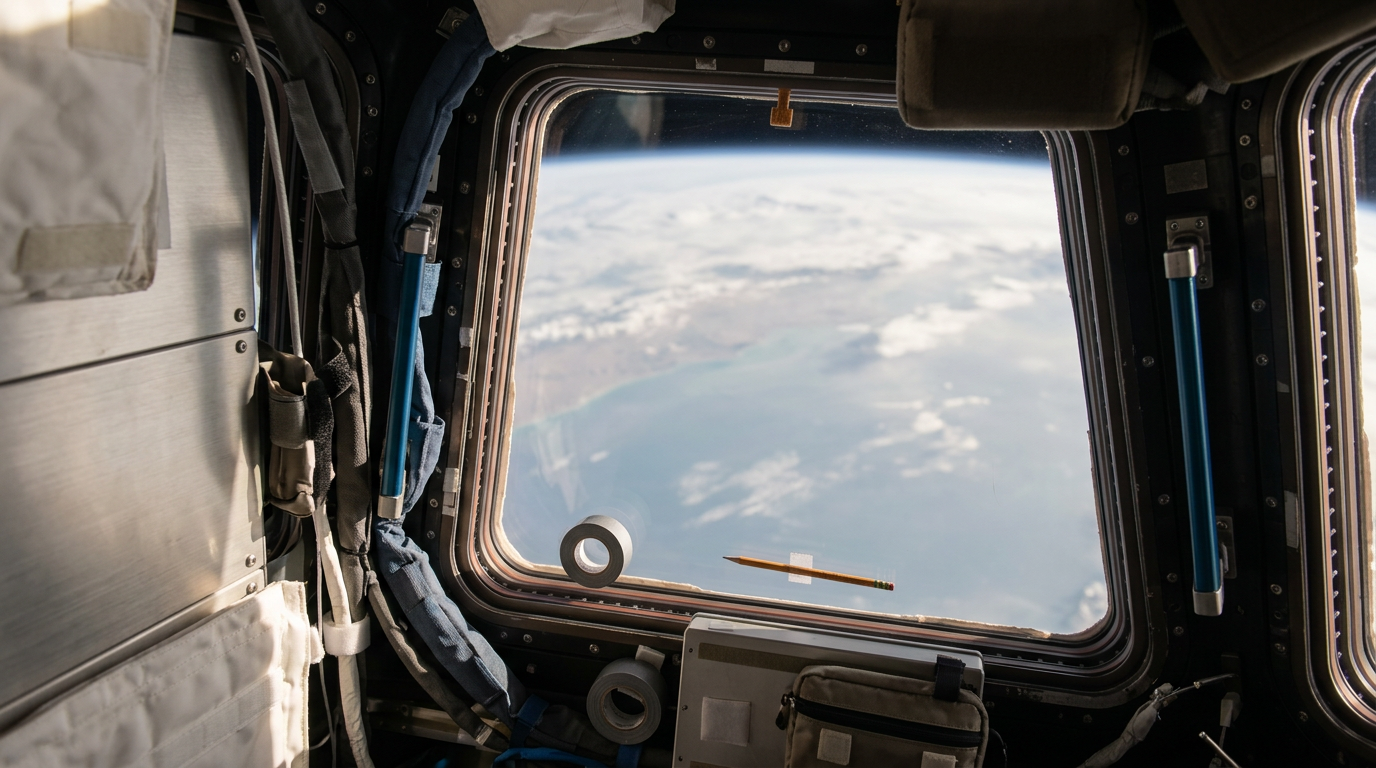
Astronauts on the International Space Station (ISS) are still very much within Earth's gravitational field, experiencing roughly 90% of the gravity felt on the planet's surface. They float because the ISS, along with everything inside it, is constantly falling around Earth. This continuous 'free fall' creates the sensation of weightlessness, not an absence of gravity itself. It's a perpetual orbital dive.
In a hurry? TL;DR
- 1ISS isn't 'zero-gravity'.
- 2It's ~90% Earth's gravity up there.
- 3Astronauts float due to constant free fall.
- 4Station and crew fall together around Earth.
- 5This 'falling' is orbit.
- 6Gravity weakens with distance, but slowly.
- 7A common misconception, now debunked.
Astronauts float about the International Space Station, their tools drifting, hair defying gravity. It looks like they're in 'zero-G', a place where Earth's pull simply ceases to exist. It's a common image, ingrained in our collective understanding of space. But here's a curious fact that might just change how you picture it: the gravity on the ISS is still about 90% of what we experience down here on solid ground.
Yes, that's right. If you were somehow able to stand still at the ISS's altitude, you'd feel pretty nearly as heavy as you do now. The idea that gravity vanishes entirely just a few hundred kilometres up is a persistent misunderstanding. But if gravity is still so strong, why do astronauts drift so serenely? The real reason is far more intriguing than a mere absence of force, and understanding it sheds light on the very nature of orbit itself.
It’s not about escaping gravity, but about perpetually falling with it. This distinction is subtle, yet fundamental. Once you grasp it, the 'magic' of weightlessness transforms into an elegant dance of physics.
The Misconception of 'Zero-G'
Let's clear this up straight away. The term 'zero-gravity' is a misnomer, and a deeply misleading one at that. While gravity does indeed weaken with distance, it does so relatively slowly. The International Space Station orbits at an average altitude of about 400 kilometres above Earth. To put that into perspective, the radius of Earth is roughly 6,371 kilometres. So, the ISS is only about 6% of an Earth radius away from the surface.
At that distance, using Newton's law of universal gravitation, we can calculate that the gravitational acceleration is still approximately 8.7 m/s², compared to 9.8 m/s² at sea level. That's a reduction of only about 11%, meaning astronauts are experiencing roughly 89% of Earth's gravity. Not 'zero', not 'almost zero', but a significant, tangible pull. So, if gravity is still very much present, what's going on?
The Truth: Constant Free Fall
The actual phenomenon behind the astronauts' weightlessness is 'free fall'. Think about it like this: if you drop a ball, it falls. If you jump off a diving board, you fall. While you're falling, you experience a momentary sensation of weightlessness. Now, imagine if you could just keep falling, indefinitely.
That's precisely what's happening on the ISS. The station, its crew, and everything inside are all in a continuous state of free fall around the Earth. The ISS is moving incredibly fast – about 28,000 kilometres per hour (17,500 mph) – horizontally relative to the Earth's surface. This immense speed means that as gravity pulls the station downwards, its forward motion carries it far enough over the horizon that it perpetually 'misses' the Earth. It's constantly falling towards the Earth, but never actually hitting it.
This continuous fall, where the only force acting upon an object is gravity, is what we call 'orbit'. Because the station and everything within it are falling together, at the same rate, there's no relative motion between them caused by gravity. The astronauts aren't being pushed against a floor, because the floor is falling at the exact same speed they are. They are, in essence, falling together, side-by-side, around the planet.
This is why they float. Not because gravity has vanished, but because they are constantly experiencing it as they fall. It's the sensation you'd feel in a lift if the cable snapped (a rather dramatic example, but accurate), or for a fleeting moment at the top of a roller coaster drop. Only, in orbit, that feeling is sustained.
The Illusion of Weight
Our perception of weight comes from the normal force pushing back against us. When you stand on scales, they push up against your feet, and that's what registers your weight. In an environment of free fall, there's no surface to push against you because everything is accelerating downwards together. The scales would fall with you, showing 'zero' because no force is being exerted on them by you (you're both falling).
This is why astronauts don't feel their weight. Their bodies aren't experiencing that opposing force from a surface. Their organs aren't being pulled 'down' relative to their skeleton because their entire body is falling together. It's a profound change in sensory input, and one that requires the human body to adapt in various ways, from bone density loss to fluid shifts.
How to Actually Use This
Understanding free fall isn't just a party trick; it changes how you conceptualise orbital mechanics. Next time you hear someone talk about 'zero-G', you can gently (and accurately) explain that it's 'microgravity' or 'weightlessness due to free fall'. This distinction is crucial for future space travel, too. Planning missions to the Moon or Mars involves understanding how their respective gravitational fields will affect spacecraft and crew, and it's always about managing gravity, not escaping it.
Moreover, this principle extends beyond space. It helps us understand why an apple falls, why tides happen, and how planets stay in their orbits. It’s a foundational concept in physics that reveals the elegance of the universe, and why an orbit is really just a very fast, very long fall.
Related Small Talk Reading
Curiosity, much like gravity, is a force that pulls us forward. If you found this explanation intriguing, why not delve into some other curious facts and discussions?
- Perhaps you're wondering how much energy your brain expends trying to process all this new information? Discover why the brain uses 20% of your energy.
- For a broader collection of intriguing tidbits, do browse the facts archive.
- And of course, for your daily dose of the curious and compelling, check out today's daily Small Talk.
- If you're eager for more myth-busting and brain-ticklers, you'll find plenty more to explore on more from the Small Talk blog.
Keep questioning, keep exploring. That's the Small Talk way.
Frequently Asked Questions
Learn something new each day
Daily words, facts and quotes delivered to your phone.
