Quick Summary
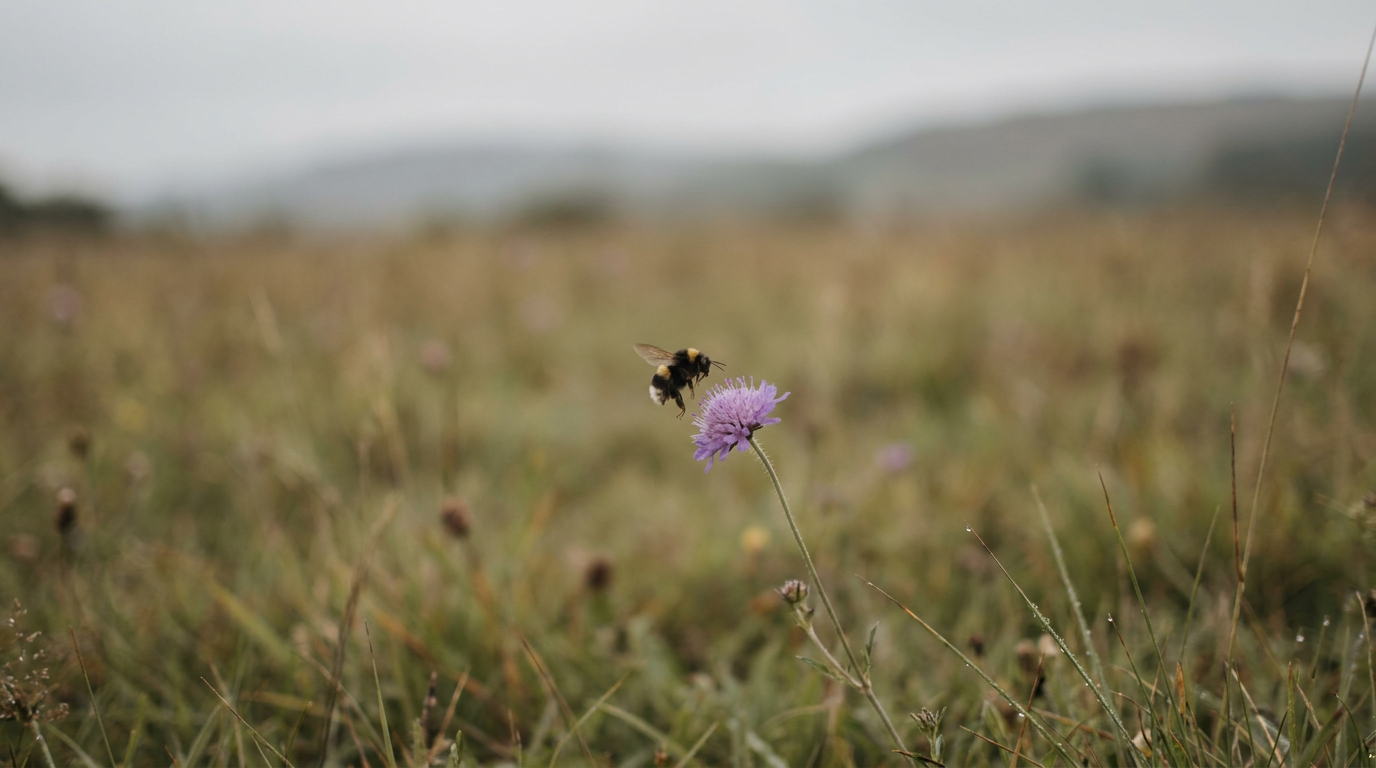
Bees build up a positive electrical charge as they fly through the air, while plants maintain a weak negative charge grounded in the soil. When a bee lands, pollen jumps across the gap, temporarily neutralising the flower's electric field. Arriving bees sense this altered voltage with mechanosensory hairs on their bodies, which bend in the presence of an electric field. If the field is weak, the bee knows nectar has just been taken.
In a hurry? TL;DR
- 1Bees accumulate a net positive charge from atmospheric friction during flight.
- 2Grounded plants carry a naturally negative, weak electrostatic potential.
- 3A visit alters the flower's charge, acting as a temporary digital timestamp.
- 4Bees feel the electric field via deflection in tiny, stiff body hairs.
- 5Bypassing depleted blossoms protects the bee's razor-thin energy margins.
A foraging bumblebee runs on an exceptionally tight energy budget. Hovering is one of the most metabolically expensive forms of locomotion in the animal kingdom, and touching down on an empty blossom is an investment that yields zero dividend. If a flower has already been drained by an earlier visitor, an incoming bee cannot afford to waste seconds probing dried-out nectaries.
Visual cues such as petal colour changes or wilting take hours or days to appear. Scent markers take time to dissipate in shifting winds. Yet bees consistently pass by recently visited flowers with uncanny efficiency.
They do it by reading invisible physics. A flower does not need a billboard to announce it is temporarily out of nectar; it broadcasts its status through static electricity, shifting its charge the moment a pollinator touches down and leaves.
The atmospheric battery
The interaction begins long before the bee touches a petal. The Earth's atmosphere is an active electrical circuit. The upper atmosphere holds a positive charge relative to the Earth's surface, creating a vertical voltage gradient of roughly 100 volts per metre of altitude in fair weather.
Because plants are rooted in the ground, they are electrically continuous with the planet. They act as natural conductors, holding a weak negative electrostatic charge. The shape of a blossom concentrates this field; sharp edges, stamens, and petal tips focus the electrical field lines into delicate, invisible crowns.
Bees, meanwhile, are air travellers. As a bee flies, atmospheric friction strips electrons from the waxy layer covering its exoskeleton. By the time a bumblebee approaches a garden border, it carries a net positive charge of several dozen to several hundred picocoulombs. When positive insect meets negative petal, the stage is set for a mutual sensory exchange.
The floral receipt
When a positively charged bee lands on a negatively charged flower, a small electrical current flows between them. It is not enough to harm either party, but it is enough to physically pull pollen grains across the air gap just before physical contact occurs. Pollen literally leaps onto the bee's coat.
This physical contact also alters the flower's electrical signature. The bee deposits positive charge onto the petal surface, neutralising or even momentarily reversing the blossom's negative potential.
Research led by sensory biophysicists at the University of Bristol demonstrated that this electrical disruption persists for minutes after the bee flies away. Because the plant's stem has electrical resistance, grounding the charge back to baseline takes time.
Crucially, that recovery time roughly mirrors the biological clock of the plant: the time it takes the flower to pump out a fresh batch of nectar. The dampened field serves as an invisible receipt. An arriving bee does not have to waste metabolic calories landing to inspect the larder; it merely sweeps past the petal, reads the altered field, and carries on to a charged, nectar-rich target.
How a bee measures voltage
Bees do not possess internal voltmeters, nor do they rely on their antennae alone. They register electric fields between flowers and bees using their mechanosensory hairs.
The bumblebee's body is covered in filiform hairs. Unlike mammalian hair, which is made of keratin, insect hairs are made of stiff chitin and sit inside specialised socket joints packed with sensitive nerve cells. Because the bee's body is positively charged, an external electric field pushes and pulls on these tiny structures.
When a bee flies within a few centimetres of an intact flower, the negative charge of the petals exerts an electrostatic pull on the bee's hairs, bending them towards the plant. The nerve cells at the base of the hair fire in response to this mechanical bend. When the flower's charge has been cancelled out by a previous visitor, the pull weakens, the hairs remain still, and the nervous system receives an immediate signal to abandon approach.
This biological mechanism exhibits a remarkable energy efficiency that outpaces synthetic sensors. Rather than spending metabolic energy generating an active radar or processing heavy optical data, the bee uses ambient physics and a few deflection-sensitive nerve endings to solve a complex logistical problem.
Multisensory foraging
Electric fields do not replace vision and smell; they complement them. In laboratory trials where artificial flowers were given distinct voltages alongside subtle geometric patterns, bees learned the visual cues substantially faster when paired with an electric field. The static charge acts as a form of sensory priming, focusing the insect's attention on subtle differences in colour, scent, and floral geometry.
Different flower species also exhibit distinct electric field geometries. A petunia, with its fluted cone, creates an electric pattern markedly different from the flat disk of a sunflower or the drooping bells of foxglove. Bees can distinguish between these spatial distributions, essentially perceiving a coarse electrical "shape" in the dark or under thick cloud cover where visual landmarks fade.
How to actually use this
While humans cannot sense these fields directly, understanding the electrostatics of pollination changes how we manage garden spaces and agricultural crops:
- Minimise artificial electrostatic interference: Plastic landscape fabrics, vinyl garden accessories, and synthetic mulches build up static charges that rival natural floral fields. In heavy concentration, they can disorient foraging insects. Opt for natural bark, untreated timber, and stone borders.
- Plant in high-density drifts: Electrostatic communication works best when flowers form a connected network with the soil. Dense clusters of perennial natives maintain stable soil grounding and clear atmospheric gradients, making floral fields sharper and easier for pollinators to detect.
- Avoid misting flowers in midday sun: Applying fine water sprays during peak foraging hours temporarily grounds the petals and equalises surface charges across all blooms, muddying the electrical signals bees use to sort the full flowers from the empty ones.
Related Small Talk reading
- Explore the original discovery of electric fields between flowers and bees and how researchers isolated the signal.
- Learn what defines an electrostatic charge in natural systems.
- Read about the remarkable energy efficiency found in microscopic biological computing.
- Discover more from the Small Talk blog on animal sensory biology, or catch up with today's daily Small Talk.
Frequently Asked Questions
Learn something new each day
Daily words, facts and quotes delivered to your phone.
