
Quick Answer
Only a handful of animals, fewer than a dozen species, can recognise themselves in a mirror. This remarkable ability, shared by creatures like dolphins, elephants, and magpies, is considered a key sign of self-awareness. It highlights the exceptional intelligence and complex minds found in these select animals, setting them apart in the vast animal kingdom.
In a hurry? TL;DR
- 1Only about 9-11 animal species, like apes, dolphins, and magpies, pass the mirror self-recognition test.
- 2The mirror test assesses self-awareness by observing if animals recognize their reflection as themselves.
- 3Chimpanzees were the first animals confirmed to pass the mirror test, using it for self-inspection.
- 4Great apes, dolphins, orcas, Asian elephants, and Eurasian magpies are among the few confirmed self-aware species.
- 5Most animals, including dogs and cats, do not recognize themselves in mirrors and react with fear or aggression.
- 6Passing the mirror test is considered a significant indicator of advanced cognitive abilities and self-awareness.
Why It Matters
It's surprising that so few animal species, a mere handful, possess the self-awareness to recognise themselves in a mirror.
Self-awareness is not a universal trait in the animal kingdom; fewer than a dozen species have passed the mirror test, including great apes, Asian elephants, bottlenose dolphins, orcas, and Eurasian magpies. This select group demonstrates a level of cognitive complexity that separates them from the vast majority of living creatures.
The Core Statistics
- Confirmed Species: Roughly 9 to 11 (varies by study rigor)
- First Successful Subject: Chimpanzees (1970)
- Only Bird to Pass: Eurasian Magpie
- Only Fish Candidate: Bluestreak cleaner wrasse
- Common Failures: Dogs, cats, monkeys, and human infants under 18 months
Why Mirror Recognition Matters
The ability to look at a reflection and understand that it represents one’s own body is considered a hallmark of self-awareness. While most animals react to a mirror as if they are seeing a stranger—often displaying aggression or fear—a handful of species use the mirror as a tool to inspect parts of themselves they cannot otherwise see.
The Origin of the Mirror Test
In 1970, psychologist Gordon Gallup Jr. developed the Mirror Self-Recognition (MSR) test at the University of Albany. He placed mirrors in the enclosures of four chimpanzees and observed their reactions. Initially, they treated the reflections as intruders.
However, after a few days, their behaviour shifted. They began using the mirrors for grooming and making faces. To prove they understood the reflection was their own, Gallup anaesthetised the chimps and painted an odourless red mark on their brow ridges. Upon waking, the chimps spent significant time touching the marks on their own heads while looking in the glass, proving they knew the image was them.
The Elite Members of the Club
The list of animals that have cleared this hurdle is remarkably short and dominated by mammals with large brain-to-body ratios.
The Great Apes
Chimpanzees, bonobos, and orangutans pass the test consistently. Gorillas are a more complicated case; because direct eye contact is a sign of aggression in gorilla culture, they often avoid looking at mirrors entirely. However, some captive gorillas, like Koko, eventually demonstrated self-recognition.
Marine Mammals
In 2001, researchers at the New York Aquarium found that bottlenose dolphins would twist and turn to inspect marks placed on their bodies. Unlike primates, dolphins lack hands to touch the marks, so they used the mirror to orient themselves for a better view. Orcas have shown similar investigative behaviours.
The Asian Elephant
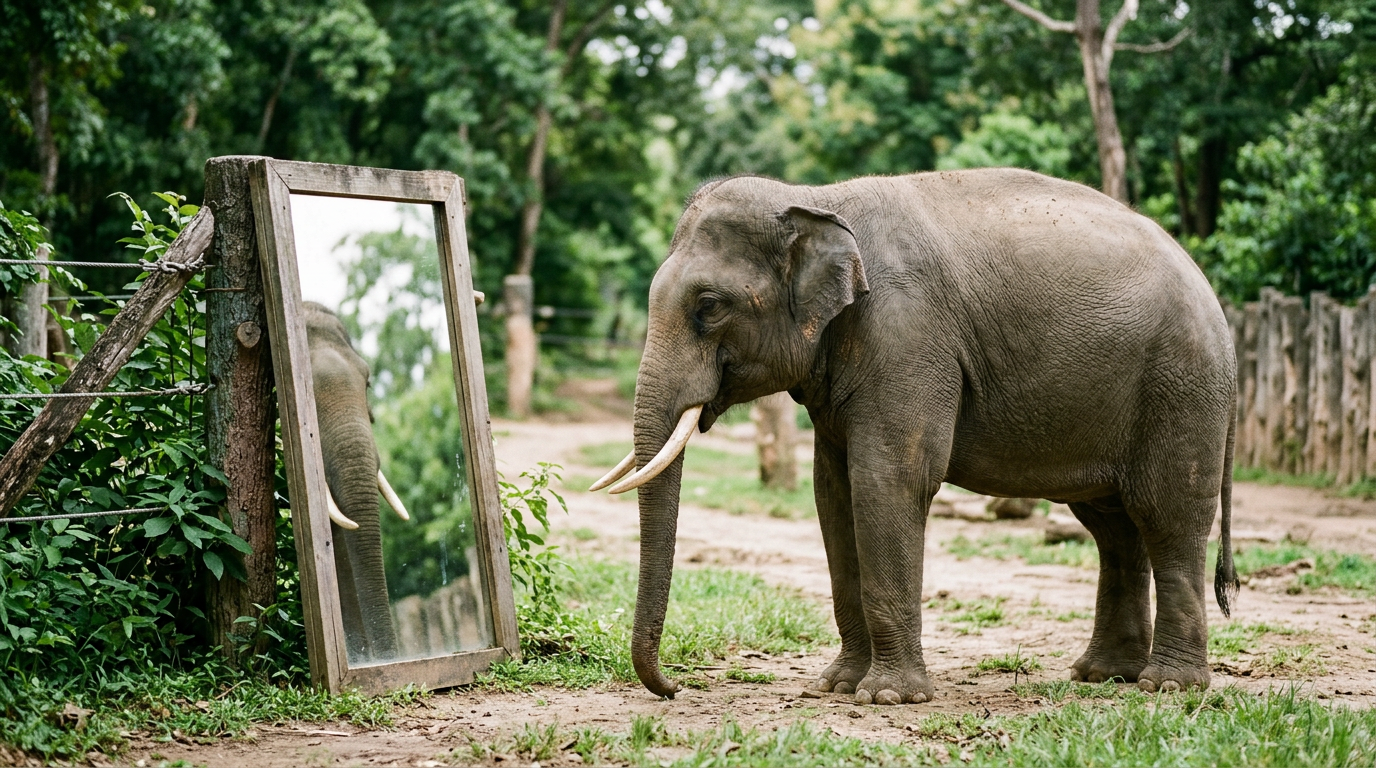
In 2006, researchers from Emory University tested Happy, an Asian elephant at the Bronx Zoo. They placed a large X on her head. Happy repeatedly touched the mark with her trunk while standing before a massive mirror, making her the first non-primate land mammal to pass.
The Outsiders: Magpies and Fish
For decades, scientists believed self-awareness was a mammalian trait linked to the neocortex. The Eurasian magpie shattered this theory. In a study published in PLOS Biology, magpies were marked with stickers. They used mirrors to locate and attempt to remove them, proving that complex intelligence can evolve in brain structures entirely different from our own.
More recently, the bluestreak cleaner wrasse became the first fish to potentially pass. It attempted to scrape marks off its body against rocks after seeing them in a mirror. This has sparked intense debate: does the wrasse possess a high level of self-awareness, or is the mirror test a flawed metric for certain species?
Practical Applications
Understanding which species are self-aware informs global conservation priorities and animal welfare laws. In many jurisdictions, the legal status of great apes is higher than that of other animals specifically because of their demonstrated self-awareness.
- Conservation Ethics: High-intelligence species often require more complex captive environments to prevent psychological distress.
- AI Development: Researchers use the mirror test as a benchmark for developing self-modelling robots.
- Developmental Psychology: The test remains a standard tool for tracking cognitive milestones in human children.
Why do dogs fail the mirror test?
Dogs rely on olfaction rather than vision. While they don't recognise their visual reflection, they demonstrate self-recognition through scent, identifying their own unique biological markers.
Do human babies pass the mirror test?
Not immediately. Human infants typically do not recognise themselves in a mirror until they are between 18 and 24 months old. Before this, they treat the reflection as a playmate.
Is the mirror test the only way to measure intelligence?
No. It only measures a specific visual-spatial component of self-awareness. Many highly intelligent animals, like crows or octopuses, may fail the mirror test while excelling at complex problem-solving and tool use.
Key Takeaways
- Exclusivity: Only a tiny fraction of the millions of species on Earth pass the MSR test.
- Cross-Species Success: The trait exists in primates, cetaceans, elephants, and at least one bird species.
- Neural Diversity: The magpie’s success proves that self-awareness does not require a primate-like neocortex.
- Test Limitations: Failing the mirror test does not necessarily mean an animal lacks consciousness; it may simply lack a visual-first orientation.
Being able to recognise oneself is less of a biological standard and more of an evolutionary luxury, reserved for the most cognitively adventurous branches of the tree of life.
Frequently Asked Questions
Sources & References
 WikipediaBackground and contexten.wikipedia.org
 Scientific AmericanScientific research and analysisscientificamerican.com
 BBCReporting and verificationbbc.co.uk
- WikipediaThis source lists species that have passed the mirror test, including great apes (chimpanzees, bonobos, orangutans), bottlenose dolphins, orcas, Asian elephants, and Eurasian magpies.en.wikipedia.org