
Quick Answer
Two thousand years ago, a Greek engineer named Hero created early versions of technologies we use today, like the steam engine, wind turbine, and vending machine. This is fascinating because it reveals that fundamental concepts behind modern inventions were being explored way back in ancient Greece, even if they didn't become mainstream until much later.
In a hurry? TL;DR
- 1Hero of Alexandria invented early steam engines, wind turbines, and vending machines around 10-70 AD.
- 2His work, detailed in Pneumatica, demonstrated theoretical blueprints for modern industrial technology centuries early.
- 3The aeolipile, a steam turbine, could spin at 1,500 RPM but was used primarily as a novelty.
- 4Hero's coin-operated vending machine dispensed a set amount of water upon coin insertion to prevent theft.
- 5Ancient technological capacity existed, but economic and social factors (like slave labor) prevented widespread adoption.
- 6Hero's inventions highlight that technological progress depends on both invention and the economic incentive to use it.
Why It Matters
It's surprising that ancient Greeks were building functional steam engines and vending machines centuries before the Industrial Revolution.
In the first century AD, a Greek mathematician and engineer known as Hero of Alexandria designed the world’s first steam engine, wind-powered organ, and coin-operated vending machine. His inventions predated the Industrial Revolution by nearly 1,700 years, proving that the ancient world possessed the theoretical blueprint for the modern age.
The Core Concept
Hero of Alexandria, often called the Leonardo da Vinci of antiquity, published a treatise titled Pneumatica. Within these pages, he detailed over 80 mechanical devices that utilised air, steam, and water pressure to automate tasks and create illusions. While many viewed his work as mere toys or temple trickery, he had effectively solved the fundamental engineering problems of the 19th century.
Key Facts and Figures
- Date of Activity: Approximately 10–70 AD
- Primary Work: Pneumatica and Automata
- The Aeolipile: The first recorded steam turbine
- Vending Mechanism: Operates on a five-drachma coin
- Location: The Great Library of Alexandria, Roman Egypt
Why It Matters
The existence of Hero’s inventions refutes the idea that human progress is a linear, inevitable climb. It suggests that the technological capacity for an industrial society existed in the Roman Empire, but the economic and social incentives—specifically a reliance on slave labour—rendered mechanical automation unnecessary.
The Lost Industrial Revolution
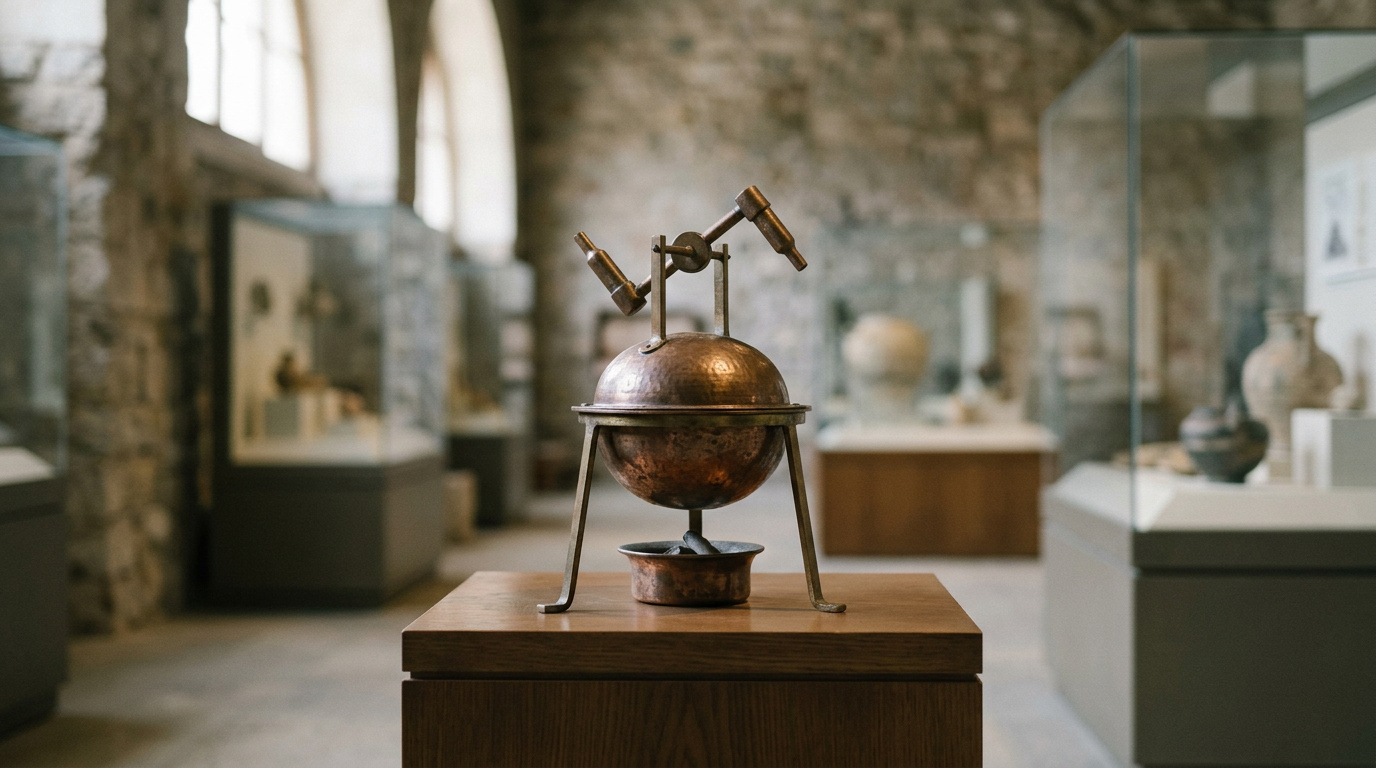
The most famous of Hero’s devices was the aeolipile. It consisted of a hollow sphere mounted on a boiler; as steam escaped through two curved nozzles, the sphere spun rapidly. Unlike the massive pistons of the Victorian era, this was a reaction engine, conceptually similar to a modern jet.
According to researchers at the University of Portsmouth who reconstructed his designs, the aeolipile could reach speeds of 1,500 revolutions per minute. Despite this efficiency, the Romans used it primarily as a dinner party novelty or a method to spark wonder in temples.
Hero’s vending machine was equally sophisticated, designed to solve a very modern problem: theft. In the temples of Alexandria, worshippers were taking more holy water than they had paid for. Hero’s solution was a sealed vessel with a slot. When a five-drachma coin was inserted, it landed on a lever. The weight of the coin tilted the lever, opening a valve that dispensed a fixed amount of water until the coin slid off and the valve snapped shut.
The Wind Turbine and the Organ
While the Persians are often credited with the first functional windmills for milling grain in the 9th century, Hero’s wind-wheel was the first documented instance of using wind to power a machine. It was a horizontal windmill designed to pump air into an organ, creating music without human breath.
In contrast to later industrial windmills, Hero’s version was small and geared toward aesthetics. Historians like Dr. Tracey Rihll have noted that the sophistication of these gears indicates the Greeks were capable of complex mechanical calculation, as seen in the Antikythera mechanism.
Real-World Applications
While Hero’s designs didn't lead to a Roman railway system, his principles survived through the Middle Ages via Arabic translations.
- Automatic Doors: Hero designed a system where a fire lit on a temple altar would expand air in a hidden sphere, pumping water into a bucket that pulled a rope to open the doors.
- Syringes: He described the first piston-based syringe for medical use.
- Fire Engines: He perfected a dual-action force pump used by Roman fire brigades.
Why didn't the Romans start the Industrial Revolution?
The Roman economy was built on inexpensive labour. When human power is cheaper than building and maintaining a complex machine, innovation stalls at the prototype stage.
Did Hero actually build these machines?
Yes. While some believe his books were purely theoretical, archaeological evidence of Roman pumps and the precision of the Antikythera mechanism suggest the manufacturing capability was well within their reach.
How do we know about his work?
Most of our knowledge comes from 16th-century Italian translations of his Greek manuscripts, which were preserved by Byzantine and Arab scholars during the Dark Ages.
Key Takeaways
- The aeolipile was the first steam turbine, created 1,700 years before James Watt.
- The first vending machine was a temple security device for dispensing holy water.
- Hero’s wind-wheel predates Persian windmills by several centuries.
- Ancient engineering failed to scale due to social structures, not lack of intellect.
- The Pneumatica remains one of the most significant technical texts in human history.
Innovation is a fragile thing; having the idea is only half the battle. The other half is having a world ready to use it.
Frequently Asked Questions
Sources & References
 WikipediaThis source confirms that the aeolipile, invented by Hero of Alexandria, was a turbine-like device that used steam jet reaction to rotate a sphere, making it the first known steam engine.en.wikipedia.org
- WikipediaThis source details Hero of Alexandria's invention of the first coin-operated vending machine, which dispensed holy water in Egyptian temples when a coin was inserted, falling onto a lever to open a valve.en.wikipedia.org