
Quick Answer
Andre Agassi could predict Boris Becker's serve by watching his tongue. This amazing detail reveals how Agassi used Becker's unconscious habit to gain an edge against a formidable opponent. It's a brilliant example of how observing tiny tells can unlock victory, even against the world's best.
In a hurry? TL;DR
- 1Andre Agassi discovered Boris Becker's serve direction by observing his tongue's position before hitting the ball.
- 2Becker's tongue would point to the corner for a wide serve, and stay central for a down-the-line serve.
- 3Agassi used this 'tell' to win 10 out of 15 career matches against Becker, many decisively.
- 4Agassi strategically used this knowledge only in critical moments to prevent Becker from adapting.
- 5This highlights how subtle observations can create significant competitive advantages over brute force.
- 6Elite performance often hinges on hidden information and keen observational skills, not just raw talent.
Why It Matters
It's fascinating how Andre Agassi used a tiny, unconscious movement of Boris Becker's tongue to consistently predict and neutralise one of tennis's most formidable serves.
Tennis legend Andre Agassi gained a career-defining advantage over his rival Boris Becker by noticing a tiny physical tell: Becker would point his tongue toward the direction he intended to serve just before striking the ball. This observation allowed Agassi to read one of the most feared serves in tennis history with near-perfect accuracy for years.
The Becker Code by the Numbers
- Career Matches: 15 head-to-head encounters.
- Agassi Wins: 10 victories, including a crucial streak after cracking the code.
- Becker Aces: Over 9,000 career aces, yet neutralized by a single facial tic.
- Reveal Date: Agassi kept the secret for over 15 years until Becker retired.
Why It Matters
This discovery remains the ultimate example of how elite performance is often decided by information asymmetry rather than raw physical ability.
Cracking the Boom Boom Serve
Boris Becker, nicknamed Boom Boom for his thunderous delivery, possessed a serve that was mathematically difficult to return. At the height of his powers in the late 1980s, the German powerhouse used his serve to bully opponents into submission. Agassi, arguably the greatest returner the game has ever seen, found himself stumped until he began obsessively reviewing match footage.
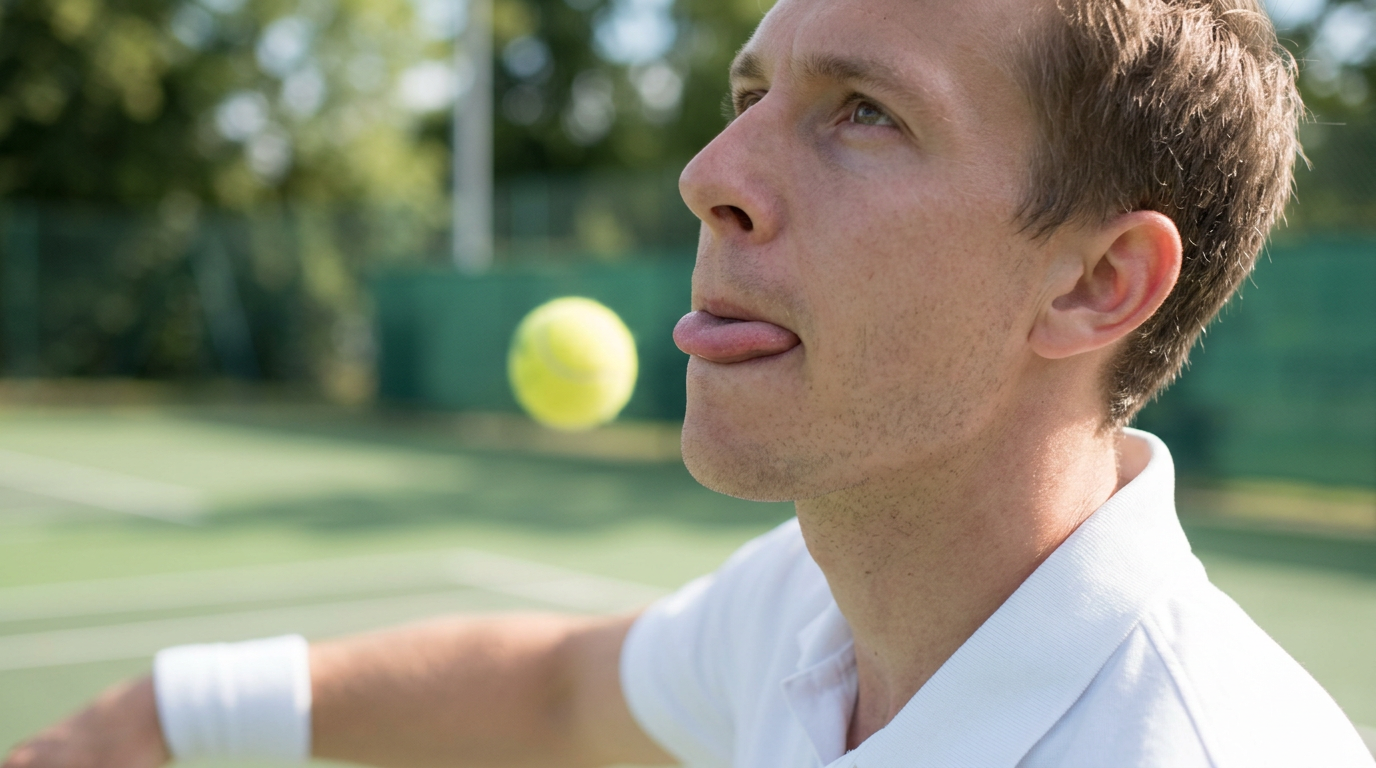
The breakthrough happened not in a coaching booth, but through a stroke of forensic observation. Agassi noticed that as Becker tossed the ball, his tongue would dart out of the corner of his mouth. If the tongue remained in the middle, the serve was going down the line; if it slid to the corner of his lip, the serve was headed wide.
The Art of the Long Game
Agassi’s genius was not just in finding the tell, but in managing the information. He realised that if he broke Becker’s serve every single time, the German would eventually figure out he was being read and change his mechanics.
Instead, Agassi played a psychological game of cat and mouse. He would save his knowledge for the most critical moments of a match—break points or tiebreakers—allowing Becker to win routine points to keep the tell alive. According to Agassi’s autobiography, Open, he spent years hiding his advantage to ensure the tongue remained a reliable compass.
Evidence of the Edge
The impact of this discovery is reflected in their head-to-head statistics. Before Agassi decoded the serve, their matches were toss-ups. Afterwards, Agassi went on a dominant run, winning eight of their last nine meetings. Unlike other players who guessed based on ball toss height or shoulder rotation, Agassi was reacting to a physiological certainty.
Researchers at the University of Queensland have noted that elite athletes often develop unconscious cues, known as pre-selection markers. While most professional players look at the hips or the toss, Agassi’s focus on the face was a radical departure from standard coaching. Whereas his peers were playing a game of physics, Agassi was playing a game of poker.
Practical Applications of Observation
The Agassi-Becker story is frequently cited in high-stakes environments outside of sports:
- Executive Negotiation: Watching for micro-expressions that contradict a verbal offer.
- Professional Poker: Identifying physical reset behaviours after a bluff.
- Cybersecurity: Spotting patterns in data that precede a system breach.
- Public Speaking: Monitoring audience fidgeting to gauge engagement levels.
Interesting Connections
The term for what Agassi spotted is a tell, a word popularized by the poker world but originated from the idea that a player is unknowingly telling the opponent their hand. Culturally, this mirrors the concept of the Sherlock Holmes method—deduction based on trifles.
In contrast to Becker’s tongue, other players have had equally strange tells. Rafael Nadal is famous for his meticulous on-court rituals, though these are considered psychological anchors rather than directional cues for his opponents.
Did Boris Becker ever find out?
Yes, but only after they had both retired. Agassi told Becker over a beer at an event in Munich. Becker was reportedly stunned, finally understanding why Agassi seemed to be standing in the right spot for every crucial serve for over a decade.
Why didn't Becker's coaches notice?
Coaches usually focus on large-scale mechanics like knee bend and arm extension. A tiny flick of the tongue is almost impossible to see from the sidelines without the specific perspective of the person standing directly across the net.
Can modern players still do this?
It is much harder today. High-definition cameras and deep-learning algorithms now analyse every frame of a player’s motion. Any physical tell is usually spotted by analysts and corrected within weeks, rather than being exploited for years.
Key Takeaways
- Mastery requires observation: Agassi succeeded because he looked for what others ignored.
- Information management is key: Knowing a secret is useless if you reveal your hand too early.
- Details matter: In professional sports, the difference between a champion and a runner-up is often measured in millimetres.
- Human fallibility: Even the most disciplined athletes have unconscious habits that can be exploited.
Frequently Asked Questions
Sources & References
 WikipediaThis source states that Agassi revealed in his autobiography 'Open' that he discovered Boris Becker had a nervous tic of sticking out his tongue in the direction he was going to serve.en.wikipedia.org
 The New York TimesThis New York Times article details Andre Agassi's admission from his memoir 'Open' that he deduced where Boris Becker would serve by observing the direction of Becker's tongue.nytimes.com