
Quick Answer
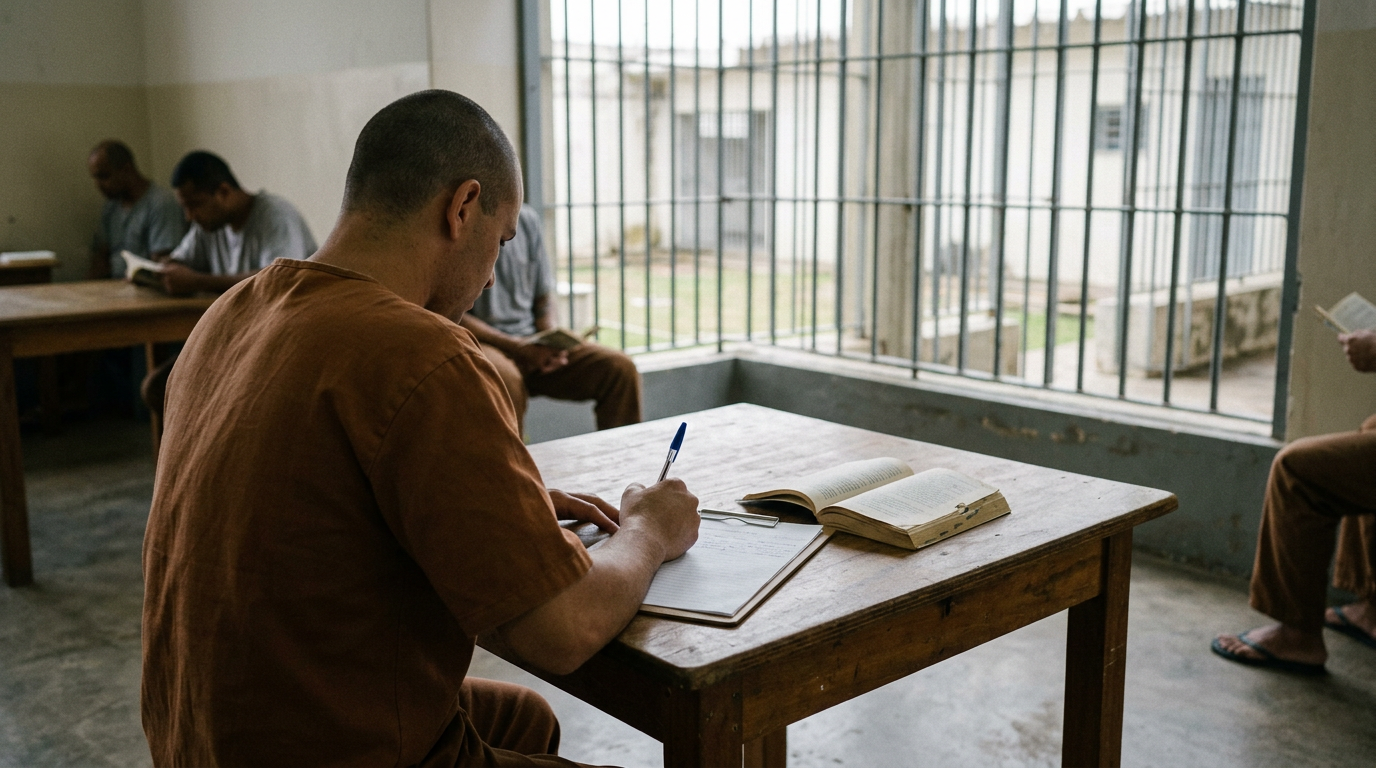
Brazilian prisoners can earn up to 48 days off their sentence each year by reading and reviewing books. This innovative approach uses literacy and education as a powerful tool for rehabilitation, incentivising inmates to improve themselves while serving their time, ultimately aiming for a more constructive return to society.
In a hurry? TL;DR
- 1Brazilian inmates can earn sentence reductions by reading and writing reports on books, receiving 4 days off per book.
- 2The 'Redemption through Reading' program allows prisoners to reduce their sentences by up to 48 days annually.
- 3To qualify, book reports must have correct grammar, legible handwriting, and meet specific content review standards.
- 4This program emphasizes cognitive rehabilitation over traditional punishment, aiming to reduce recidivism.
- 5The initiative requires critical thinking and engagement with texts, promoting intellectual development.
- 6Participation is limited to federal inmates with high literacy potential, making it a selective rehabilitation tool.
Why It Matters
It's surprising that Brazil offers inmates sentence reductions for reading and reviewing books, effectively turning intellectual engagement into a path towards freedom.
In federal prisons across Brazil, inmates can reduce their sentences by four days for every book they read and review. This programme, known as Redemption through Reading, allows prisoners to shave up to 48 days off their jail time each year.
Key Program Statistics
- Reduction per book: 4 days
- Annual maximum reduction: 48 days (12 books total)
- Review requirements: Correct grammar, legible handwriting, and no margins used
- Evaluation: A special commission of educators and officials
- Eligibility: Federal inmates with high literacy potential
Why It Matters
This policy flips the script on traditional punishment, treating intellectual engagement as a measurable form of rehabilitation rather than a luxury.
The Logic of Literacy
The programme, officially titled Remição pela Leitura, was formalised in 2012 by the Brazilian federal government. It applies to some of the most crowded facilities in the country, where the prison population has surged by over 300 percent since the turn of the millennium. Unlike vocational training, which requires physical workshops and equipment, reading is a low-overhead intervention.
According to the Brazilian National Justice Council, the goal is to encourage a shift in perspective. To qualify for the reduction, an inmate must spend up to four weeks reading a single work of literature, philosophy, or science. They then have to produce an essay that is vetted by a panel. If the report is deemed a genuine reflection on the text, the four-day credit is applied to their sentence.
Evidence of Impact
While many correctional systems focus on manual labour, the Brazilian model suggests that cognitive development is a stronger deterrent against recidivism. Research published in the Journal of Education and Development suggests that inmates who participate in educational programmes are 43 percent less likely to return to prison than those who do not.
Unlike other international models that focus solely on primary literacy, the Brazilian scheme requires critical thinking. In contrast to standard work-for-time programmes, this initiative forces an internal shift. The prisoner is not just moving rocks or sewing uniforms; they are grappling with the ideas of Dostoevsky or Clarice Lispector.
Real-World Applications
- Mental Health: Prisoners reported lower rates of depression when given access to diverse libraries, providing a mental escape from harsh physical conditions.
- Literacy Rates: The programme incentivises functional literacy in a country where a significant portion of the incarcerated population lacks a high school education.
- Resource Allocation: It provides a scalable model for overcrowded systems in developing nations to manage inmate populations without massive infrastructure spend.
Surprising Connections
The concept of bibliotherapy (using books for healing) dates back to Ancient Greece, where library entrances in Thebes were inscribed with the phrase Healing place for the soul. In the 1800s, American reformers like Zebulon Brockway introduced libraries to Elmira Reformatory, believing that high-brow literature could cure criminal tendencies. Brazil has simply formalised this ancient intuition into a legal calculation.
Can prisoners read any book they want?
No. The selection is typically curated by a pedagogical team to ensure the works have educational or philosophical merit. Inmates cannot simply read pulp fiction or comic books to earn time off.
Is there a limit to how much time they can cut?
Yes. The law caps the reduction at 48 days per year. This ensures that the primary sentence remains the focus, while the reading serves as a consistent, long-term incentive for good behaviour.
Who grades the essays?
A commission composed of teachers, prison officials, and sometimes volunteers from the local community evaluates the reports for original thought and grammatical accuracy.
Key Takeaways
- Freedom for Thought: Brazil allows 4 days off a sentence per book read.
- High Standards: Inmates must write a formal report to prove they understood the material.
- Annual Cap: The maximum benefit is 48 days of reduction per year.
- Strategic Literacy: The programme targets recidivism by fostering critical thinking skills.
If a prison cell is a place where time is the enemy, Brazil has found a way to make that time work for the prisoner, one chapter at a time.