
Quick Answer
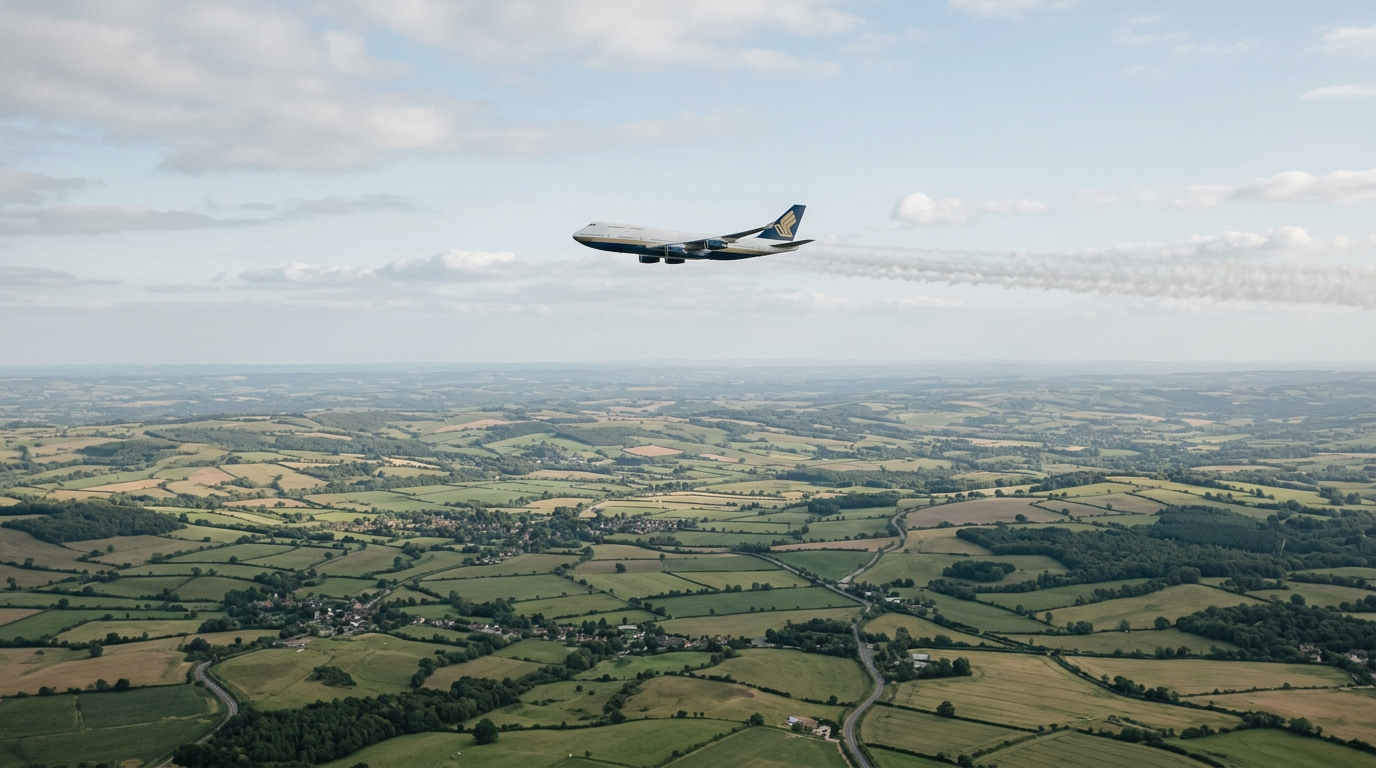
A Boeing 747 guzzles around 4 litres of fuel per second mid-flight. This might sound like a lot, but surprisingly, when you factor in the hundreds of passengers it carries, it's more fuel-efficient per person than many cars on the road today.
In a hurry? TL;DR
- 1A Boeing 747 burns about 4 litres of fuel every second during cruise flight.
- 2This translates to 14,400 litres of fuel consumed per hour of flight time.
- 3Despite high total consumption, the 747 is efficient per passenger, using less fuel than a single-occupant car.
- 4The 747's efficiency per passenger helped democratize international travel by lowering seat-mile costs.
- 5The development of high-bypass turbofan engines was key to the 747's fuel efficiency advancements.
- 6Most fuel consumption occurs during takeoff and climb; cruising is more efficient due to thinner air.
Why It Matters
It's astonishing that a Boeing 747 can be more fuel-efficient per person than a single-occupant car when you consider its passenger capacity.
A Boeing 747 burns approximately 4 litres of fuel every second during cruise flight, translating to 240 litres per minute or 14,400 litres for every hour spent in the air. Over the course of a 10-hour flight, this iconic jumbo jet consumes roughly 150,000 litres of Jet A-1 fuel.
The Numbers at a Glance
- Fuel Burn Rate: 4 litres per second
- Hourly Consumption: 14,400 litres
- Fuel per Kilometre: 12 litres
- Total Capacity: Up to 238,840 litres (Boeing 747-8)
- Weight of Fuel: Roughly 190,000 kg at full capacity
Why It Matters
While the raw volume of fuel sounds staggering, the 747 is surprisingly efficient when measured by passenger distance, often outperforming a single-occupant car on the same route.
The Engineering Behind the Burn
The Boeing 747, famously known as the Queen of the Skies, requires immense energy to keep its 400,000-kilogram maximum takeoff weight airborne. Most of this fuel consumption occurs during the takeoff and climb phases, where the four massive turbofan engines operate at peak thrust to overcome gravity and drag.
Once the aircraft reaches its cruising altitude of approximately 35,000 feet, the air is thinner and resistance is lower. According to data provided by Boeing’s technical specifications for the 747-400, the aircraft achieves about 0.2 miles per gallon. While this sounds abysmal compared to a fuel-efficient hybrid car, the math changes when you consider the payload.
With a capacity of over 400 passengers, the 747 is essentially a flying village. When the 150,000 litres used on a long-haul flight is divided by 400 people, the efficiency works out to roughly 2.4 litres per 100 kilometres per passenger. In contrast, a typical mid-sized car carrying only a driver consumes about 8 litres per 100 kilometres.
The Evolution of the Jumbo
When Joe Sutter and his team of engineers (known as The Incredibles) designed the 747 in the late 1960s, they weren't just building a big plane; they were creating a platform for high-bypass turbofan technology. These engines were revolutionary because they pushed a large volume of air around the engine core rather than through it, providing more thrust with less fuel than previous generations.
Compared to the earlier Boeing 707, the 747 was significantly more expensive to fuel in total, yet it lowered the cost per seat-mile by 30 percent. This economic shift is what effectively democratised international travel, moving it from a luxury for the elite to a possibility for the middle class.
Modern Efficiency and the Twin-Engine Shift
Despite its legendary status, the four-engine 747 is being phased out by airlines in favour of twin-engine aircraft like the Boeing 787 Dreamliner and the Airbus A350. These newer models use composite materials to reduce weight and advanced aerodynamics to burn significantly less fuel.
According to a report by the International Council on Clean Transportation (ICCT), modern twin-engine jets are roughly 20 to 25 percent more fuel-efficient than the 747-400. Maintaining four engines is simply no longer cost-effective when two engines can now produce enough thrust to carry nearly as many passengers over the same distance.
Practical Applications
- Route Planning: Airlines use sophisticated algorithms to find tailwinds (jet streams) that reduce fuel burn by pushing the plane forward, saving thousands of litres per trip.
- Weight Management: Every kilogram counts. This is why airlines have switched to lighter catering trolleys, digital flight manuals, and even thinner magazines to shave fractions off that 4-litre-per-second burn rate.
- Tankering: Sometimes airlines carry extra fuel from a cheaper airport to avoid buying expensive fuel at the destination, even though the extra weight increases the burn rate.
Interesting Connections
- Range: A fully fuelled 747-8 can fly over 14,000 kilometres, roughly the distance from New York to Hong Kong, without stopping.
- Density: Jet fuel is less dense than water. While 1 litre of water weighs 1 kg, 1 litre of jet fuel weighs about 0.8 kg.
- Speed: At cruise, the 747 travels at Mach 0.85, or about 913 kilometres per hour.
How much fuel does a 747 use during takeoff?
Takeoff is the most fuel-intensive part of the flight. The engines can burn through several hundred litres of fuel just during the taxi and the initial two-minute climb to altitude.
Does the 747-8 burn less than the older 747-400?
Yes, the 747-8 uses GEnx engines, which are similar to those on the 787. It is roughly 16 percent more fuel-efficient than its predecessor, despite being larger.
What happens to the fuel if a plane has to land early?
Because the 747 is too heavy to land with full fuel tanks without damaging the landing gear, it must use a fuel jettison system to dump fuel into the atmosphere, where it evaporates before hitting the ground.
Key Takeaways
- Volume: A 747 consumes 4 litres of fuel every second it is in flight.
- Efficiency: Despite the high total consumption, it is more fuel-efficient per passenger than a car with a single occupant.
- Weight: Fuel accounts for nearly a third of the aircraft's weight at takeoff.
- Obsolescence: The high cost of feeding four engines is why the 747 is being replaced by more efficient twin-engine jets.
If you ever feel guilty about your car’s fuel economy, remember the Queen of the Skies: she drinks a gallon every time your heart beats.
Frequently Asked Questions
Sources & References
- 1Federal Highway Administration (FHWA)This FAA reference manual includes details on aircraft fuel burn modeling, which can be used to estimate consumption rates for aircraft like the 747.aedt.faa.gov
 WikipediaBackground and contexten.wikipedia.org
 Scientific AmericanScientific research and analysisscientificamerican.com
 BBCReporting and verificationbbc.co.uk