
Quick Answer
Most supermarket fruit are genetically identical clones, propagated by grafting. This ensures consistency in taste and appearance, making your fruit choices predictable. It's fascinating because it guarantees a reliable shopping experience, but it also poses a significant vulnerability – a single pest or disease could decimate entire harvests, as all plants share the same weaknesses.
In a hurry? TL;DR
- 1Most supermarket fruits are genetic clones, created through grafting for consistent taste, size, and appearance.
- 2Grafting attaches a branch from a desired tree to a root system, bypassing seed reproduction and ensuring uniformity.
- 3Retailers demand standardized fruit, driving the use of clones for predictable color, size, and shelf-life.
- 4Reliance on clones creates vulnerability; a single disease could wipe out entire fruit varieties, as seen with the Gros Michel banana.
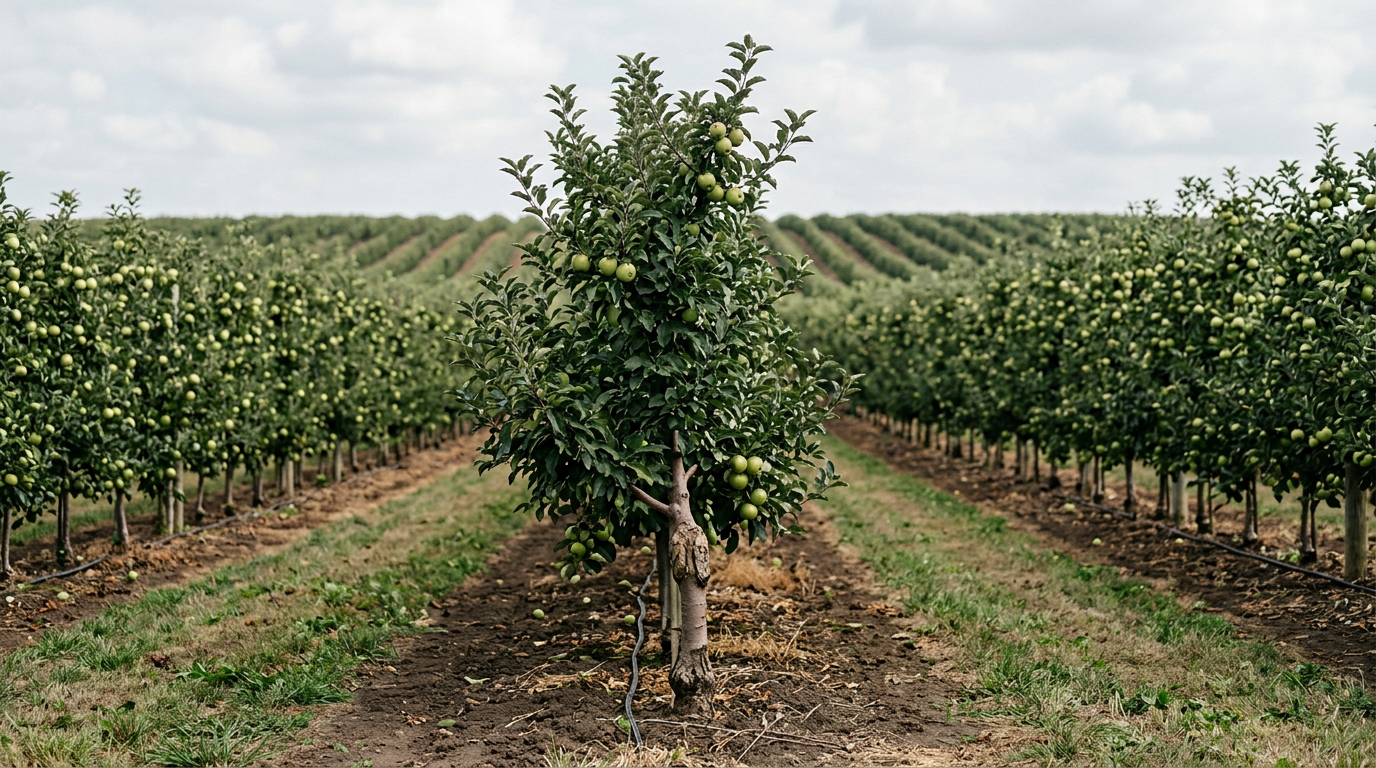
- 5Commercial orchards are vast monocultures, with every tree being a genetic copy of a single parent plant.
- 6Planting fruit seeds rarely yields the desired variety, as offspring from seeds are genetically unpredictable.
Why It Matters
It's surprising that the Gala apple you're eating is likely a genetic twin to one discovered nearly 200 years ago, grown identically through cloning.
Every Granny Smith apple you have ever eaten is a genetic copy of a single tree discovered in Australia in 1868. Because seeds produce unpredictable offspring, commercial fruit relies on grafting to ensure every piece of produce looks and tastes exactly the same.
The Illusion of Variety
- Genetic Stagnation: Most commercial fruits are not bred from seeds but are physical extensions of a single parent plant.
- The Grafting Method: Farmers attach a branch from a desired tree onto the root system of another to bypass sexual reproduction.
- Standardisation: Retailers require uniform size, colour, and shelf-life, which genetic cloning guarantees.
- The Gros Michel Warning: Relying on clones creates a massive vulnerability to disease, as seen in the collapse of the 1950s banana industry.
Quick Facts
- Oldest Clone: Some grape varieties, like Pinot Noir, have been cloned for over 1,000 years.
- Banana Monoculture: The Cavendish banana accounts for 99 percent of all banana exports.
- Success Rate: A single tree can provide thousands of grafts, populating entire continents with identical fruit.
- Seed Failure: Plant a Honeycrisp seed, and you will likely grow a sour, inedible crabapple.
Why It Matters
We live in a world of biological mass production where a single fungus could theoretically wipe out an entire global fruit category overnight.
The Architecture of the Orchard
When you bite into a Gala apple, you are eating a piece of a tree that might be thousands of miles away. Unlike most living things, commercial fruit trees do not come from the union of two parents. In nature, sexual reproduction via seeds creates genetic diversity, resulting in offspring that look and taste different from their parents.
For a supermarket, this diversity is a liability. A grocery store needs a pallet of oranges to ripen at the exact same time and fit into the exact same plastic bags. To achieve this, farmers use grafting. They take a cutting from a successful tree, known as the scion, and fuse it onto the trunk of a hardy rootstock.
According to researchers at Cornell University, this process ensures that every Honeycrisp or Red Delicious is a literal clone of the original seedling. While humans have used grafting for millennia, modern industrial agriculture has pushed this to an extreme, creating vast monocultures where every plant in a thousand-acre orchard is genetically identical.
The Case of the Disappearing Banana
The dangers of this genetic uniformity were proven by the Gros Michel banana. Before the 1950s, this was the world’s primary export banana, praised for its thick skin and rich flavour. Because every Gros Michel was a clone, none of them had natural resistance to Panama Disease. When the fungus arrived, it decimated the global supply because there was no genetic variation to provide a survivor.
The industry eventually pivoted to the Cavendish banana, which was resistant to that specific fungus. However, a new strain, Tropical Race 4, is currently threatening the Cavendish. Because the world’s banana supply lacks genetic diversity, the entire industry remains on a knife-edge.
Real World Implications
- Food Security: A single pest or disease can move through an orchard with devastating speed because no tree has a unique immune system.
- Flavour Limits: We prioritise durability and appearance over taste because those traits are easier to select for in a cloning system.
- Loss of Heritage: Thousands of unique, non-commercial fruit varieties are disappearing because they do not fit the strict requirements of global shipping.
If they are clones, why does some fruit taste better than others?
While the genetics are identical, environmental factors like soil quality, water, and sunlight, known as the terroir, can still influence the final flavour of the fruit.
Are all fruits grown this way?
Most tree fruits like apples, citrus, and stone fruits are cloned. However, many berries and vegetables are still grown from seeds, though they are often highly controlled hybrid seeds.
Is cloning the same as GMO?
No. Grafting is a physical process that has been used for thousands of years. It does not involve altering the DNA in a laboratory; it simply replicates an existing plant through asexual reproduction.
The Bottom Line
The consistency of our food supply is built on a foundation of biological repetition. While this allows us to buy a perfect apple in any month of the year, it leaves our food systems vulnerable to the same risks that face any population without diversity. We have traded resilience for reliability.
Frequently Asked Questions
Sources & References
 WikipediaThis source states that the Granny Smith apple originated in Australia in 1868 from a chance seedling, and all Granny Smith trees are propagated vegetatively from this original tree, making them genetic clones.en.wikipedia.org
- WikipediaBackground and contexten.wikipedia.org
 Scientific AmericanScientific research and analysisscientificamerican.com
 BBCReporting and verificationbbc.co.uk