
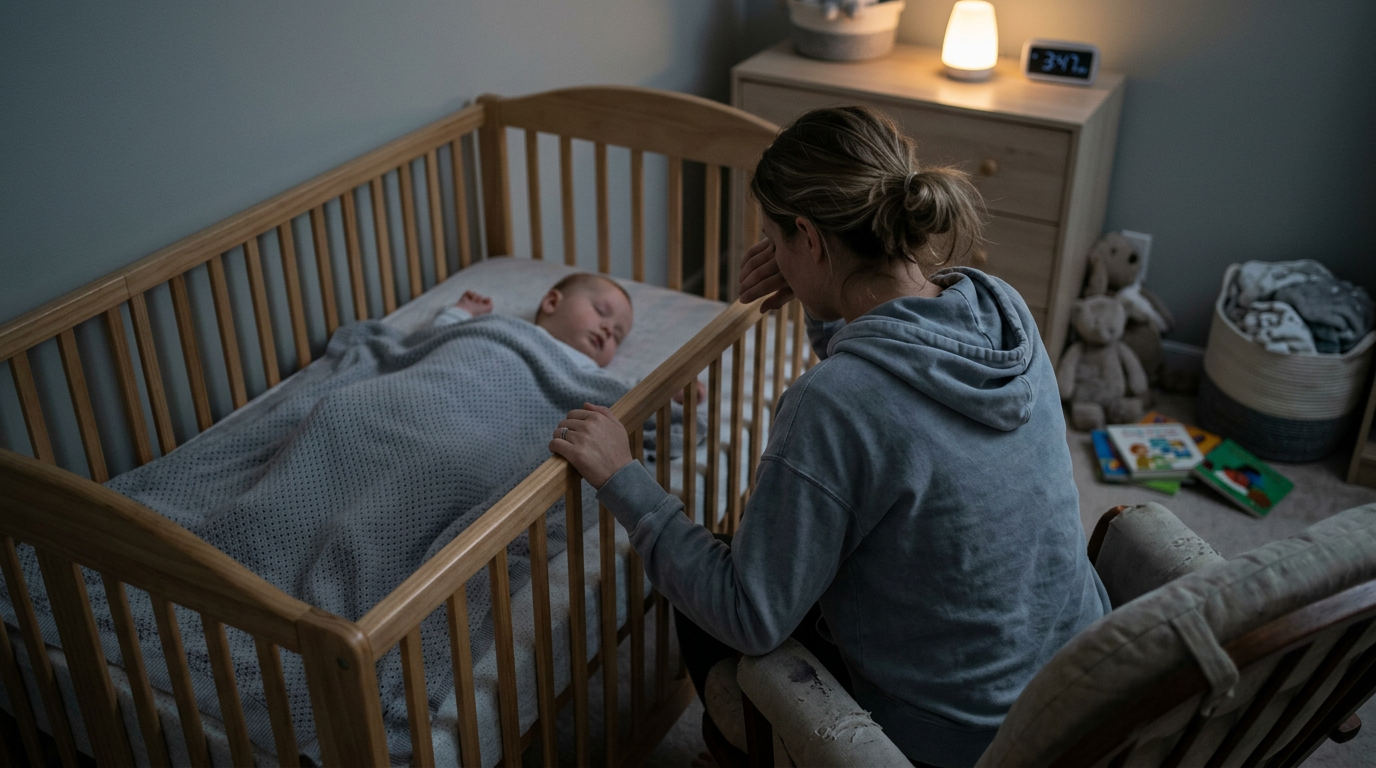
Quick Answer
Most new parents are seriously sleep-deprived, with seven in ten losing three hours of sleep nightly in their baby's first year. This massive sleep deficit means they're constantly running on empty, impacting their health, mood, and ability to cope. It highlights the immense challenge of early parenthood.
In a hurry? TL;DR
- 1New parents lose ~3 hours of sleep nightly in the first year, totaling 1,095 hours by baby's first birthday.
- 2This chronic sleep deprivation, averaging just over 5 hours/night, impairs cognitive function and emotional regulation.
- 3Interrupted sleep prevents restorative sleep cycles, making fragmented rest as harmful as minimal total sleep.
- 4Night feeds, diaper changes, and parental anxiety about the baby's well-being contribute to sleep loss.
- 5Revenge bedtime procrastination, reclaiming personal time, also adds to sleep deficits for exhausted parents.
- 6Sleep satisfaction and duration may not fully recover until six years after the child's birth.
Why It Matters
It's surprising how much sleep new parents lose, averaging nearly three hours less each night for a whole year, which impacts their health and ability to function.
New parents lose an average of three hours of sleep every night during their child's first year, according to a survey of 2,000 British parents. This cumulative deficit amounts to roughly 1,095 lost hours of rest by the time the baby reaches their first birthday.
- 70 percent: Proportion of parents reporting significant sleep loss.
- 1,095 hours: Total sleep lost per parent in the first year.
- 5.1 hours: Average total sleep per night for new parents.
- 3: 00 AM: The peak hour for parental wakefulness.
The Cost of the First Year
The transition into parenthood is often framed through the lens of emotional milestones, but the physiological reality is defined by a brutal, sustained deprivation. A study commissioned by Silentnight discovered that seven in ten parents lose three hours of sleep per night throughout the first year.
While the clinical recommendation for adults is eight hours of rest, new parents average just over five. Unlike the occasional late night or work deadline, this deficit is chronic. It creates a state of permanent jet lag that affects cognitive function, emotional regulation, and physical health.
The Science of Interrupted Sleep
The issue isn't just the quantity of sleep, but the quality. Sleep is composed of cycles, and the most restorative stages—Deep Sleep and REM—typically occur later in the night. Frequent interruptions prevent parents from completing these cycles.
Research published in the journal Sleep Health indicates that interrupted sleep can be as detrimental to mood and attention spans as getting only four hours of total sleep. For the 70 percent of parents identified in the survey, the problem is twofold: they are getting less sleep, and the sleep they do get is functionally inferior.
Why the Three-Hour Gap Exists
The three-hour deficit isn't solely down to a crying infant. The survey data suggests a complex mix of factors contributes to the 440 lost days of sleep over a lifetime of parenting.
Night feeds and nappy changes are the primary culprits, but they are supplemented by secondary anxieties. Parents report spending significant time lying awake worrying about their child's health, temperature, or breathing.
Furthermore, the phenomenon of revenge bedtime procrastination plays a role. Exhausted parents often stay awake later than necessary simply to reclaim a sense of personal agency and quiet time, even if it costs them an extra hour of rest.
Comparing the Deficit
Unlike other forms of temporary sleep restriction, such as those experienced by shift workers or students, parental sleep loss is unpredictable. A shift worker knows when their break begins; a parent is in a state of hyper-vigilance, where the brain remains partially alert even during sleep.
Industry experts at the Sleep Council note that this prolonged state of alertness prevents the glymphatic system from efficiently clearing metabolic waste from the brain. This explains the brain fog often described as baby brain.
Practical Realities of the Sleep Gap
The survey highlighted several ways parents attempt to cope with the 1,095-hour loss:
- Hyper-caffeination: A sharp increase in daily caffeine consumption to mask cognitive decline.
- Split shifts: Couples adopting a tag-team approach to ensure at least one person gets a four-hour block.
- Napping: Attempting to sleep when the baby sleeps, though only a minority of parents find this logistically possible.
Does sleep return to normal after the first year?
While the first year is the most intense, data suggests that sleep patterns often take several years to fully stabilise, as toddlers introduce new challenges like night terrors and illness.
Is the sleep loss equal between parents?
Historically, primary caregivers—often mothers—bore the brunt of the deficit. However, modern surveys show an increasing trend toward both parents sharing the burden, resulting in two sleep-deprived adults rather than one.
Can you catch up on lost sleep during the weekend?
Sleep debt cannot be repaid on a one-to-one basis. While extra rest helps, it does not immediately reverse the inflammatory markers or cognitive deficits caused by a year of chronic deprivation.
Key Takeaways
- Chronic Deficit: 70 percent of parents lose three hours every single night.
- Cumulative Impact: This totals 1,095 hours, or roughly 45 days of lost sleep in a single year.
- Beyond Exhaustion: The loss affects cognitive function and emotional stability due to broken sleep cycles.
- Long-term Horizon: Recovery of pre-child sleep quality can take up to six years.
Parenthood effectively reconfigures the human circadian rhythm, trading restorative rest for a year-long marathon of interrupted consciousness.
Frequently Asked Questions
Sources & References
 WikipediaBackground and contexten.wikipedia.org
 Scientific AmericanScientific research and analysisscientificamerican.com
 BBCReporting and verificationbbc.co.uk
- 4Current BiologyThis research paper explains that sleep deprivation leads to increased activity in the amygdala, the brain region associated with processing emotions, which contributes to heightened emotional responses.cell.com