
Quick Answer
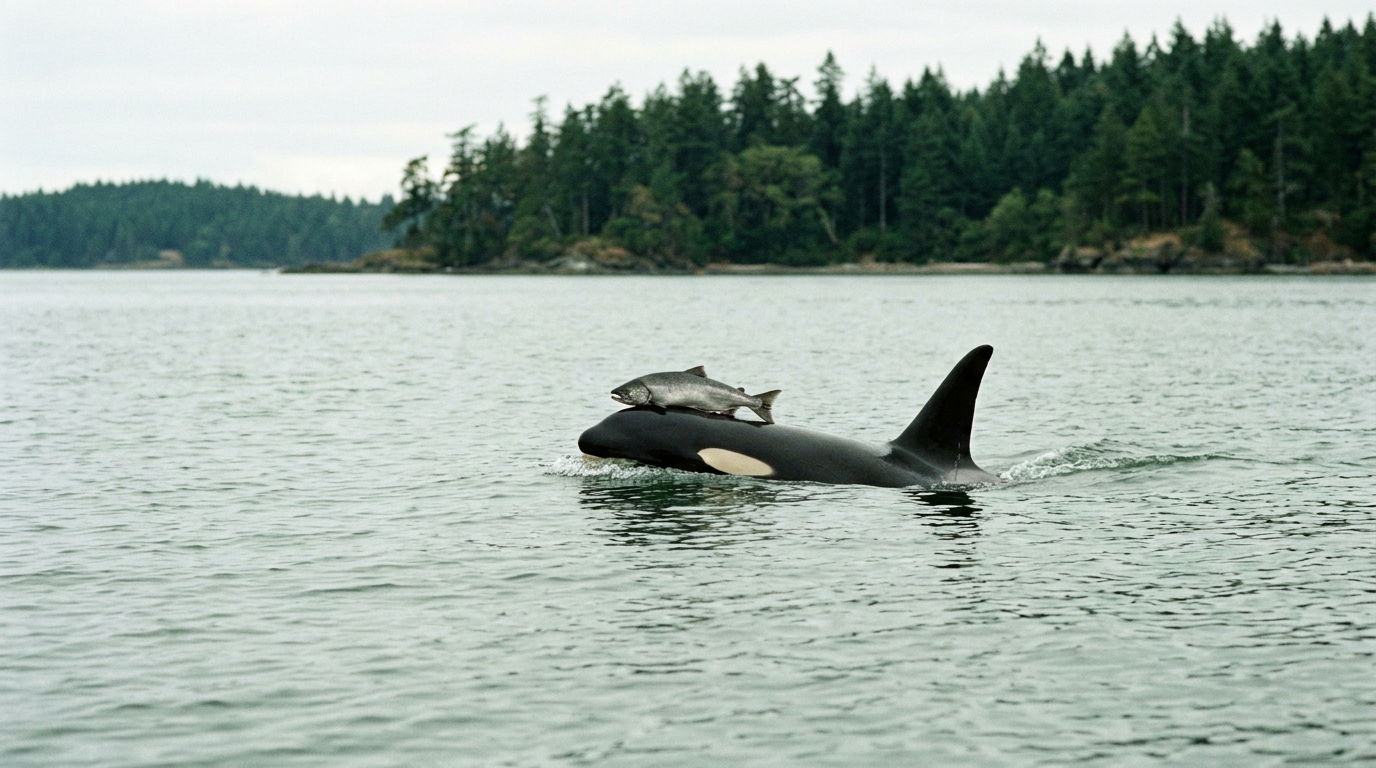
Orcas, or killer whales, once had a bizarre "fashion trend" where they'd balance dead salmon on their heads. This is fascinating because it suggests these intelligent creatures, like humans, can engage in playful, non-essential behaviours that spread through their pods, revealing a surprising social complexity beyond just survival instincts.
In a hurry? TL;DR
- 1Orcas exhibit 'fashion trends,' like balancing dead salmon on their heads in 1987, demonstrating social mimicry.
- 2This 'salmon hat' behavior served no survival purpose, highlighting complex social learning in orcas.
- 3The fad spread through pods, showing that orcas, like humans, can adopt behaviors based on social relevance.
- 4Understanding these trends reshapes our view of the line between animal instinct and cultural behavior.
- 5Orcas are capable of passing down traditions for tradition's sake, not just for survival needs.
- 6Similar temporary orca trends include boat interactions and changing vocal dialects, showcasing cultural transmission.
Why It Matters
It's surprisingly fascinating that apex predators like orcas engage in seemingly pointless fashion trends, proving that social behaviour and fads aren't exclusively human.
Orcas are capable of developing temporary, non-functional cultural fads, most famously demonstrated in 1987 when a population in the Pacific Northwest spent a summer wearing dead salmon as hats. This behaviour serves no evolutionary purpose beyond social mimicry, proving that apex predators are susceptible to the same peer-pressure trends as humans.
- Year observed: 1987
- Primary location: Puget Sound, Washington State
- Duration of fad: Approximately 5-6 weeks
- Species: Southern Resident killer whales (Orcinus orca)
- Type of salmon used: Pacific salmon (predominantly Coho)
Why It Matters: Understanding that high-level cognitive animals engage in useless, aesthetic-driven trends changes how we perceive the boundary between human culture and animal instinct.
The Summer of the Salmon Hat
In the summer of 1987, a female orca in the Puget Sound area of the Pacific Northwest began carrying a dead salmon on her nose. She did not eat it. She simply balanced it, swimming through the water with the fish draped over her snout like a bizarre accessory.
Within weeks, the behaviour spread through her pod and into two other related pods. By the peak of the season, a significant portion of the Southern Resident population was participating in what researchers now officially classify as a cultural fad. They were essentially wearing their prey as hats.
Social Learning and Cultural Transmission
Unlike hunting techniques or migratory routes, which are passed down for survival, these fads appear to be purely social. According to research published by biological oceanographer Luke Rendell and biologist Hal Whitehead, orcas possess a sophisticated capacity for social learning that mirrors human cultural transmission.
Unlike other marine mammals that largely rely on instinct, orcas observe, imitate, and discard behaviours based on social relevance. This puts them in a rare category of animals, alongside certain primates and birds, that engage in tradition for tradition's sake.
The Mechanics of a Marine Trend
For an orca, balancing a dead fish is a nuisance. It creates drag and requires constant micro-adjustments to keep the carcass in place. The fact that they continued to do it suggests the social reward outweighed the physical inconvenience.
In contrast to the structured, hierarchical teaching seen in chimpanzees, orca fads seem more democratic and viral. One individual experiments, and the others copy because the innovator is a high-status member of the group.
Real-World Applications
Observation of these fads allows scientists to map social networks within pods. By tracking who adopts a trend first, researchers can identify the influencers and social hubs within a whale community.
- Social Hubs: Identifying which whales are most frequently imitated helps in conservation efforts by protecting key individuals.
- Cognitive Mapping: These behaviours provide a window into the orca prefrontal cortex, showing a capacity for non-utilitarian thought.
- Cultural Evolution: It suggests that orca populations are not just biological units, but distinct cultural groups with their own histories.
Why did they stop wearing the salmon?
Like human fashion, the novelty likely wore off. Once the behaviour no longer provided a social dopamine hit or the initial trendsetters moved on to other activities, the rest of the pod followed suit.
Was it a form of play?
Most researchers categorise it as play, but specifically social play. It differs from a solo calf playing with a piece of kelp because it required widespread communal participation to be sustained.
Have they done it again since the 80s?
There have been isolated reports of similar head-balancing acts with other objects, but nothing has reached the community-wide scale of the 1987 salmon season.
Key Takeaways
- Peer Pressure: Orcas are one of the few species known to engage in temporary, useless social trends.
- Cultural Sophistication: These fads prove that orca behaviour is dictated by culture and imitation, not just survival instincts.
- Short-Lived: The 1987 salmon hat trend lasted less than two months, mirroring the rapid cycle of human internet memes.
- Advanced Cognition: Balancing prey requires significant coordination, suggesting the whales were making a conscious effort to participate in the trend.
The dead salmon of 1987 remain a pointed reminder that while we may be the most technologically advanced species, we are certainly not the only ones doing things just because everyone else is.
Frequently Asked Questions
Sources & References
 WikipediaBackground and contexten.wikipedia.org
 Scientific AmericanScientific research and analysisscientificamerican.com
 BBCReporting and verificationbbc.co.uk
- WikipediaThis source mentions the salmon-wearing behavior in the Southern Resident killer whales in 1987 as an example of an orca cultural fad.en.wikipedia.org