
Quick Answer
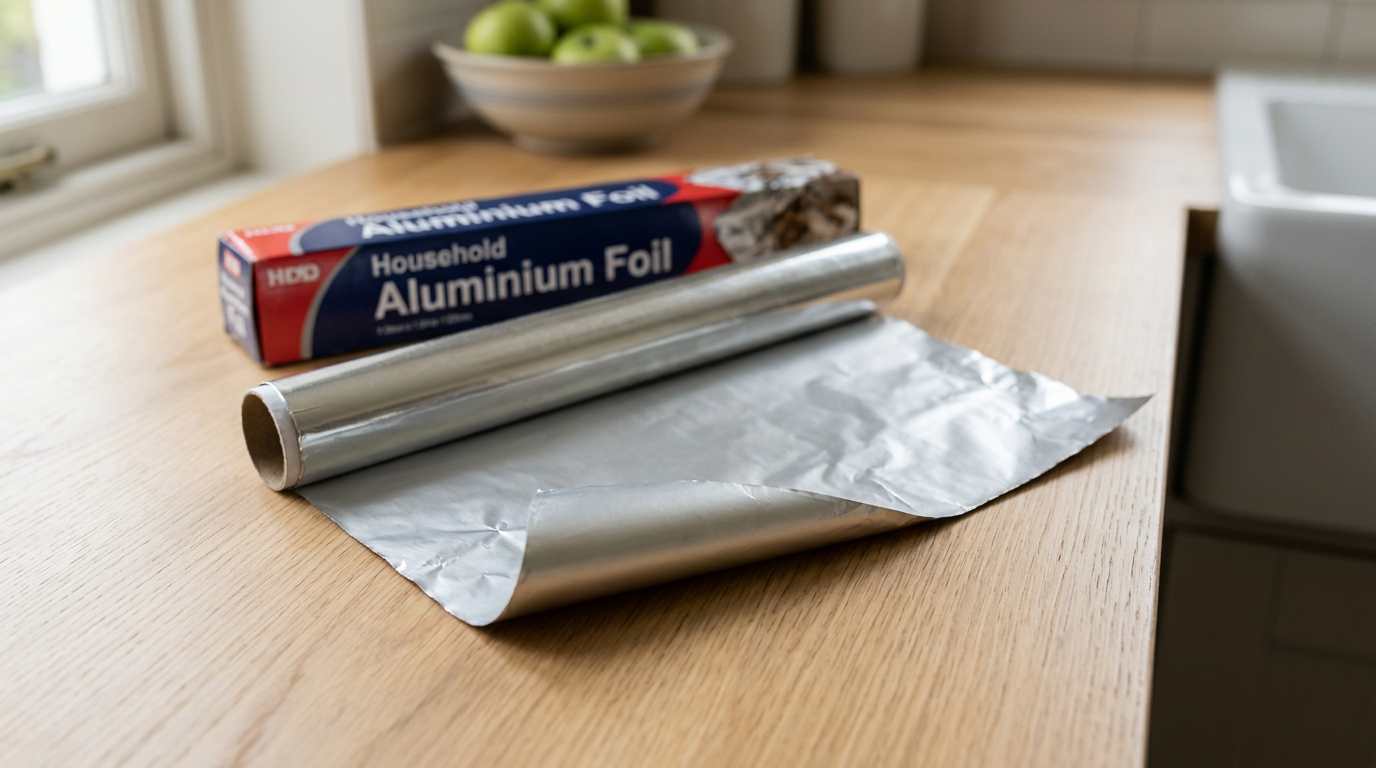
Aluminium foil has a shiny side and a dull side, but this difference is purely down to how it's made. When two sheets are rolled together, one side gets polished by machinery, while the other rubs against its fellow sheet. Don't worry about which side is which for cooking or wrapping food – both sides do the exact same job.
In a hurry? TL;DR
- 1The shiny and matte sides of aluminum foil are due to the manufacturing process, not for cooking functionality.
- 2Both sides of standard aluminum foil perform identically for cooking, freezing, and food storage.
- 3The difference in appearance arises from two foil sheets rolling together; outer sides are shiny, inner sides are matte.
- 4Shiny side in vs. shiny side out makes no significant difference in heat reflection for home cooking.
- 5Convection and conduction, not minor radiant heat differences, are the primary heat transfer methods in home ovens.
- 6Exception: Non-stick foil has a specific coated side (usually matte) that must be used correctly to prevent sticking.
Why It Matters
It's surprising that the shiny and dull sides of aluminium foil are just a manufacturing quirk and don't actually affect how well they cook or store food.
The matte and shiny sides of aluminium foil are a result of a manufacturing process called pack rolling, not a functional design choice. Both sides perform identically when cooking, freezing, or storing food.
- 0.016 mm: The typical thickness of standard household foil.
- 2: The number of sheets rolled together simultaneously to prevent breakage.
- 660.3°C: The melting point of aluminium, though rolling happens at lower temperatures.
- 0%: The difference in heat reflection between the shiny and matte sides in home ovens.
The Friction of Manufacture
The visual difference between the two sides is a mechanical byproduct rather than a culinary feature. During the final stage of production, aluminium manufacturers use a process called pack rolling. Because the foil is so thin and delicate, it would likely tear if passed through the heavy rollers as a single sheet.
To solve this, technicians feed two layers of foil through the mill at the same time. The sides that come into contact with the highly polished steel rollers emerge with a mirror-like, shiny finish. The sides that face each other, touching only the opposite layer of metal, emerge with a dull, matte appearance.
The Myth of Heat Reflection
A common kitchen myth suggests that the shiny side should face inward to reflect heat back into the food, or outward to speed up roasting. However, thermal experts at manufacturers like Reynolds Kitchens confirm that for the vast majority of domestic tasks, the orientation makes no difference.
In a standard kitchen oven, heat is transferred via convection (moving air) and conduction (direct contact). The tiny difference in radiant heat reflection between the two surfaces is too negligible to affect cooking times or food temperature. Unlike industrial heat shields or laboratory-grade insulation, household foil is simply too thin to exhibit meaningful thermodynamic variance between its sides.
Exceptions to the Rule
While standard foil is identical on both sides, there is one notable exception: non-stick foil. In this specific product, one side is coated with a food-grade silicone or similar non-stick layer.
In these cases, the manufacturer clearly marks the non-stick side, which is usually the matte side. Using the wrong side here will result in your grilled cheese or salmon skin adhering firmly to the metal. Outside of these specialised products, the choice of side is purely aesthetic.
Historical and Cultural Context
Aluminium foil replaced tin foil in the early 20th century, largely because tin left a metallic taste in food and was less malleable. The transition began around 1910, when the first aluminium rolling plant, Dr. Lauber, Neher & Cie., opened in Switzerland.
By 1913, the U.S. began domestic production, and the two-sided finish became a standard feature of the high-speed rolling mills developed to meet growing consumer demand. Despite over a century of use, the shiny-versus-dull debate remains one of the most persistent legends in domestic science.
Which side should I use for freezing food?
Either side is effective. The moisture barrier properties of the foil remain the same regardless of which side faces the food. The most important factor for freezing is ensuring a tight seal to prevent freezer burn.
Does one side reflect more light?
Yes, the shiny side reflects more visible light because it is smoother. This is purely an optical effect and does not translate to faster cooking or better heat retention in a standard oven.
Is it safe to use both sides?
Yes. Both the matte and shiny surfaces are composed of the same food-safe aluminium. The manufacturing lubricants used during rolling are washed off or burned away during the final annealing process.
Key Takeaways
- Mechanical Origin: The shiny side touches steel rollers; the matte side touches another sheet of foil.
- Thermal Parity: There is no measurable difference in cooking speed or efficiency between the two sides.
- Non-Stick Exception: Only specially coated non-stick foil requires a specific side to be used.
- Tight Seal Matters More: The quality of the wrap is far more important for food preservation than the orientation of the metal.
If you are looking to improve your kitchen efficiency, focus on the science of searing or understanding how convection ovens work rather than flipping your foil. You might also be interested in the history of canned food and how it changed global logistics.
Frequently Asked Questions
Sources & References
 WikipediaBackground and contexten.wikipedia.org
 Scientific AmericanScientific research and analysisscientificamerican.com
 BBCReporting and verificationbbc.co.uk
- 4The Halo Effect: Why Attractiveness Influences How We Perceive OthersThis source explains that aluminum foil is so thin that during the final rolling stages, two layers are fed through the mill simultaneously, which results in one side being dull and the other shiny.science.howstuffworks.com