
Quick Answer
Ravens can actually learn to talk more clearly than some parrots, and they mimic all sorts of sounds like car engines and flushing toilets. This shows their remarkable intelligence; it's not just about looks, but about being clever enough to survive in the wild by mastering complex communication.
In a hurry? TL;DR
- 1Captive ravens can achieve clearer speech than many parrots, mimicking human voices and a wide range of sounds.
- 2Ravens possess remarkable vocal control and a high intelligence quotient comparable to great apes, using mimicry strategically.
- 3Unlike parrots' rhythmic repetition, ravens use mimicry with timing and intent, informed by their ability to attribute mental states.
- 4Ravens can mimic non-biological sounds like flushing toilets and car alarms, demonstrating advanced vocal dexterity.
- 5In the wild, ravens use mimicry for survival, such as imitating wolves to scavenge carcasses.
- 6Captive ravens learn human speech by identifying it as the dominant sound, using it to adapt to their environment.
Why It Matters
It's surprising that intelligent ravens, not parrots, can often mimic human speech more clearly and use it contextually, showing a deeper cognitive ability than we typically assume.
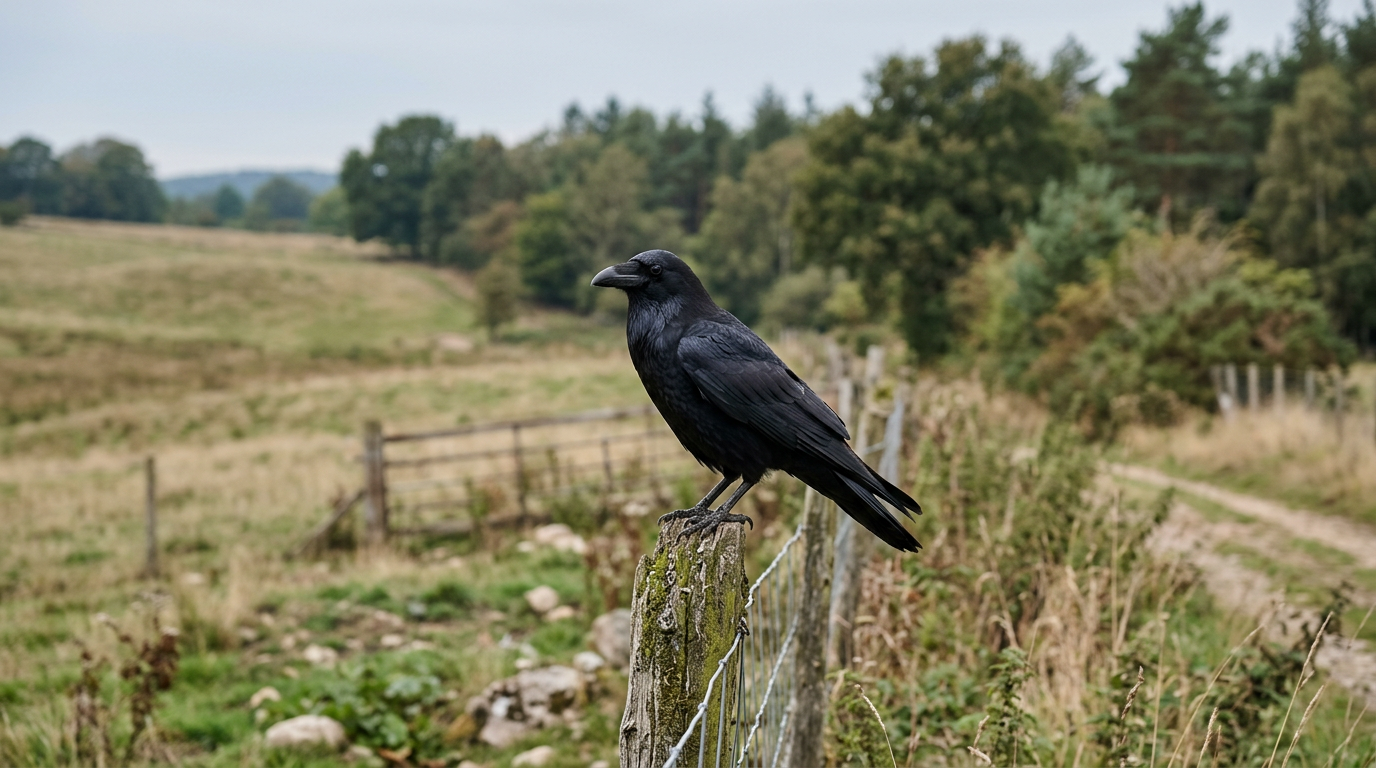
While parrots are the poster children for avian speech, ravens are the undisputed heavyweights of vocal mimicry. In captivity, these corvids can learn to speak more clearly than many parrot species, flawlessly imitating human voices, engines, and household appliances.
- Mimicry Range: Ravens can replicate human speech, animal calls, and mechanical noises like car alarms.
- Intelligence Quotient: Corvid brain-to-body ratios are comparable to those of great apes.
- Vocal Clarity: Captive ravens often produce deeper, more human-like tones than the high-pitched rasps of budgies.
- Social Complexity: Wild ravens use specific calls to identify individuals, similar to how humans use names.
Why It Matters
Understanding raven mimicry reveals that high-level communication isn't exclusive to primates or colourful tropical birds; it is a byproduct of the extreme social intelligence required to survive in harsh, competitive environments.
The Science of the Corvid Throat
The common raven (Corvus corax) does not have vocal cords. Like all birds, they produce sound using a specialised organ called the syrinx. Located at the base of the trachea, the syrinx allows ravens to control two independent membranes simultaneously.
Unlike parrots, which often rely on rhythmic repetition, ravens appear to use mimicry with a sense of deliberate timing. Researchers at the University of Vienna have noted that ravens are not just mindless mimics. They possess a theory of mind, meaning they can attribute mental states to others, which informs how and when they choose to use their vocal repertoire.
Masters of the Mechanical
In captivity, the raven’s ability to imitate non-biological sounds is uncanny. There are documented cases of ravens perfectly recreating the sound of a flushing toilet, the beep of a reversing lorry, and the distinct clatter of a domestic engine.
This is more than a party trick. In the wild, ravens use mimicry as a survival tool. They have been observed imitating the howls of wolves to lead the predators to a carcass. Once the wolves tear the hide open, the ravens swoop in to finish the remains. This inter-species manipulation requires a level of vocal control that few animals possess.
The Captivity Catalyst
The reason we rarely hear wild ravens speaking English is a matter of necessity. In the forest, there is no evolutionary benefit to saying hello. However, in a captive environment, ravens quickly identify the dominant sound in their social circle: the human voice.
According to bird experts at the Smithsonian’s National Zoo, ravens are so adept at this that they can mimic specific individuals. If a raven is raised by a person with a low, gravelly voice, the bird will replicate that specific timbre rather than a generic human sound.
Real-World Scenarios
- The Prankster: A captive raven at a wildlife centre learns to mimic the sound of the caretaker's walkie-talkie, causing staff to check their equipment repeatedly.
- The Wolf Caller: A wild raven in the Rockies emits a perfect elk call, not to mate, but to draw a predator toward a specific location.
- The Domestic Mimic: A pet raven learns the exact sound of a ringing smartphone, successfully tricking its owner into reaching for their pocket every few minutes.
Interesting Connections
- Norse Mythology: Odin, the All-Father, was accompanied by two ravens, Huginn (thought) and Muninn (memory), who travelled the world and reported back to him in speech.
- Etymology: The collective noun for ravens is an unkindness or a conspiracy, reflecting their historical reputation as deceptive and overly clever.
- Literature: Edgar Allan Poe chose a raven for his famous poem specifically because of the bird’s ability to speak, though he initially considered using a parrot before deciding it lacked the necessary gloom.
Can all ravens talk?
Almost all ravens have the physical capacity to mimic speech, but they generally only do so in captivity where they are exposed to human language consistently and have a social incentive to bond with keepers.
Are ravens smarter than parrots?
While both are highly intelligent, ravens typically outperform parrots in tasks involving logic, planning, and tool use. Parrots generally excel more in social mimicry and emotional bonding.
Why do they mimic car engines?
Ravens are attracted to novel sounds. In an environment where mechanical noises are frequent, a raven may mimic an engine simply because it is a distinct, complex sound that captures their attention.
Key Takeaways
- Superior Mimics: Ravens can produce clearer, more human-like speech than many parrots.
- Tool Users: Their vocal mimicry is often used as a tool for manipulation rather than just social bonding.
- Complex Anatomy: The twin membranes of the syrinx allow for a dual-tone vocal range.
- High Intelligence: Raven cognition is on par with great apes and young children.
- Environmental Influence: Speech is almost exclusively a captive trait driven by the bird's need to integrate into its social group.
Frequently Asked Questions
Sources & References
 Smithsonian's National ZooThis source confirms that common ravens are highly intelligent and known for their ability to mimic a wide range of sounds, including human speech.nationalzoo.si.edu
 WikipediaThis source details the common raven's advanced cognitive abilities, including their capacity for vocal mimicry, problem-solving, and tool use, highlighting their intelligence comparable to great apes.en.wikipedia.org