
Quick Answer
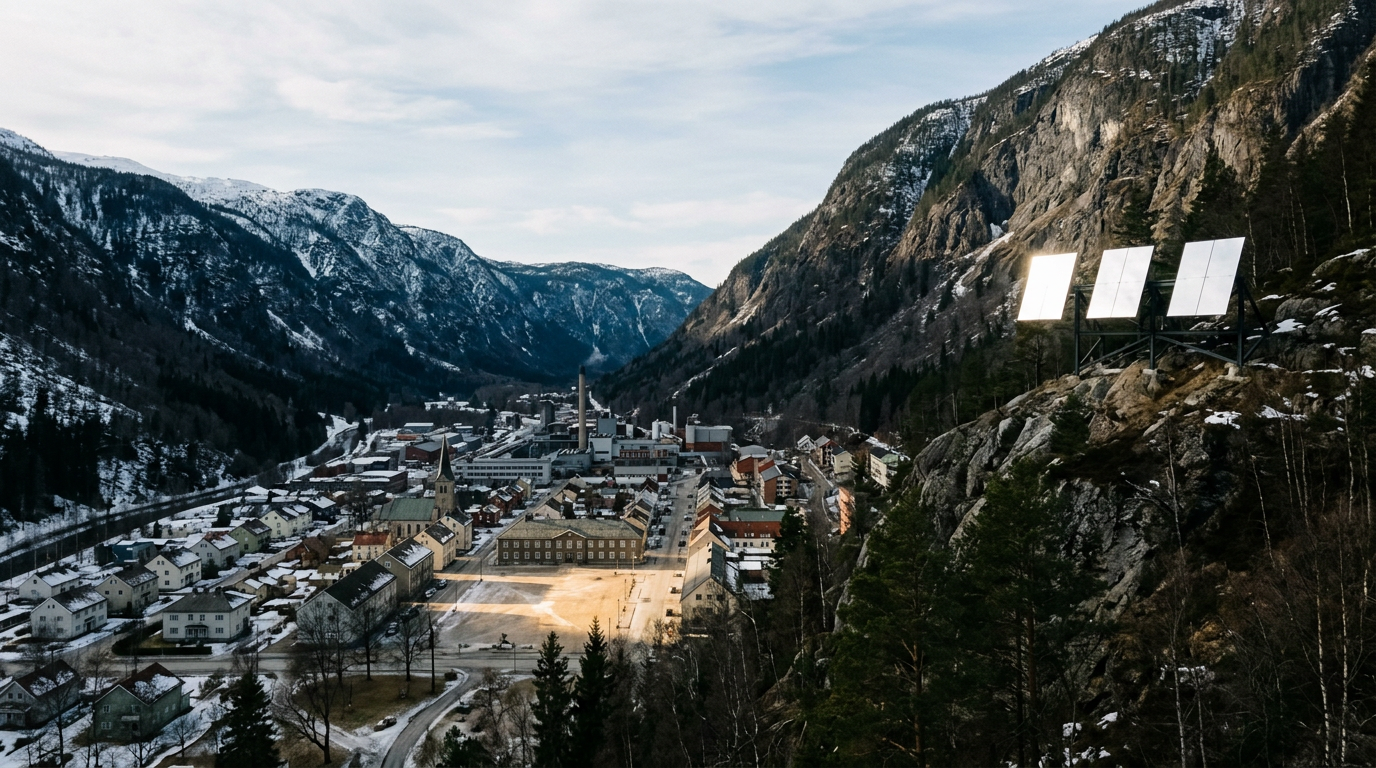
A town in Norway cleverly uses giant mirrors on a mountain to beam winter sunshine into its main square. This ingenious engineering solution battles the dark, shadowy winters, bringing natural light and a welcome boost of cheer to the residents. It’s a fascinating example of adapting to extreme natural conditions.
In a hurry? TL;DR
- 1Rjukan, Norway, uses three large, computer-controlled mirrors to reflect sunlight into its town square during winter months.
- 2These mirrors, installed on a mountain peak, track the sun automatically to keep the town square illuminated.
- 3The project aims to combat the effects of prolonged darkness and Seasonal Affective Disorder (SAD) in the town's residents.
- 4The 'Solspeil' mirrors provide a psychological boost and a central gathering place, encouraging social interaction during winter.
- 5This innovative solution uses optics to overcome geographical limitations, bringing sunlight to a valley that is in shadow for six months annually.
- 6The mirrors do not provide heat but create a significant psychological anchor and a sense of well-being for the community.
Why It Matters
It's surprisingly brilliant how Rjukan uses giant, sun-tracking mirrors to banish winter darkness and bring light to its town square.
Rjukan, a small industrial town in Norway, uses three massive heliostatic mirrors to bounce sunlight from a mountain peak down into its shadowy valley floor during winter. These mirrors, known as the Solspeil, rotate automatically to track the sun and illuminate the town square for residents who would otherwise live in darkness for six months of the year.
The Facts at a Glance
- Location: Telemark, Norway
- Installation Date: October 2013
- Mirror Surface Area: 51 square metres
- Elevation: 450 metres above the town
- Target Area: 600 square metre circle in the town square
- Cost: 5 million Norwegian Krone (approx. £370,000)
Why It Matters
This project represents a rare triumph of human engineering over geography, proving that environmental limitations on mental health and community well-being can be solved with relatively low-tech optics.
A Century of Shadow
Rjukan was founded by industrialist Sam Eyde between 1905 and 1916 to house workers for Norsk Hydro. The town is nestled at the base of the steep Vestfjorddalen valley, dominated by the Gaustatoppen mountain.
Because of the extreme topography, the sun never rises high enough to clear the peaks from September to March. For over a hundred years, the 3,000 residents lived in a permanent twilight during the winter. Eyde himself first proposed the idea of mountain mirrors in 1913, but the technology did not yet exist to make it viable.
Instead, the town built the Krossobanen in 1928. This aerial tramway was the first of its kind in Northern Europe, designed specifically to carry sun-starved residents 500 metres up the mountain so they could see the horizon.
The Modern Solspeil
The project was revived in 2005 by local artist Martin Andersen, who moved to the town and felt the oppressive weight of the winter shadow. Unlike previous attempts, Andersen’s vision utilised computer-controlled heliostats, which are more commonly found in concentrated solar power plants.
Installed by helicopter 450 metres above the town square, the three mirrors are controlled by a central computer system. This system calculates the sun's trajectory and adjusts the angle of the mirrors every ten seconds to ensure the reflected beam remains fixed on the town square.
The Impact on Local Well-being
The lack of natural light is more than an inconvenience; it is a physiological challenge. According to research from the University of Tromsø, Seasonal Affective Disorder (SAD) affects a significant portion of the Norwegian population, leading to lethargy and depression.
In contrast to other sun-deprived regions that rely exclusively on indoor light therapy, Rjukan’s mirrors encourage social interaction. By creating a physical space of light, the town has effectively weaponised optics to combat the isolation typically associated with harsh northern winters.
Practical Applications and Examples
- Community Gatherings: The town square now hosts winter festivals and volleyball matches in the patch of light, events that were previously impossible in the gloom.
- Tourism Growth: Since the installation in 2013, Rjukan has seen a spike in international visitors who come specifically to stand in the reflected beam.
- Psychological Study: The town serves as a living laboratory for researchers studying how architectural interventions can mitigate the effects of geographic light deprivation.
Interesting Connections
- Similar Projects: The Italian village of Viganella installed a single, smaller mirror in 2006 for the same purpose, serving as the primary inspiration for Rjukan.
- Heavy Water History: Rjukan is also famous for the Vemork hydroelectric plant, the site of a daring World War II sabotage mission to stop the Nazis from developing atomic weapons.
- UNESCO Status: The town and its industrial landscape, including the mirrors, are part of a UNESCO World Heritage site celebrating industrial heritage and innovation.
Do the mirrors provide heat?
No, the mirrors are designed to reflect light, not concentrated heat. While you can feel the brightness, the thermal energy is insufficient to raise the ambient temperature of the square significantly.
How are the mirrors powered?
The system is incredibly efficient, using wind and solar power harvested on the mountain to drive the small motors that tilt and rotate the mirrors throughout the day.
Can the mirrors be seen from everywhere in town?
The beam is focused specifically on the market square (Torget). From other parts of the town, you can see the glowing mirrors on the mountain, but you are not standing in the light.
Key Takeaways
- Engineering: Three computer-controlled heliostats track the sun to reflect light into the valley.
- History: The idea was first conceived in 1913 but took a century to become technologically feasible.
- Health: The project addresses the psychological impact of living in a six-month shadow.
- Innovation: Rjukan demonstrates how existing solar technology can be repurposed for urban planning and mental health.
Geography is often destiny, but Rjukan proves that with enough mirrors and a bit of Norwegian persistence, even the deepest valleys can find their place in the sun.
Frequently Asked Questions
Sources & References
 Smithsonian MagazineThis article from Smithsonian Magazine details how Rjukan, Norway, uses three large heliostatic mirrors to reflect sunlight into its town square during the winter months, mentioning the installation date of October 2013 and the mirrors' purpose.smithsonianmag.com
 WikipediaThe Wikipedia page for Rjukan confirms the town's location in a valley surrounded by mountains, leading to winter sunlight deprivation, and describes the installation of the 'solspeil' (sun mirrors) in 2013 to direct sunlight into the town square.en.wikipedia.org