
Quick Answer
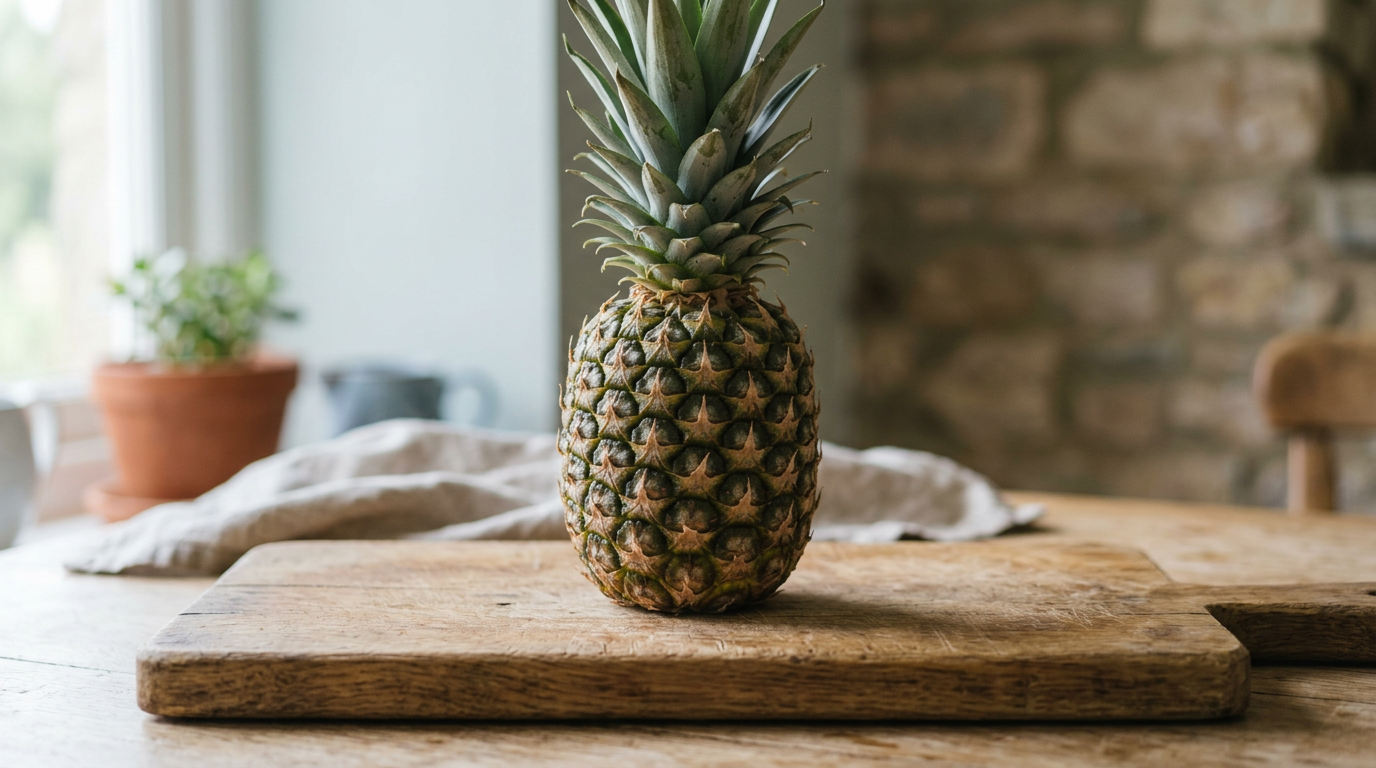
A pineapple is actually a cluster of many berries fused together. Each 'eye' on the fruit is a single berry that grew from its own flower. It's fascinating because we see a pineapple as one fruit, but it's really the result of a whole bunch of individual berries joining up.
In a hurry? TL;DR
- 1Pineapples are multiple fruits, technically clusters of fused berries, with each 'eye' representing an individual berry.
- 2Each pineapple develops from 50-200 individual flowers that pollinate and fuse together around a central stalk.
- 3The 'eyes' on a pineapple's skin are remnants of the original flowers' sepals and bracts.
- 4Pineapples contain bromelain, a potent protein-digesting enzyme that can cause a tingling sensation in your mouth.
- 5Historically, pineapples were rare and expensive status symbols, costing thousands of dollars in today's currency.
- 6A single pineapple plant typically yields only one fruit every two years, making it a slow-growing crop.
Why It Matters
It's surprisingly useful to know that each 'eye' on a pineapple is a separate berry, especially when considering its potent protein-digesting enzyme.
A pineapple is not a single fruit, but a collective of individual berries fused together around a central core. Each hexagonal eye on the surface represents a single berry that originated from a distinct flower before merging into a unified structure.
Quick Answer
Technically known as a multiple fruit, the pineapple is a cluster of individual berries that grow together. Each eye on the skin is the remnant of a single flower that successfully pollinated and fused with its neighbours.
Key Facts and Figures
- Scientific Classification: Ananas comosus
- Type: Multiple fruit (coalesced berries)
- Flower Count: 50 to 200 individual flowers per fruit
- Growth Cycle: Roughly 18 to 24 months to reach maturity
- Enzyme Content: Bromelain (a protein-digesting enzyme)
The Botany of Fusion
Unlike a peach or an apple, which develops from one flower with one ovary, the pineapple is a botanical teamwork project. This classification places it in the category of multiple fruits, a group shared by figs and mulberries.
The process begins with an inflorescence, a cluster of up to 200 purple or red flowers arranged around a central stalk. As these flowers develop into berries, they swell and press against one another. Eventually, they fuse into the single, heavy structure we recognise in the produce aisle.
Historical Rarity and Status
For centuries, the pineapple was a symbol of immense wealth rather than a lunchbox staple. Because they were difficult to transport from the Caribbean without rotting, they became the ultimate 18th-century status symbol.
In Georgian England, a single fruit could cost the equivalent of £5,000 in today's money. They were so precious that people would rent them for an evening to display as a centrepiece at dinner parties, returning the fruit the next morning without ever taking a bite.
Practical Applications
- Culinary Tenderising: Marinating tough cuts of meat in pineapple juice for short periods uses the berries' enzymes to soften muscle fibres.
- Architectural Motifs: You will find pineapple shapes on gateposts and furniture across London and Charleston, representing a traditional sign of hospitality derived from its history as a prized guest offering.
- Sustainable Textiles: Pinatex is a leather alternative made from the cellulose fibres found in pineapple leaves, turning agricultural waste into high-end fashion.
Interesting Connections
- Bromelain Digestion: Learn why fresh pineapple ruins gelatin desserts.
- The Fibonacci Spiral: The eyes of a pineapple usually follow the Fibonacci sequence, typically arranged in eight spirals in one direction and thirteen in another.
- Colonial Symbols: The history of the pineapple in Caribbean trade.
How do you know when a pineapple is ripe?
Ignore the skin colour, which can remain green even when ripe. Instead, smell the base; it should have a sweet, fragrant aroma. You can also gently tug at one of the inner leaves at the top. If it slides out easily, the fruit is ready.
Do pineapples grow on trees?
No, pineapples grow on low-lying herbaceous plants close to the ground. The fruit sits atop a central spike surrounded by long, waxy leaves.
Can you grow a new pineapple from the top?
Yes. By twisting off the leafy crown, drying it for a few days, and planting it in soil, you can grow a new plant. However, be prepared for a long wait, as it will likely take two years to produce a single new fruit.
Key Takeaways
- The pineapple is a multiple fruit composed of many fused berries.
- Each eye on the skin is the site of a former individual flower.
- It contains bromelain, an enzyme that breaks down proteins and tenderises meat.
- Historically, the fruit was a rented status symbol for European aristocrats.
- The plant belongs to the bromeliad family, making it a relative of Spanish moss.
Frequently Asked Questions
Sources & References
 WikipediaThis source verifies that a pineapple is a multiple fruit, a collective of many berries that have grown together.en.wikipedia.org
 Encyclopaedia BritannicaThis source confirms that the pineapple is a multiple fruit composed of numerous individual fruitlets developed from the flowers of a spike-like inflorescence.britannica.com
- 3Purdue UniversityThis source states that the fruit is a multiple fruit, formed by the coalescence of individual fruits (berries) developed from separate flowers, with each 'eye' on the skin representing a single flower.hort.purdue.edu