
Quick Answer
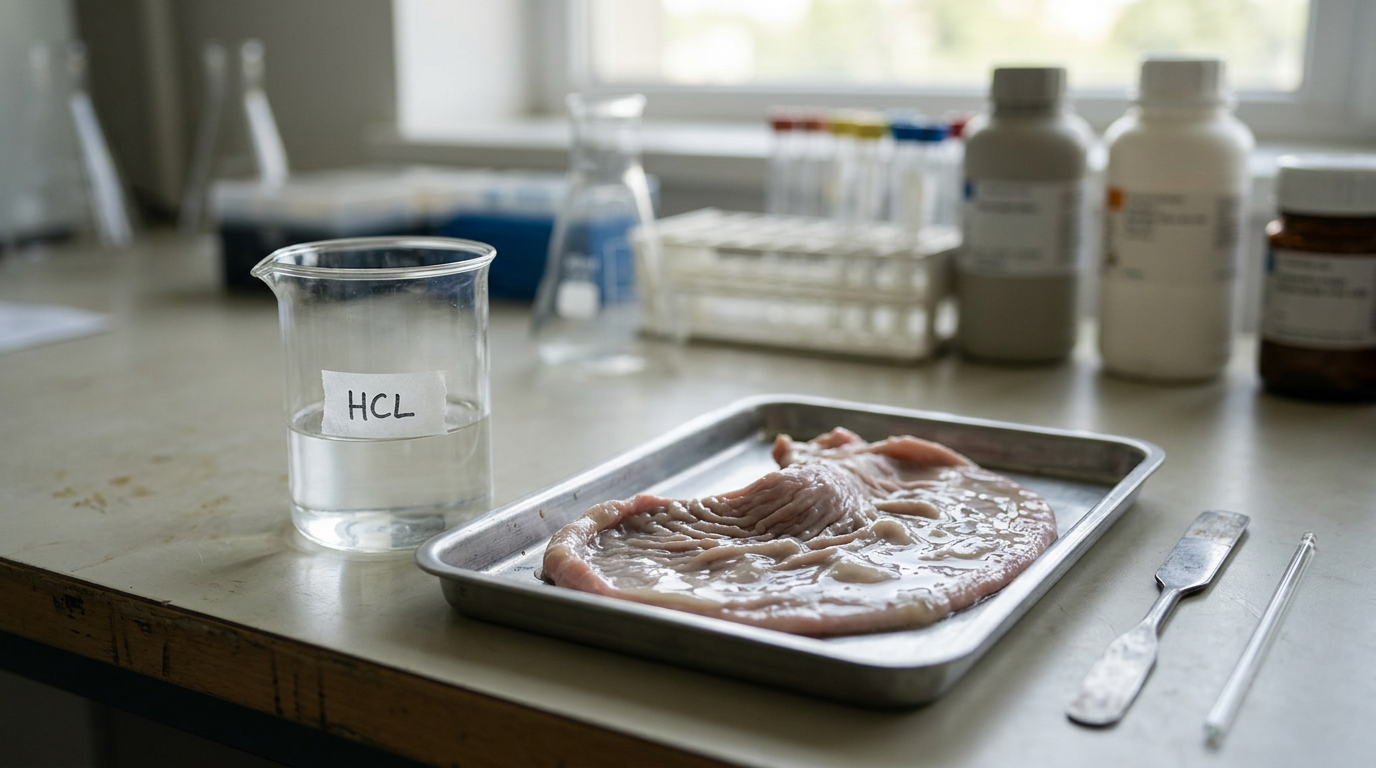
Stomach acid is so powerful it can dissolve metal and bone. This is surprising because the stomach doesn't digest itself thanks to a thick, constantly renewing mucus lining that acts as a protective shield.
In a hurry? TL;DR
- 1Your stomach acid is highly corrosive (pH 1.0-3.0), capable of dissolving metal and bone.
- 2A protective mucus layer containing bicarbonate neutralizes the acid, shielding your stomach lining.
- 3The stomach lining regenerates rapidly, replacing itself every 3-5 days for continuous protection.
- 4This potent acid denatures proteins and kills bacteria, aiding digestion and preventing infection.
- 5Ulcers form when the protective mucus barrier is compromised, allowing acid to damage the stomach wall.
- 6Historical experiments confirmed stomach digestion is a chemical process driven by hydrochloric acid.
Why It Matters
It's fascinating that our stomachs can hold an acid strong enough to dissolve metal, yet we're protected by a constantly renewing mucus lining.
Stomach acid is a potent solution of hydrochloric acid strong enough to dissolve metal, yet the body remains unharmed because of a resilient, self-regenerating mucus barrier. This biological paradox prevents the digestive system from consuming itself.
- pH Level: 1.0 to 3.0 (highly acidic)
- Main Component: Hydrochloric acid (HCl)
- Barrier Lifespan: The stomach lining replaces itself every 3 to 5 days
- Corrosive Power: Capable of dissolving zinc and carbon steel
The Chemistry of Corrosion
Gastric juice is not merely a digestive aid; it is a chemical weapon. Produced by parietal cells in the stomach lining, the acid sits at a pH level between 1.0 and 3.0. For context, this is significantly more corrosive than vinegar and roughly equivalent to the acid found in lead-acid car batteries.
The primary function is to denature proteins and kill ingested bacteria, but the side effect is an environment that can liquefy solid materials. Research published in the journal Gastrointestinal Endoscopy demonstrated that common items, such as razor blades and small coins, begin to show significant degradation after just 24 hours of exposure to gastric fluids.
Real-World Implications
The sheer strength of stomach acid has practical consequences for medicine and safety. It dictates how pharmaceutical companies design pills. Time-release medications often use enteric coatings—polymers that are resistant to acid but dissolve in the more neutral pH of the small intestine—ensuring the drug survives the stomach’s corrosive bath.
Common Scenarios
- Foreign Object Ingestion: Most small, non-sharp metal objects can be safely passed because the acid softens them, though doctors still monitor for heavy metal poisoning.
- Heartburn: When the lower oesophageal sphincter fails, this acid enters the throat. Unlike the stomach, the oesophagus lacks the thick mucus shield, leading to the characteristic burning sensation.
- Bacterial Defence: The acidity acts as a first line of defence against pathogens like Salmonella, which struggle to survive in such a low-pH environment.
Can stomach acid dissolve a penny?
While it can corrode the outer layer of a modern penny (mostly zinc), it takes a significant amount of time to fully dissolve a coin. However, the acid is strong enough to cause structural damage and chemical leaching.
Why does the acid not dissolve the small intestine?
As food leaves the stomach, the pancreas secretes sodium bicarbonate. This base neutralises the acid immediately, raising the pH level to a safe, alkaline range for the rest of the digestive tract.
Does drinking water dilute stomach acid?
Drinking moderate amounts of water during a meal has a negligible effect on pH levels. The stomach is highly efficient at regulating its own acidity to ensure digestion remains consistent.
Key Takeaways
- Corrosive Power: Gastric acid can dissolve carbon steel and certain metals within 24 hours.
- The Barrier: A bicarbonate-rich mucus layer prevents the acid from touching the stomach wall.
- Rapid Growth: The stomach lining is one of the fastest-growing tissues in the body, replacing itself every 72 to 120 hours.
- Survival Mechanism: The low pH is essential for breaking down complex proteins and sterilising food against harmful microbes.
The human body is essentially carrying a bag of battery acid at all times. We survive only because our biology is faster at rebuilding than the acid is at destroying.
To understand more about human extremes, read about the limits of human endurance, the science of muscle memory, or why we crave salt.
Frequently Asked Questions
Sources & References
 Encyclopaedia BritannicaThis source confirms that hydrochloric acid is the main component of gastric acid.britannica.com
 WikipediaThis source states that stomach acid, primarily hydrochloric acid, maintains a pH level of 1.5 to 3.5, making it highly acidic.en.wikipedia.org
- WikipediaThis source explains that the stomach is protected from its own acid by a gastric mucosal barrier, which includes a layer of mucus and bicarbonate, and that the surface epithelium regenerates every 3-5 days.en.wikipedia.org