
Quick Answer
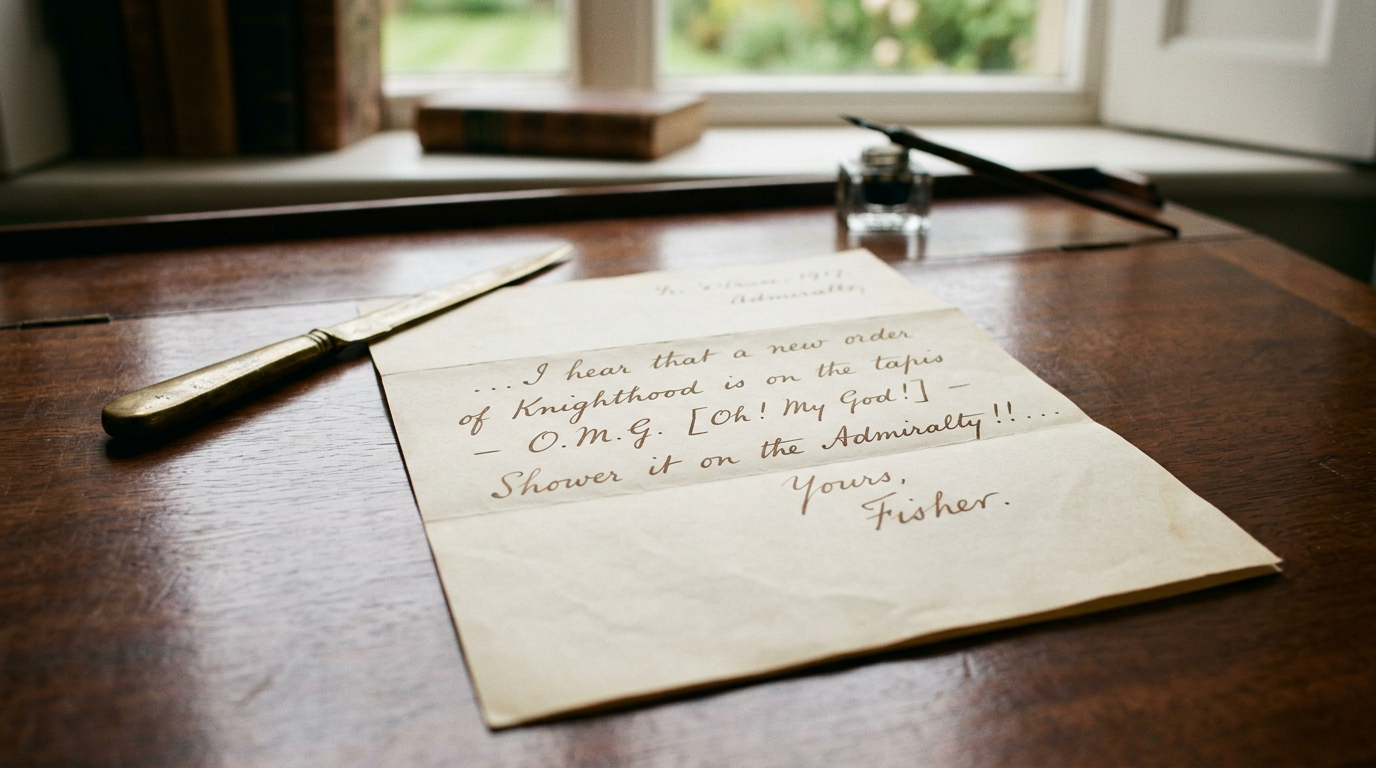
The first known use of 'OMG' for 'Oh My God' dates back to 1917, in a letter from Admiral Fisher to Winston Churchill. It's surprising because we associate 'OMG' with modern texting, but this shows people have been using such abbreviations for strong reactions for over a century, even in formal correspondence.
In a hurry? TL;DR
- 1The first recorded use of 'OMG' (Oh My God) was in a 1917 letter from Admiral John Arbuthnot Fisher to Winston Churchill.
- 2Fisher used 'OMG' satirically to criticize naval honors and newspaper headlines, not as modern digital slang.
- 3This discovery shows acronyms existed for linguistic efficiency and informal flair long before the internet.
- 4Fisher's 'OMG' was a 'linguistic fossil,' existing in isolation before widespread adoption decades later.
- 5The use of 'OMG' highlights that satire and criticism can be primary drivers of new language.
- 6'OMG' was officially added to the Oxford English Dictionary in 2011, acknowledging its modern prevalence.
Why It Matters
It's surprising that the ubiquitous internet slang 'OMG' was actually coined by a British Admiral in 1917 in a letter to Winston Churchill.
The first recorded use of the acronym OMG was not in a 1990s chatroom, but in a 1917 letter from British Admiral John Arbuthnot Fisher to Winston Churchill. While we associate the term with digital slang, its origins are firmly rooted in the high-stakes naval politics of the First World War.
Key Facts: The Birth of OMG
- Year: 1917
- Author: Admiral John Arbuthnot Fisher
- Recipient: Winston Churchill
- Original context: A letter regarding naval honours and newspaper headlines
- Modern popularity: Added to the Oxford English Dictionary in 2011
Why It Matters: This discovery shatters the assumption that acronym culture is a byproduct of the internet, proving that linguistic efficiency has always been a trait of eccentric thinkers.
The Admiral and the Politician
On 9 September 1917, the 76-year-old retired Admiral of the Fleet, Lord Fisher, sent a characteristically fiery letter to Winston Churchill. Fisher was known for his frantic, colourful writing style, often peppering his correspondence with multiple exclamation marks and underlined phrases.
In the letter, Fisher expressed his distaste for certain naval promotions and headlines, writing: I hear that a new order of Knighthood is on the tapis—O.M.G. (Oh! My God!)—Shower it on the Admiralty!
Fisher was mocking the proliferation of bureaucratic titles, specifically the newly created Order of the British Empire (OBE). By inventing a satirical title, he inadvertently birthed the most ubiquitous phrase of the digital age.
Linguistic Efficiency Before the Keyboard
Contrary to popular belief, acronyms were not invented to save thumb movements on a smartphone. Research published by the Oxford English Dictionary (OED) suggests that early 20th-century writers used abbreviations to convey a sense of urgency or informal flair.
Fisher’s use of OMG was an outlier for its time. Unlike other shorthand like RSVP or PhD, which derive from formal Latin or French, OMG was purely conversational. The OED senior editor Bernadette Paton noted that the acronym likely stayed dormant in private correspondence for decades before resurfacing in the late 20th century.
Real-World Implications
The Fisher letter forces a rethink of how language evolves. It suggests that:
- Satire is a primary driver: New words often start as jokes or criticisms of existing structures.
- Personality dictates style: Creative, high-energy individuals like Fisher often bypass standard grammar to match the speed of their thoughts.
- Technology is a catalyst, not a creator: The internet did not invent shorthand; it simply provided the infrastructure for it to scale.
Did Churchill use the phrase back?
There is no record of Churchill adopting the acronym in his replies. While Churchill was a master of the English language, he generally preferred expansive oratory over Fisher’s punchy shorthand.
Was it common in the 1910s?
No. Fisher’s use was an isolated incident. The acronym did not enter general public consciousness until the 1980s and 1990s with the rise of Usenet and SMS messaging.
Are there other early acronyms like this?
Yes. The term OK dates back to 1839, originating as a joke misspelling of all correct (oll korrect) in a Boston newspaper.
Key Takeaways
- Origin: 1917 letter from Lord Fisher to Winston Churchill.
- Intent: A satirical jab at British naval honours.
- Revival: The phrase lay dormant for nearly a century before becoming a digital staple.
- Significance: Proves that modern slang often has deep, aristocratic roots.
Fisher ended his life as a hero of the British Empire, but his most enduring legacy isn't a battleship—it is a three-letter sequence used millions of times a day to react to everything from celebrity gossip to morning coffee.
Frequently Asked Questions
Sources & References
- 1Oxford English DictionaryThis source confirms that the earliest known use of 'OMG' (Oh! My God!) was in a letter dated 1917 from Lord Fisher to Winston Churchill, and was added to the OED in 2011.oed.com
 Encyclopaedia BritannicaThis source states that the acronym 'OMG' first appeared in a letter written in 1917 by John Arbuthnot Fisher to Winston Churchill, long before its widespread use online.britannica.com