
Quick Answer
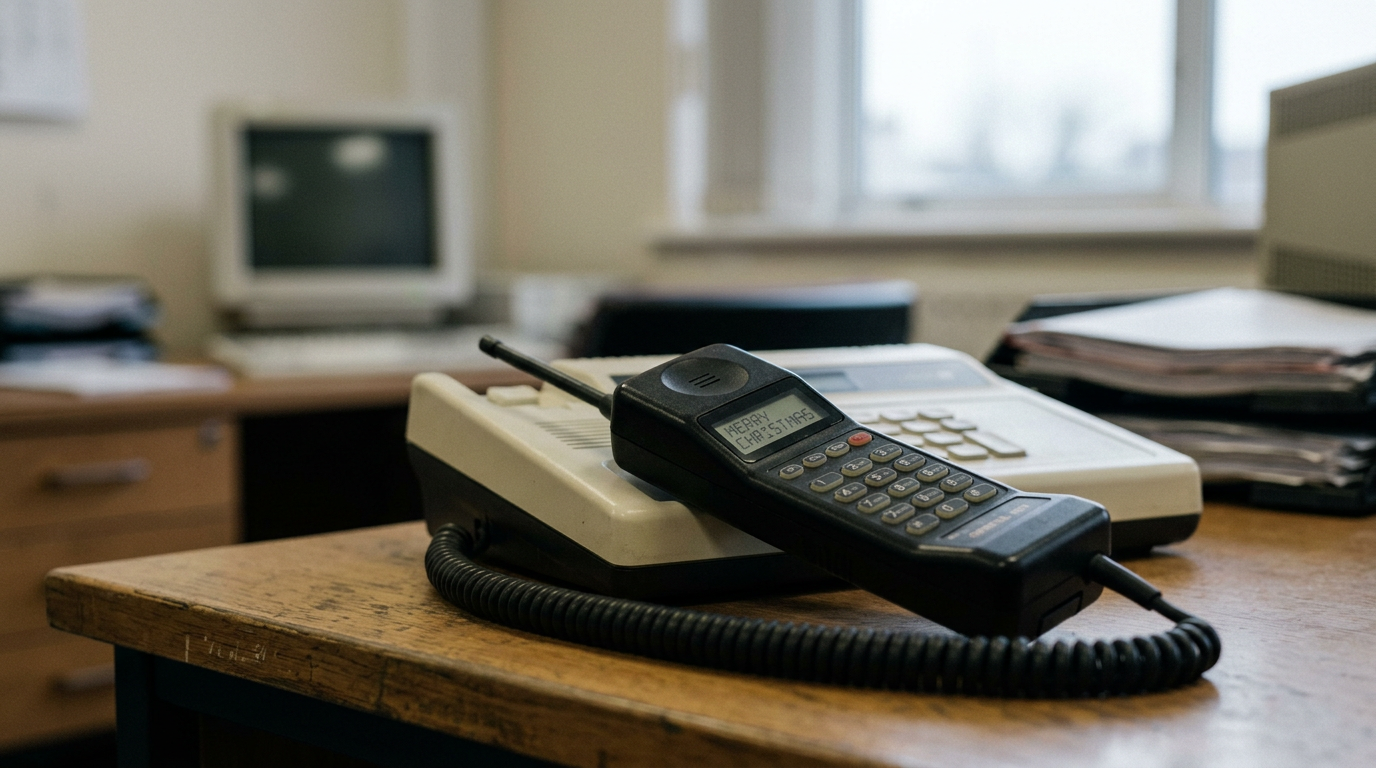
The very first text message ever sent said "Merry Christmas" and was sent to a colleague in 1992. It's pretty amazing to think that this simple 15-character greeting, sent by a software engineer from a computer, kicked off the text-messaging revolution that so many of us use every day.
In a hurry? TL;DR
- 1The first SMS, 'Merry Christmas', was sent from a computer to a mobile phone in 1992.
- 2Early SMS was limited to 160 characters, a decision based on linguistic research and network capacity.
- 3Mobile keyboards didn't exist initially; messages were typed on computers and sent to then-large phones.
- 4Prepaid plans and T9 predictive text in the late 90s fueled the explosive growth of SMS usage.
- 5SMS enabled asynchronous communication, shifting mobile phones from luxury items to communication hubs.
- 6The impact of that first text message is still evident in all modern digital communication platforms.
Why It Matters
It's interesting that the first text message was a festive greeting rather than a dramatic announcement, completely by accident starting a communication revolution.
On 3 December 1992, software engineer Neil Papworth sent the world’s first Short Message Service (SMS) from a computer to a mobile phone. The message read simply: Merry Christmas.
The First Message: Key Figures
- Date: 3 December 1992
- Sender: Neil Papworth (Sema Group)
- Recipient: Richard Jarvis (Vodafone)
- Device (Send): Orbitel 901 desk-side computer
- Device (Receive): Orbitel 901 mobile phone
- Character Count: 15
Why It Matters: This fifteen-character greeting transformed mobile phones from portable luxury landlines into the primary communication hubs for the modern era.
The Accidental Revolution
The first text was not sent from a palm-sized device, nor was it sent by a teenager. Neil Papworth, a 22-year-old developer working for the Sema Group, was part of a team developing a Short Message Service Centre for Vodafone.
At the time, mobile handsets did not have keyboards. To test the system, Papworth had to type the message on a computer and send it to the briefcase-sized Orbitel 901 of Vodafone director Richard Jarvis. Jarvis was attending a staff Christmas party when the message arrived, effectively launching the digital messaging age during a festive drinks reception.
160 Characters: The Constraints of the Medium
The standard 160-character limit that defined early mobile culture was not an arbitrary technical bug. It was a calculated decision based on the linguistic research of Friedhelm Hillebrand.
Hillebrand, a German engineer, sat at his typewriter and composed random sentences and questions. He discovered that the vast majority of human thoughts, greetings, and queries could be expressed in fewer than 160 characters. This became the standard for the Global System for Mobile Communications (GSM) because it could fit within the spare signaling capacity of existing networks.
The Rise of T9 and Thumb Culture
For years after Papworth’s message, texting remained a niche utility. It was the introduction of prepaid plans and the T9 predictive text system in the late 1990s that catalysed the boom. Unlike the instant gratification of a phone call, SMS allowed for asynchronous communication—the ability to leave a digital note without the pressure of an immediate response.
According to data from the ITU, the volume of SMS sent globally peaked around 2012, before the mass adoption of internet-based messaging apps like WhatsApp. However, the legacy of that first 1992 transmission remains in the DNA of every tweet, Slack message, and notification we receive today.
Practical Applications
- Marketing: SMS remains one of the most effective direct-to-consumer tools, with open rates drastically higher than email.
- Authentication: Two-factor authentication (2FA) via text is the most widely used security layer for banking and digital accounts.
- Emergency Services: Text-to-911 services allow individuals in volatile situations to contact emergency responders without making a sound.
Interesting Connections
- Mnemonic Etymology: The term texting entered the dictionary as a verb in the late 90s, replacing the more formal phrase sending an SMS.
- Cultural Shift: The 160-character limit gave birth to text speak (u, r, lol), a linguistic evolution that linguists initially feared would ruin language, but now view as a distinct dialect.
- Digital Auction: In 2021, a digital replica of the first Merry Christmas text was auctioned as an NFT for over 100,000 euros, with proceeds donated to charity.
Who sent the first text?
Neil Papworth, a British engineer, sent the first message on 3 December 1992. He was 22 years old at the time.
Why did it say Merry Christmas?
The message was a festive greeting sent to Richard Jarvis, who was attending a corporate holiday party.
When did texting become popular?
Texting took nearly a decade to go mainstream. It was not until the early 2000s, when networks allowed users to text people on different carriers, that usage exploded.
What was the first phone to have a keyboard?
The Nokia 9000 Communicator, released in 1996, was one of the first mobile devices to feature a full QWERTY keyboard, making texting significantly easier.
Key Takeaways
- Accidental Success: SMS was designed for engineers, not the general public.
- Concise Design: The 160-character limit was based on the average length of postcards and telegrams.
- Enduring Legacy: Despite the rise of data-rich apps, the simplicity of the 1992 protocol remains a cornerstone of global communication.