
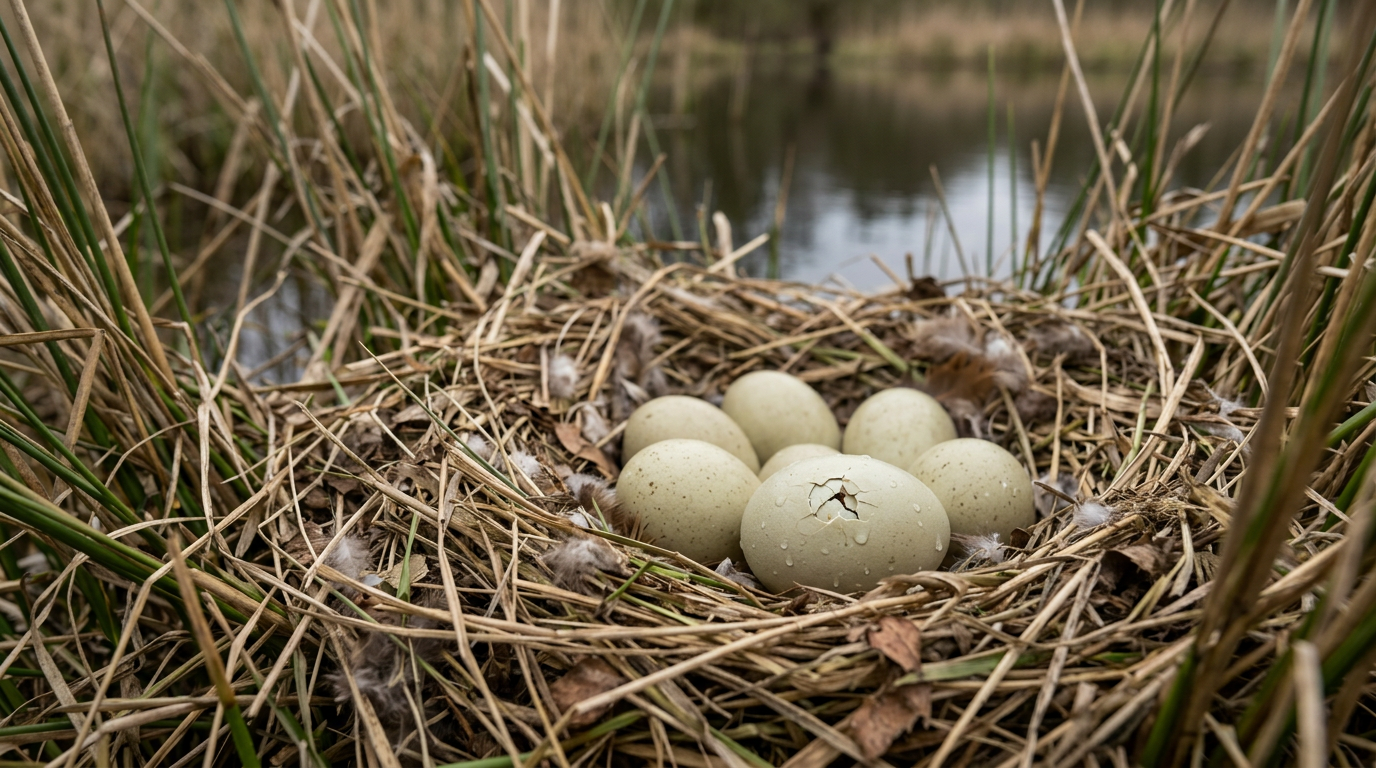
Quick Answer
Remarkably, ducklings communicate before hatching by clicking and tapping inside their eggs. This coordination helps them hatch simultaneously. Why does this matter? It allows the brood to enter the water as a unified group. This collective movement offers crucial protection against predators, giving the young ducklings a better chance of survival.
In a hurry? TL;DR
- 1Ducklings coordinate hatching through internal clicking and tapping sounds, starting 24-48 hours before hatching.
- 2This prenatal communication ensures siblings hatch simultaneously, creating a unified brood for survival.
- 3More developed embryos accelerate slower siblings' metabolism with rhythmic clicks, while slower ones signal to prevent early hatching.
- 4This synchronized hatching is a survival strategy for precocial birds, crucial for escaping predation.
- 5Research indicates some waterfowl clutches can hatch within a two-hour window due to this communication.
- 6The clicking is a byproduct of accelerated breathing, not the beak hitting the shell.
Why It Matters
It's surprising that ducklings can "phone home" from inside their eggs to synchronise their hatching, which helps the whole brood survive.
Ducklings engage in a sophisticated dialogue before they even take their first breath of air. By clicking and tapping through their shells, siblings communicate to ensure they hatch simultaneously.
The Shell Phone: A Precise Biological Sync
Ducklings use vocalisation and rhythmic clicking to coordinate their entry into the world. This synchronisation is not a fluke of biology but a survival strategy designed to ensure no bird is left behind when the mother departs for the water.
Quick Facts
- Species: Mallards and Wood Ducks are primary exponents
- Mechanism: Clicking sounds produced by the duckling respiratory system
- Timeframe: Coordination begins roughly 24 to 48 hours before hatching
- Benefit: Reduces predation risk by ensuring the brood moves as a unit
- Comparison: Unlike megapodes (mound-builders) which hatch alone and scramble, ducks are highly social from day zero
The Discovery of the Click
In the late 1960s, Margaret Vince, a researcher at Cambridge University, pioneered the study of avian prenatal communication. While investigating the development of the nervous system, Vince noticed something peculiar about the timing of hatching in Bobwhite quail and various duck species.
Vince observed that eggs placed in physical contact with one another hatched within a much tighter window than those kept in isolation. When eggs were separated, the hatching was staggered over several days. When they touched, the process was compressed into a few hours.
Further experimentation revealed that the more advanced embryos were actually speeding up the metabolism of their slower siblings. They achieved this through a series of rhythmic clicks, which acted as a biological metronome.
How the Dialogue Works
The process begins when a duckling enters the internal pipping phase. This is when they break into the air cell at the blunt end of the egg and start breathing air for the first time.
These signals serve two primary functions:
- Acceleration: More developed embryos emit clicks that stimulate the slower-developing siblings to increase their metabolic rate.
- Retardation: Slower embryos produce their own signals to keep the leaders from moving too far ahead, ensuring a cohesive exit.
This provides a distinct evolutionary advantage. In the wild, a mother duck cannot wait around for days while her eggs hatch one by one. Vulnerable to foxes and raptors, the brood must move toward the safety of the water almost immediately.
Practical Applications and Evolutionary Logic
Evolution has fine-tuned this auditory link specifically for precocial birds. These are species that are relatively mature and mobile from the moment of birth.
- Predator Avoidance: A group of twelve ducklings is easier for a mother to protect than twelve individual ducklings hatching at different times.
- Energy Conservation: Synchronised hatching allows the mother to maintain a predictable brooding schedule, ensuring all offspring receive warmth and guidance at the same time.
- Neural Development: The ability to process sound signals while still in the egg suggests that avian brains are far more developed at the embryonic stage than previously thought.
Interesting Connections
The concept of prenatal communication extends beyond ducks. Research published in the journal Nature Ecology & Evolution indicates that zebra finch parents sing to their embryos when temperatures are high, which triggers the chicks to adjust their growth rates to suit a warmer climate.
- Terminology: The first hole made in an egg is called the pip.
- Etymology: The word duckling dates back to the 15th century, using the diminutive ling to denote a young or small version of the animal.
- Cultural Reference: The Ugly Duckling by Hans Christian Andersen hinges on the idea of being different, but in nature, being different from the group timing would likely result in being left behind.
Do all birds communicate in the egg?
No. Songbirds, which are born blind and helpless, generally do not exhibit the same level of coordinated hatching. It is primarily a trait of ground-nesting, precocial birds like ducks, geese, and quail.
What happens if an egg is kept in isolation?
Studies show that isolated eggs often hatch much later than those kept in a clutch. Without the auditory stimulation of their siblings, the embryo follows its own internal clock rather than the accelerated group pace.
Can humans hear the clicking?
Yes. If you place a late-stage duck egg near your ear, you can often hear a distinct clicking or tapping sound. This is the chick communicating its readiness to move.
Key Takeaways
- Survival is a team sport: Ducklings rely on their siblings for the best chance of survival before they even see the sun.
- Acoustic stimulation: The clicking sounds act as a metabolic trigger for slower embryos.
- Minimal lag: This communication allows an entire brood to hatch within hours rather than days.
- Evolutionary pressure: The need to escape ground predators drove the development of this sophisticated prenatal dialogue.
Being part of the group is the first lesson a duckling learns, and it learns it in the dark.
Frequently Asked Questions
Sources & References
- 1Phys.orgThis source details how duck and chick embryos communicate from within their eggs to coordinate hatching, offering a survival advantage.phys.org
- 2The Cornell Lab of Ornithology All About BirdsThis article mentions the synchronized hatching of ducklings as an exception to staggered hatching in some birds, referencing the communication within eggs.allaboutbirds.org