
Quick Answer
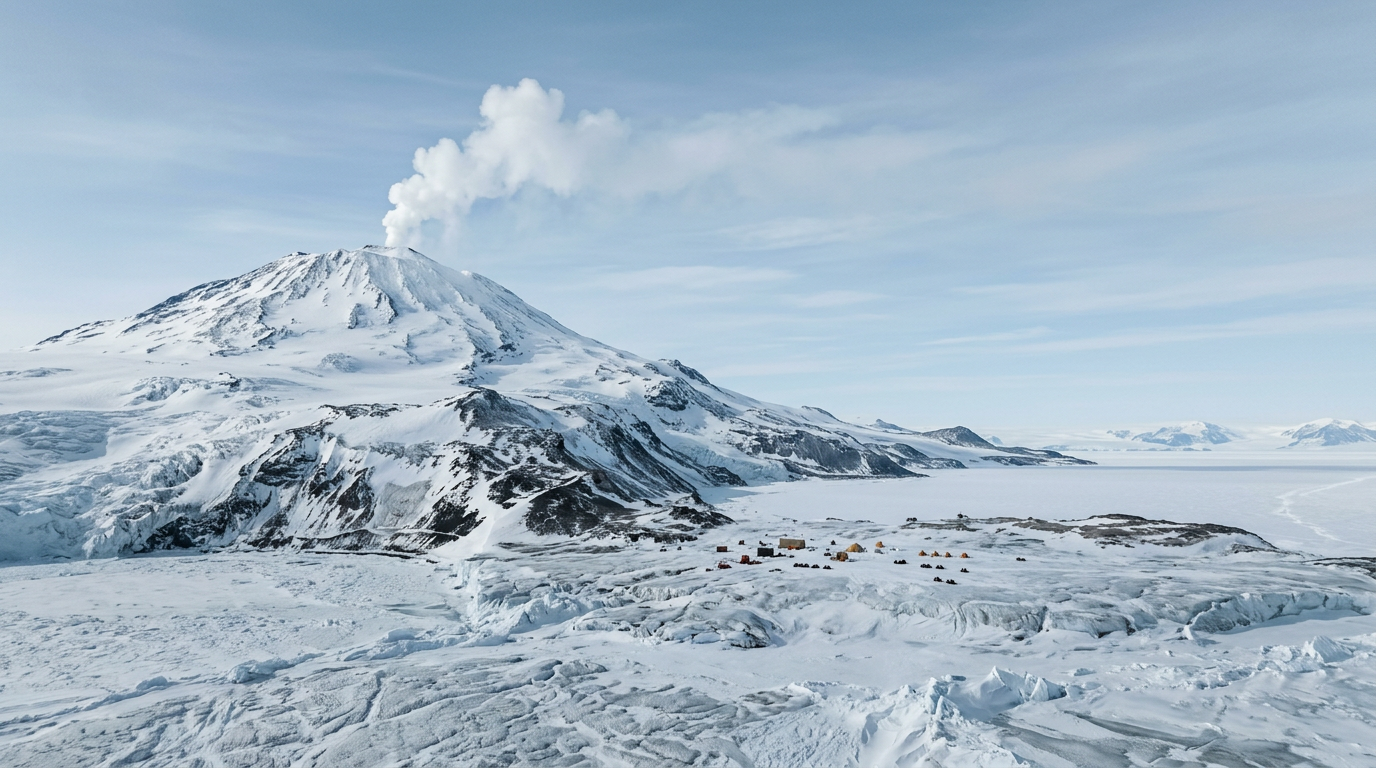
Antarctica's Mount Erebus spits gold dust into the air. This remarkable volcano releases microscopic gold particles through its volcanic gases. It's an astonishing reminder of how unexpectedly precious metals can ascend from the Earth's core, becoming airborne and dispersed by nature's powerful forces.
In a hurry? TL;DR
- 1Mount Erebus in Antarctica daily releases approx. 80 grams of crystallised gold particles into the atmosphere.
- 2These microscopic gold fragments are carried by volcanic gas and can travel up to 600 miles from the crater.
- 3The gold is released as tiny crystalline flakes, not nuggets, when hot volcanic gas meets frigid Antarctic air.
- 4While valuable, the dispersed nature and extreme environment make recovering this gold economically unfeasible.
- 5This phenomenon challenges scientific understanding of how precious metals move from Earth's interior to its surface.
- 6Mount Erebus is unique for its persistent lava lake, enabling continuous degassing of gold.
Why It Matters
It's surprising that Antarctica's Mount Erebus constantly releases nearly £6,000 worth of gold dust into the atmosphere daily.
Mount Erebus, the southernmost active volcano on Earth, emits roughly 80 grams of crystallised gold into the atmosphere every day. These microscopic fragments drift through the Antarctic air, reaching as far as 600 miles away from the crater.
TL;DR
- Daily Output: Approximately 80 grams of gold particles
- Estimated Value: Roughly £5,000 to £6,000 per day
- Particle Size: Between 0.1 and 20 micrometres in diameter
- Range: Traces found in air samples 1,000 kilometres away
Why It Matters
This rare geological phenomenon turns a lethal volcanic plume into a literal treasure map, challenging our understanding of how precious metals move from the Earth's core to the surface.
Vital Statistics: Mount Erebus
| Metric | Detail |
|---|---|
| Elevation | 3,794 metres (12,448 feet) |
| Location | Ross Island, Antarctica |
| Discovery Year | 1841 by Sir James Clark Ross |
| Gold Export | Roughly 6,000 USD worth daily |
| Known Status | Southernmost active volcano on Earth |
The Golden Breath of Erebus
Mount Erebus is a geological anomaly. Unlike most volcanoes that erupt violently and then go dormant, Erebus has maintained a persistent, open lava lake since at least 1972. It is this constant state of low-level activity that allows it to produce its most famous export: gold.
The gold is not being spat out in nuggets. Instead, it is released within the volcanic gas. As the hot gas hits the frigid Antarctic air, it undergoes a chemical change that causes the gold to crystallise into tiny metallic flakes. These particles are incredibly small, ranging from 0.1 to 20 micrometres in volcanic dust and up to 60 micrometres in the surrounding snow.
Evidence from the Ice
Researchers from the New Mexico Institute of Mining and Technology first identified these gold particles during an expedition in the late 20th century. According to studies published in the journal Nature, the gold particles are likely transported via the volcano’s gas plumes, which are rich in chlorine and sulphur.
Unlike other volcanic systems where precious metals remain trapped in the cooling magma or are lost in massive, infrequent explosions, the steady degasification of Erebus creates a consistent conveyor belt for the metal. In contrast to most volcanic sites where miners must dig through rock, Erebus simply exhales its wealth into the wind.
The Cold Reality of Recovery
The idea of an Antarctic gold rush is tempered by the sheer brutality of the environment. Mount Erebus sits on Ross Island, where temperatures frequently drop below minus 50 degrees Celsius.
The gold is invisible to the naked eye. To even find it, scientists must filter thousands of litres of air or melt down massive quantities of snow. Even then, the particles are so fine they resemble smoke more than jewellery.
Real-World Implications
The study of Erebus is not about get-rich-quick schemes; it is about planetary history.
- Resource Mapping: Understanding how gold reaches the surface helps geologists locate land-based deposits.
- Atmospheric Science: Tracking the gold dust helps researchers understand how air currents move across Antarctica.
- Extraterrestrial Comparison: Erebus is often used as a stand-in for volcanic activity on Jupiter’s moon, Io.
Key Takeaways
- Natural Alchemy: Mount Erebus creates gold through the rapid cooling of volcanic gases.
- Rare Chemistry: It is one of the few places on Earth with a persistent phonolitic lava lake.
- Global Reach: Microscopic gold from the volcano travels hundreds of miles across the Antarctic ice.
- Scientific Value: It serves as a natural laboratory for studying how minerals move through the Earth’s crust.
It is a reminder that the world’s most hostile environments are often its most extraordinary. Antarctica might be a desert of ice, but it is one that breathes gold.
