
Quick Answer
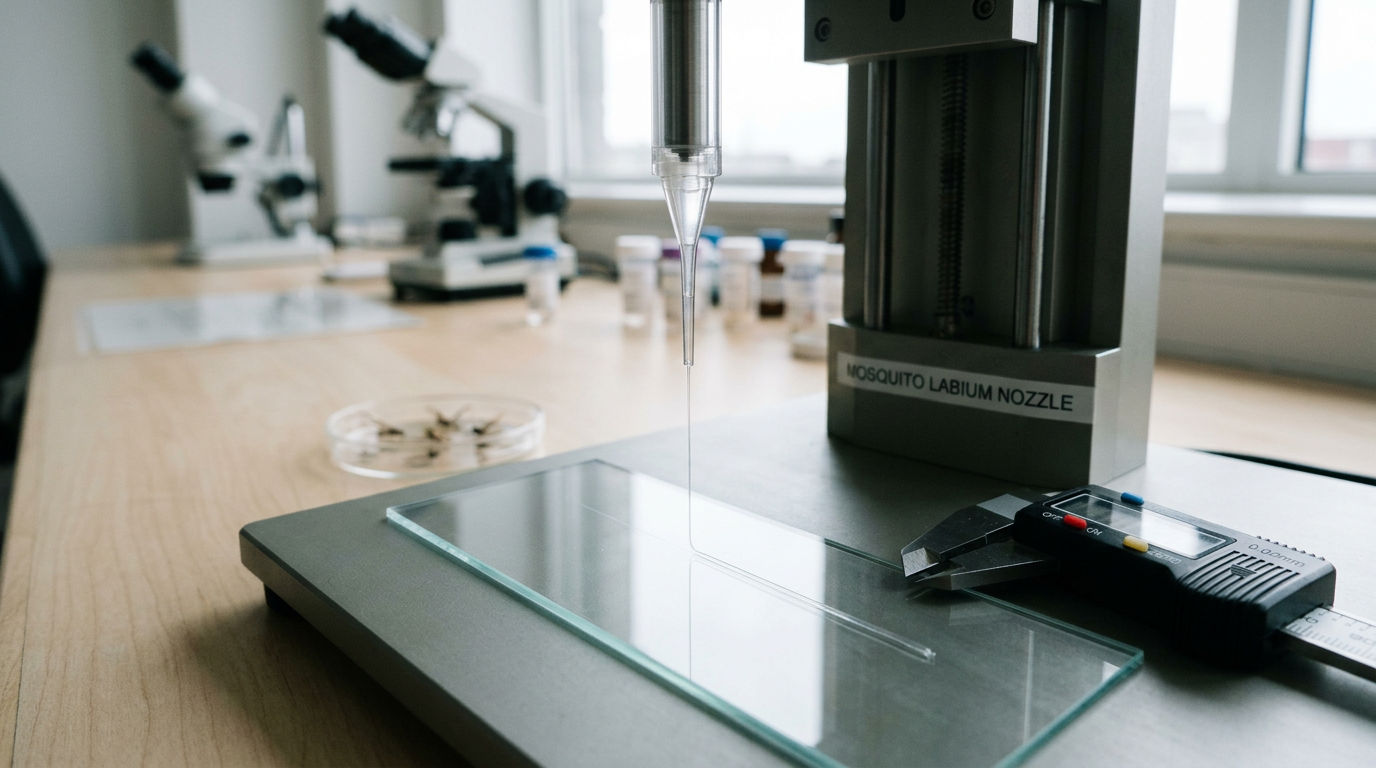
Necroprinting is a 3D printing technique using a dead mosquito's mouthpart as a microscopic nozzle. This allows for incredibly fine prints, just 20 micrometres wide. It's fascinating because scientists are repurposing nature's own precision engineering, a mosquito's proboscis, to create advanced technology instead of developing complex artificial nozzles.
In a hurry? TL;DR
- 1Repurpose dead mosquito mouthparts (labia) as ultra-fine 3D printing nozzles for precise micro-fabrication.
- 2Achieve print line widths as small as 20 micrometres, significantly finer than standard 3D printers.
- 3Utilize the natural, resilient structure of mosquito mouthparts to overcome limitations of synthetic micro-nozzles.
- 4Print with conductive inks and hydrogels, enabling applications in microelectronics and bio-scaffolding.
- 5This low-cost, biodegradable technique offers a sustainable alternative to expensive industrial micro-fabrication methods.
Why It Matters
It's fascinating that scientists are repurposing dead mosquito mouthparts as ultra-precise nozzles for 3D printing.
Necroprinting is a high-precision 3-D printing method that repurposes the labium of a deceased mosquito as a natural nozzle to extrude materials at a microscopic scale. This bio-hybrid approach allows researchers to print lines as narrow as 20 micrometres, roughly one-quarter the width of a human hair.
Key Facts and Figures
- Precision: 20-micrometre line width
- Primary Organ: Mosquito labium (mouthpart)
- Originating Institution: Rice University
- Lead Researchers: Daniel Preston and Faye Yap
- Material Compatibility: Conductive inks and hydrogels
- Field: Necrobotics
Why It Matters
This technique represents a shift from building complex synthetic tools to repurposing the intricate, high-performance biological structures already perfected by evolution. Using a mosquito's proboscis solves the engineering challenge of creating ultra-fine nozzles that do not clog or break under pressure.
The Birth of Necrobotics
The concept of necroprinting emerged from the Soft Robotics Control Lab at Rice University. In 2022, the team gained international attention for necrobotics when they converted dead spiders into mechanical grippers.
The mosquito project, led by Professor Daniel Preston and graduate student Faye Yap, takes this a step further. Instead of using a carcass as a mechanical tool, they use it as a fluid delivery system.
Traditional 3-D printing nozzles face a physical wall when they get too small. They are difficult to manufacture, expensive, and prone to catastrophic failure. Nature, however, has already solved micro-fluidic delivery.
How the Process Works
To create a necroprinter, researchers extract the labium from a dead mosquito. This organ is naturally designed to penetrate skin and transport fluids with extreme precision.
The labium is attached to a syringe pump system. By applying controlled pressure, the researchers can push conductive silver ink or bioactive scaffolds through the biological nozzle onto a substrate.
Unlike synthetic glass capillaries, which are brittle, the mosquito's mouthpart is flexible and resilient. It can withstand the mechanical stresses of high-speed printing without the structural fatigue seen in needle-thin glass or metal tips.
Comparative Performance
Compared to traditional aerosol jet printing or lithography, necroprinting is strikingly low-cost. While industrial micro-fabrication machines can cost hundreds of thousands of pounds, a mosquito nozzle is essentially free and biodegradable.
Research published in the journal Advanced Materials underscores that these bio-nozzles maintain their structural integrity through multiple printing cycles. They offer a level of precision usually reserved for high-end semiconductor manufacturing labs.
Real-World Applications
- Micro-Electronics: Printing ultra-fine circuits on flexible surfaces for wearable technology.
- Tissue Engineering: Depositing cells and hydrogels with enough precision to mimic the structure of human capillaries.
- Biosensors: Creating highly sensitive tracking devices that require microscopic conductive pathways.
- Rapid Prototyping: Allowing researchers to test micro-fluidic designs without ordering custom-tooled synthetic nozzles.
Is the mosquito alive during the process?
No. The process strictly uses deceased specimens. The mechanical properties of the mouthpart remain functional even after the organism has died.
Does the nozzle clog easily?
The labium is naturally coated with proteins that facilitate fluid flow, making it surprisingly resistant to the clogging issues that plague synthetic micro-nozzles.
Are there other insects being used?
While the mosquito is the current focus for fluid delivery, other insects like bees and spiders are being studied for their unique structural properties in grip and sensory perception.
Future Implications
The success of necroprinting suggests a future where lab equipment is grown rather than machined. As we look for more sustainable manufacturing methods, the intersection of entomology and engineering provides a blueprint for high-tech production with a low carbon footprint.
By turning a pest into a high-precision tool, scientists have flipped the script on how we view biological waste. The smallest irritant in the backyard may soon be the most essential component in the next generation of micro-electronics.
Key Takeaways
- Definition: Necroprinting uses dead mosquito mouthparts as 3-D printing nozzles.
- Accuracy: It achieves line widths of 20 micrometres, far surpassing standard synthetic nozzles.
- Durability: Biological structures handle the stress of micro-fluidic delivery better than many man-made materials.
- Sustainability: This method reduces the need for expensive, energy-intensive manufacturing of micro-tools.
Frequently Asked Questions
Sources & References
- 1Journal of Sleep ResearchPresents the research article titled 'NecroPrinting: Biohybrid 3D Printing with Insect-Derived Microliter-Scale Nozzles' which details the methodology and results of using mosquito labia for ultra-fine 3D printing.onlinelibrary.wiley.com
- 2Rice UniversityProvides details about Rice University's development of 'necroprinting' using dead mosquitos as 3D printing nozzles, led by Daniel Preston and Faye Yap, capable of printing lines as thin as 20 micrometres.news.rice.edu