
Quick Answer
We're the only animals with a proper chin, that bony bit sticking out on our lower jaw. It's a bit of an evolutionary quirk, likely appearing by chance as our faces and jaws got smaller over time. It's rather interesting to think our unique chins might not have served any special purpose at all!
In a hurry? TL;DR
- 1Humans are the only animals with a distinct bony chin on their lower jaw.
- 2Even our closest relatives like chimpanzees and extinct Neanderthals lacked chins.
- 3The human chin is likely an evolutionary byproduct, not a functional adaptation.
- 4Scientists theorize chins arose as human faces and jaws shrank over millions of years.
- 5Face downsizing, due to changes in diet and tool use, led to the chin's prominence.
- 6The chin is a unique anatomical feature arising from the specific way our facial structure evolved.
Why It Matters
It's surprising that the human chin, a distinctive feature of our faces, appears to be an evolutionary accident with no actual biological purpose.
No other creature on the planet possesses a chin. While we often conflate the jawline with the chin, the true chin is a unique bony protrusion on the lower mandible exclusive to Homo sapiens.
Key Facts: The Human Chin
- Species with chins: 1 (Homo sapiens)
- Closest relatives without chins: Chimpanzees, Bonobos, Gorillas
- Extinct relatives without chins: Neanderthals, Homo erectus
- Primary theory: Facial downsizing rather than functional evolution
- Comparison: Even the Great Apes have a receding simian shelf instead of a forward-projecting chin
Why It Matters
Understanding the chin helps us map the weird, unintentional path of human evolution, proving that not every physical trait exists for a survival-based reason.
A Bone Without a Purpose
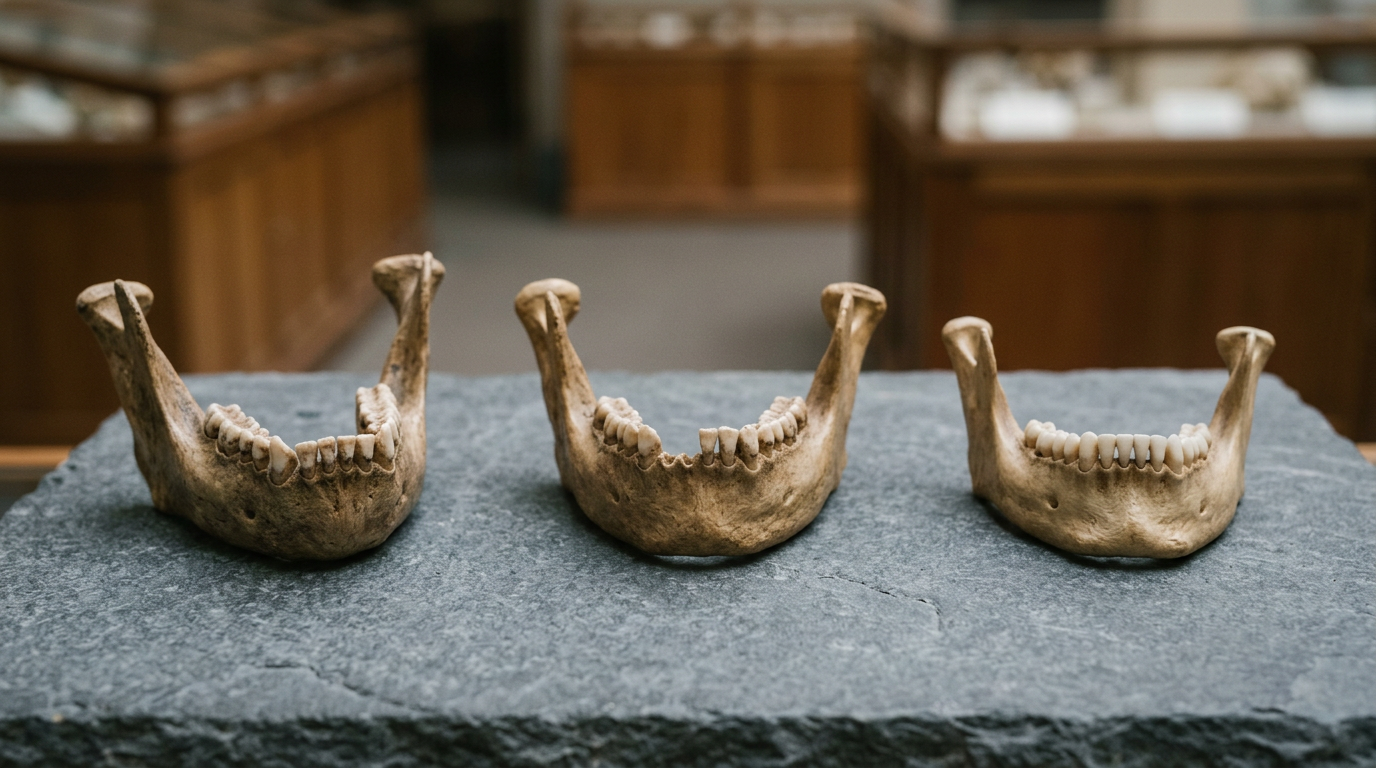
While we take the protrusion at the bottom of our faces for granted, it is an anatomical anomaly. If you look at a chimpanzee or a gorilla, their lower jaw slopes backward toward the neck. Even our closest extinct relatives, the Neanderthals, lacked this feature. Their jaws were massive and robust, yet they remained chinless.
The chin is not the jaw itself. It is a specific piece of thickened bone sitting on the lower front of the mandible. Humans are the only animals in the world to have it. Not dogs, not elephants, and certainly not other primates.
The Evolutionary Accident
For decades, biologists searched for a mechanical reason for the chin. Some argued it helped us chew by reinforcing the jaw against physical stress. Others suggested it helped us speak. However, research led by Dr Nathan Holton at the University of Iowa suggests these theories do not hold up.
According to Holton’s study published in the Journal of Anatomy, chins are actually less capable of resisting mechanical strain than the flat jaws of our ancestors. The research indicates that the chin is not a functional tool at all. Instead, it is likely a spandrel: a byproduct of other evolutionary changes.
As humans evolved, our faces became significantly smaller. We stopped using our teeth as tools and began cooking food, which required less chewing power. As our faces retracted and our jaws shrank, the bottom edge of the mandible remained prominent. We did not grow a chin so much as we lost the face around it.
The Shrinking Face
The transition occurred roughly 2 million years ago as Homo erectus began the trend toward smaller features. By the time anatomically modern humans appeared, the face had tucked itself under the braincase.
Unlike other primates, whose faces jut forward in a snout-like fashion, the human face is remarkably flat. This mechanical shift forced the jaw bone to redistribute. In contrast to the Neanderthal, who had a heavy brow and a receding jaw, the modern human has a flat forehead and a protruding chin.
Practical Implications of a Chinless Past
Understanding this helps palaeontologists identify human remains with absolute certainty. If a jawbone found in a cave lacks that mental protuberance, it is not a modern human.
This anatomical quirk also changes how we view sexual selection. While a prominent chin is often associated with masculinity today, the chin itself is a feature of a more delicate, feminised face compared to our robust ancestors. We find chins attractive not because they signify strength, but because they signify our humanity.
Do elephants have chins?
No. While an elephant has a protruding lower lip and jaw structure, it lacks the specific bony growth on the mandible that defines a true chin.
Did Neanderthals have chins?
No. Neanderthals had very large, powerful jaws, but they sloped backward. This is one of the primary skeletal differences used to distinguish Neanderthal remains from early modern humans.
Is a weak chin an evolutionary disadvantage?
Not in a biological sense. Since the chin serves no known mechanical or respiratory function, its size or prominence does not affect a person's physical survival.
Interesting Connections
- Etymology: The word chin comes from the Old English cin, related to the High German chinni.
- Cultural Reference: The term chin up as a display of fortitude relies on the uniquely human ability to lead with this specific bone.
- Forensics: The mental protuberance is often one of the first features checked by forensic anthropologists to determine if remains are human or animal.
Key Takeaways
- Humans are the only species with a true bony chin.
- It likely evolved because our faces shrank as we started cooking food.
- Researchers believe it is an accidental byproduct of evolution, not a functional tool.
- Even our closest ancestors, including Neanderthals, lacked this feature.
- The chin is one of the most reliable markers of Homo sapiens in the fossil record.
Our faces retreated, our teeth grew smaller, and we were left with a lonely point of bone that separates us from the entire animal kingdom.
Frequently Asked Questions
Sources & References
 The New York TimesThis article discusses the uniqueness of the human chin among all animal species and explores the scientific theories behind its existence.nytimes.com
- 2Journal of Sleep ResearchThis research paper proposes that the human chin is a consequence of facial reduction during evolution, rather than a direct adaptation for mechanical functions like chewing.onlinelibrary.wiley.com
 WikipediaThis Wikipedia entry provides a comprehensive overview of the human chin, including its anatomy, evolutionary theories, and the fact that it is unique to Homo sapiens.en.wikipedia.org