
Quick Answer
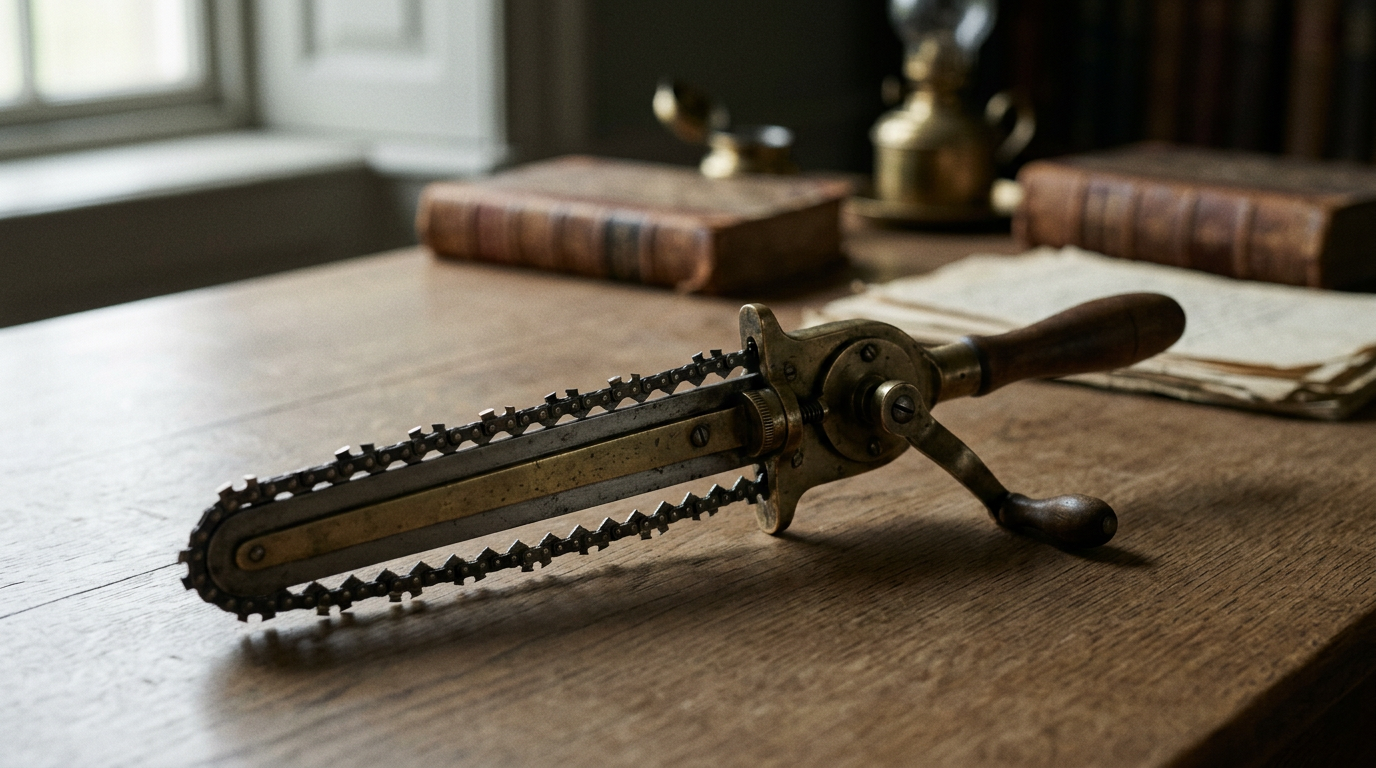
Believe it or not, the chainsaw was invented for childbirth! Early portable versions were used by medics to cut through bone and cartilage during difficult births, a far cry from their modern use in felling trees. This surprising origin highlights how inventions can evolve into entirely different, unexpected applications.
In a hurry? TL;DR
- 1The chainsaw was originally invented around 1785 by Scottish surgeons as the 'osteotome' for medical use.
- 2Its initial purpose was to surgically cut pelvic bone and cartilage during difficult childbirths to widen the birth canal.
- 3This early medical version was hand-cranked and much smaller than modern chainsaws.
- 4The procedure it aided, symphysiotomy, became less common with the rise of safer C-sections.
- 5The cutting mechanism was later adapted for forestry in the late 19th and early 20th centuries.
- 6Modern chainsaws evolved significantly from their medical origins, with petrol-powered versions appearing in the 1920s.
Why It Matters
It's surprising to learn that the chainsaw, now synonymous with forestry, was originally invented as a medical tool to assist in childbirth.
The modern chainsaw began its life in the labour ward, not the forest. Two Scottish surgeons invented the device in the late 18th century as a medical instrument designed to saw through pelvic bone during obstructed births.
Key Facts and Origins
- Date Invented: Circa 1783–1785
- Inventors: John Aitken and James Jeffray
- Original Name: Osteotome
- Mechanism: Hand-cranked chain with serrated teeth
- Primary Use: Symphysiotomy (widening the pelvis)
- Transition to Forestry: Late 19th century
The Surgical Birth of a Power Tool
Before the caesarean section became a safe, routine procedure, doctors faced a grim dilemma when a baby was stuck in the birth canal. The solution was often a symphysiotomy, a procedure that involved manually cutting through the cartilage and bone of the pelvic joint to create more space.
Until the 1780s, this was performed with a small knife, a process that was notoriously slow, imprecise, and excruciating for the patient. Scottish doctors John Aitken and James Jeffray sought a more efficient method to minimise trauma and time.
Their invention, the osteotome, featured a fine-toothed chain that moved along a guide. It was powered by a hand crank, allowing surgeons to cut through bone with a speed and accuracy that a traditional blade could never achieve.
From Bone to Bark
The device remained a staple of the surgical toolkit for nearly a century. However, as anaesthesia and improved hygiene made caesarean sections more survivable, the invasive symphysiotomy fell out of fashion.
The transition from flesh to wood happened when people realised that the same mechanical principle used to slice through human bone was exceptionally good at cutting through timber. In 1830, German orthopaedist Bernhard Heine refined the design, but it wasn't until the 1920s that the first petrol-powered, heavy-duty versions were patented for the logging industry.
Why It Matters Today
Understanding the medical origin of the chainsaw changes our perception of industrial history. It reminds us that some of our most rugged tools began as delicate, albeit terrifying, solutions to biological problems. According to researchers at the Royal College of Surgeons, the device was considered a significant leap forward in maternal health technology at the time, despite its modern reputation as a horror movie prop.
Practical Applications
- Medical History: The device serves as a case study in how surgical necessity drives mechanical innovation.
- Industrial Evolution: It demonstrates the concept of exaptation, where a tool designed for one purpose is co-opted for something entirely different.
- Engineering Design: The basic mechanical loop of the Aitken chainsaw remains the fundamental blueprint for every STIHL or Husqvarna on the market today.
Interesting Connections
- Etymology: The word surgeon comes from the Greek kheirourgos, meaning working with hands, a fitting origin for the inventors of the hand-cranked saw.
- Cultural Reference: The chainsaw became a horror icon in the 1970s, unaware that its true history was perhaps more visceral than the fiction.
- Related Technology: The same surgical precision that birthed the chainsaw eventually led to the development of the Gigli saw, a wire saw still used in neurosurgery today.
Why wasn't it used for wood immediately?
The manual version was too small and delicate for trees. It required the invention of the internal combustion engine to make the chainsaw a viable alternative to the axe.
Did it use petrol in the hospital?
No. The surgical chainsaw was strictly hand-powered. The inventor used a watch-like winding mechanism and a hand crank to rotate the chain.
Is the medical chainsaw still used?
Not in its original form. While variations of bone saws exist in orthopaedics, the specific chain-link design was phased out of hospitals by the early 20th century.
Key Takeaways
- Medical Roots: The chainsaw was a 1780s Scottish medical invention.
- Purpose: It was designed to cut the pelvic bone during difficult births.
- Evolution: It shrank the time needed for bone-cutting, reducing patient shock.
- Re-purposing: The design was scaled up for forestry nearly 100 years later.
- Modern Context: It remains one of the most successful examples of medical tech crossing over into the mainstream industrial world.
The next time you hear the roar of a chainsaw, remember its original audience wasn't a forest of pine, but a room full of medical students and a mother in distress. Progress, it seems, is frequently written in steel and bone.
Frequently Asked Questions
Sources & References
 History.comExplains that the chainsaw was invented by two Scottish doctors in the late 18th century for symphysiotomies during difficult childbirths.history.com
 WikipediaStates that the first chainsaw was invented around 1785 by two Scottish doctors, John Aitken and James Jeffray, for symphysiotomy procedures.en.wikipedia.org