
Quick Answer
Ancient Greeks invented a basic steam engine and a coin-operated vending machine over 2,000 years ago. Hero of Alexandria's ingenious designs, like the aeolipile, demonstrate surprisingly advanced technological understanding for the time. It challenges our modern view of history and highlights forgotten ancient innovations.
In a hurry? TL;DR
- 1Hero of Alexandria, living around 60 AD, invented the aeolipile, an early steam engine demonstrating reaction principles.
- 2He also created the first vending machine, a coin-operated dispenser for holy water in Egyptian temples.
- 3These ancient Greek inventions utilized pneumatic and hydraulic principles, appearing magical to their contemporaries.
- 4The aeolipile functioned like a basic steam turbine, with steam exiting nozzles to create rotational motion.
- 5The vending machine used a coin's weight to trigger a lever, opening a valve for a measured water release.
- 6Ancient Greece lacked an Industrial Revolution due to an economy reliant on slave labor, making labor-saving machines less attractive.
Why It Matters
It's surprising that ancient Greeks were dabbling with steam engines and vending machines over a thousand years before they became commonplace.
Ancient Greece possessed functional steam engines and coin-operated vending machines two millennia before the Industrial Revolution. Developed by the inventor Hero of Alexandria in the 1st century AD, these devices used pneumatic and hydraulic principles to automate tasks that seemed like magic to the ancient world.
Key Technical Specifications
- Inventor: Hero of Alexandria (also known as Heron)
- Primary Invention: The Aeolipile (Steam Engine)
- Secondary Invention: The Holy Water Dispenser (Vending Machine)
- Date of Origin: Circa 60 AD
- Mechanism: Thermal expansion and weight-based pivot systems
The Steam Engine of Alexandria
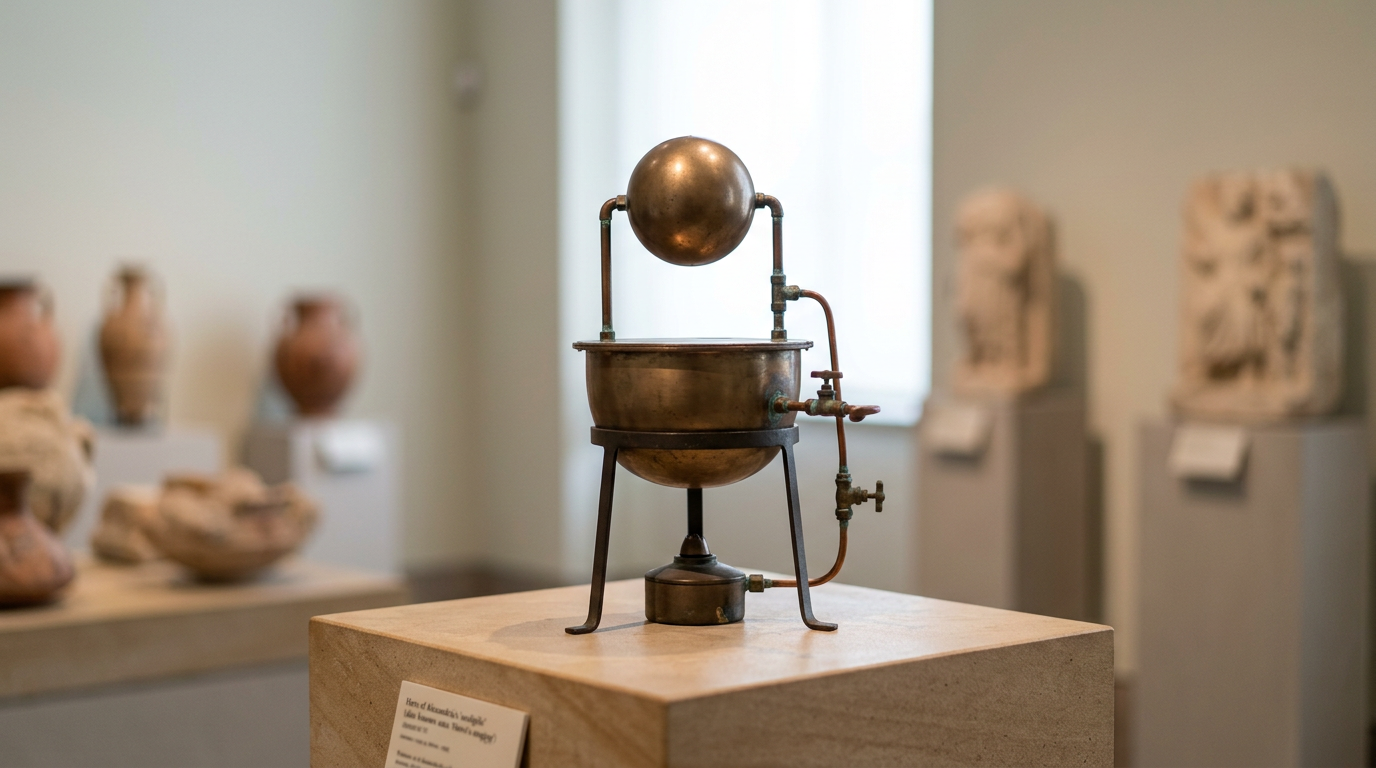
While we associate steam power with 18th-century coal mines, Hero of Alexandria described the aeolipile in his treatise Pneumatica nearly 2,000 years ago. It consisted of a sealed cauldron of water positioned over a fire.
Two pipes extended from the lid into a hollow sphere, which was equipped with two curved nozzles. As the water boiled, steam rose through the pipes and exited the nozzles, creating thrust that caused the sphere to spin at high speeds.
The First Vending Machine
The first vending machine was not designed for snacks, but for spiritual regulation. In Egyptian temples, worshippers often took more holy water than they had paid for. Hero solved this with a copper pot equipped with a slot.
When a five-drachma coin was dropped into the machine, it fell onto a small tray attached to a lever. The weight of the coin depressed the lever, which pulled open a valve and allowed a set amount of water to flow out. Once the coin slid off the tray, a counterweight snapped the valve shut.
Why the Industrial Revolution Didn't Happen in 60 AD
It is a common historical puzzle: if the Greeks had the steam engine, why did they not build locomotives or factories? According to historians at Stanford University, the primary barrier was the ancient economy.
In a society built on the backs of millions of enslaved people, there was little incentive to develop labour-saving machinery. Human muscle was cheaper and more readily available than the precision engineering required to scale Hero’s prototypes into industrial tools.
Practical Applications and Legacy
Hero’s inventions were not entirely frivolous. They were frequently used in religious and theatrical settings to create a sense of divine intervention.
- Temple Doors: Hero designed a system where a fire lit on an altar caused air to expand in a hidden sphere, eventually forcing water into a bucket that acted as a counterweight to pull open massive temple doors.
- Fire Safety: His dual-action piston pump became a blueprint for fire engines used in Rome to combat urban blazes.
- Theodolite: He created the dioptra, a surveying instrument that predates the modern transit and allowed for precise tunnel engineering.
Who was Hero of Alexandria?
He was a Greek engineer and mathematician, often called the greatest experimenter of antiquity. He taught at the Musaeum in Alexandria, which included the famous Great Library.
Did these machines actually work?
Yes. Modern reproductions based on Hero’s precise drawings in Pneumatica have successfully functioned using only the materials and tools available in the 1st century.
Did the Romans use his steam engine?
No. The Romans were excellent civil engineers but focused their efforts on aqueducts, roads, and concrete rather than mechanical automation.
Key Takeaways
- Ancient Innovation: The Greeks understood the principles of steam power and automation by the 1st century AD.
- Religion and Tech: The earliest vending machine was a tool for preventing the theft of holy water in temples.
- Economic Barriers: The prevalence of slavery meant there was no market for expensive mechanical labour.
- Lost Knowledge: Much of Hero’s work was lost to the West during the Middle Ages, only returning via Arabic translations during the Renaissance.
The aeolipile serves as a reminder that the gap between scientific discovery and practical application can sometimes span two thousand years.
Frequently Asked Questions
Sources & References
 BritannicaThe aeolipile, invented by Hero of Alexandria, was the first steam engine, functioning on the reaction principle of steam exiting nozzles to rotate a sphere.britannica.com
 WikipediaHero of Alexandria also invented the first vending machine, which dispensed holy water when a coin was inserted, as described in his work Pneumatica.en.wikipedia.org
- WikipediaHero of Alexandria was a Greek mathematician and engineer who invented the aeolipile and a coin-operated holy water dispenser around the 1st century AD.en.wikipedia.org