
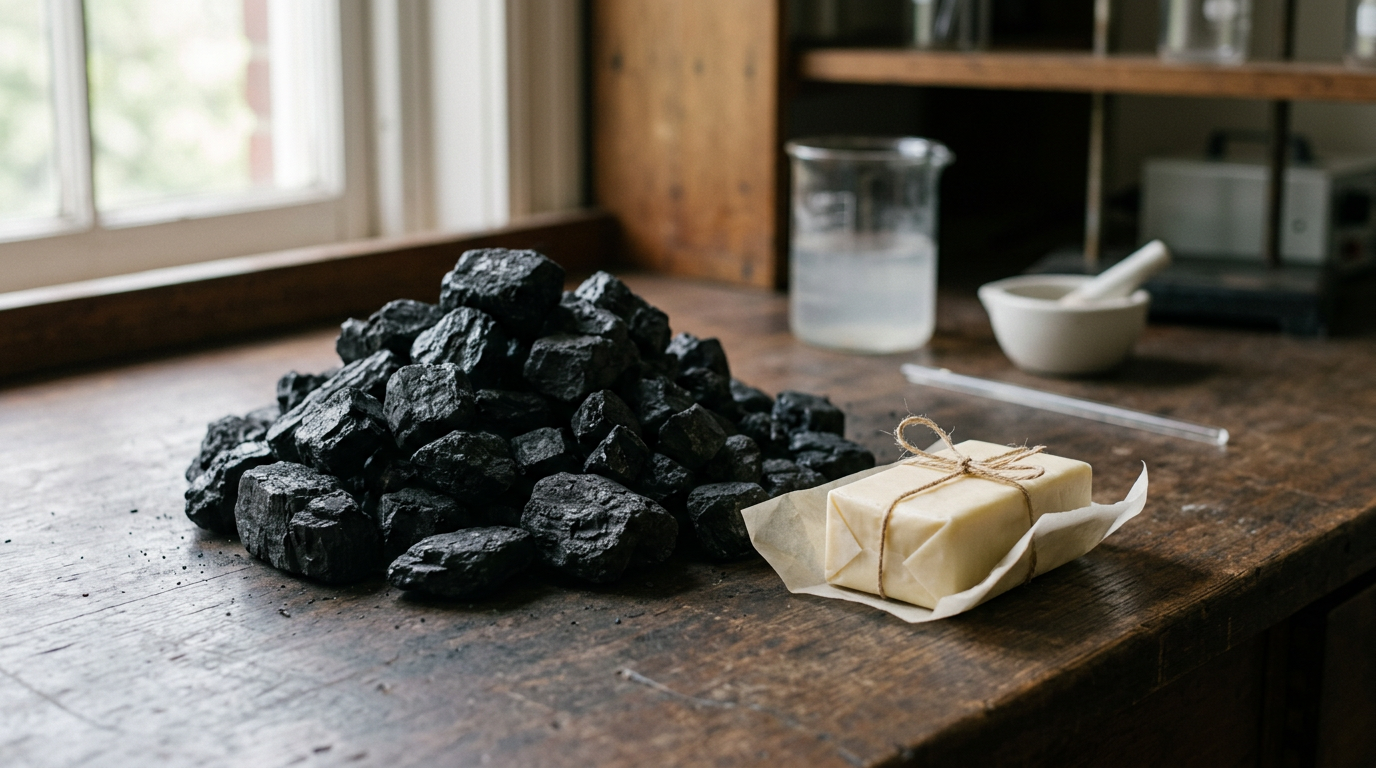
Quick Answer
A German chemist in the 1930s and 40s managed to make edible butter from coal. It sounds bizarre, but it shows how far people will go to find solutions when resources are scarce, even if it took an astonishing 60kg of coal to make just 1kg of butter!
In a hurry? TL;DR
- 1German chemist Arthur Imhausen created edible synthetic butter from coal-derived paraffin wax in the 1930s-1940s.
- 2Producing 1kg of this synthetic butter required a massive 60kg of coal, highlighting extreme self-sufficiency efforts.
- 3The process involved oxidising paraffin wax and adding colorant and scent to mimic butter, but taste was reportedly industrial.
- 4This 'ersatz' butter was a wartime necessity for Germany due to fat shortages and strategic liabilities from imports.
- 5The Imhausen-Chemie plant produced hundreds of tonnes monthly, primarily for military and industrial workers.
- 6Though a chemical feat, the high energy cost and later availability of cheaper oils made the technology obsolete post-war.
Why It Matters
It's surprising that during the 1930s, scientists in Germany were able to create edible butter entirely from coal.
In the mid-20th century, German chemist Arthur Imhausen successfully synthesised edible fat from paraffin wax derived from coal. This synthetic butter required roughly 60 kilograms of coal to yield a single kilogram of finished product.
Key Figures: The Coal-to-Butter Ratio
- Total Coal Required: 60 kilograms per 1 kilogram of butter
- Developer: Arthur Imhausen
- Primary Era: 1937 to 1945
- Base Material: Paraffin wax (Fischer-Tropsch byproduct)
- Production Peak: 600 tonnes per month
Why It Matters
This experiment represents the ultimate extreme of autarky—the pursuit of total national self-sufficiency through chemistry—proving that with enough energy and desperation, even the most basic human needs can be engineered from industrial waste.
The Chemistry of Ersatz
During the 1930s, Germany faced a critical shortage of fats and oils. With a blockade-prone geography and limited grazing land, the Third Reich looked to its most abundant resource: coal. Arthur Imhausen, based in Witten, realised that fatty acids could be synthesised by oxidising paraffin wax, a byproduct of the Fischer-Tropsch process used to create synthetic fuel.
The process was not a simple alchemy. It involved heating the coal derivatives, refining the resulting fatty acids, and then combining them with glycerine to create a triglyceride. To make it palatable, Imhausen added carotene for colour and a hint of diacetyl for a buttery scent.
Real-World Applications
- Military Rations: The synthetic fat was used as a shelf-stable ingredient in soldier rations, where its resistance to rancidity was an advantage over dairy.
- Industrial Baking: Because of its neutral (if slightly chemical) profile, it was used in mass-produced bread and biscuits.
- Soap Production: The fatty acids produced in the coal-to-butter pipeline were also diverted to create soap, freeing up natural oils for human consumption.
Was synthetic butter toxic?
No. Chemical analysis at the time and subsequent reviews by nutritional scientists verified that the synthetic triglycerides were fully digestible and non-toxic, though they lacked the Vitamin A and D found in natural dairy.
Why don't we eat coal butter today?
The 60:1 ratio makes it commercially disastrous. Compared to modern palm oil or soybean oil production, coal-based fats are vastly more expensive and environmentally taxing to produce.
Did people know they were eating coal?
Yes. The product was marketed transparently as a triumph of German science. It was frequently featured in propaganda films as proof that the nation could not be starved into submission.
Interesting Connections
- Fischer-Tropsch Process: The same chemical foundation used for coal butter is still used today by companies like Sasol to create synthetic fuels and chemicals.
- Margarine Evolution: While margarine was originally made from beef tallow and later vegetable oils, the coal butter experiment remains the only widespread use of mineral-based edible fat.
- Vitamin Fortification: Because coal butter was nutritionally hollow, chemists had to pioneer some of the first methods for mass-fortifying fats with synthetic vitamins.
Key Takeaways
- Resourcefulness: Arthur Imhausen proved that edible fats could be manufactured from inorganic minerals.
- Strategic Inefficiency: The process required a massive 60kg of coal for every 1kg of butter produced.
- The End of Ersatz: The technology vanished shortly after 1945 as global trade resumed and cheaper vegetable fats became available.
- Chemical Legacy: The experiment remains a landmark in organic chemistry, demonstrating the malleability of carbon chains.
Frequently Asked Questions
Sources & References
- 1Der SpiegelDetails the development of synthetic butter from coal by Arthur Imhausen, its use during World War II for military provisions, and its palatability.spiegel.de
- 2Journal of Positive PsychologyDiscusses the broader German wartime economy and the strategic importance of synthetic materials like fat from coal to achieve self-sufficiency.tandfonline.com