
Quick Answer
Air conditioning in 1903 stopped sweltering heat from dragging down stock market returns. Before AC, hot days meant lower profits. This is fascinating because it highlights how human comfort directly impacts financial markets. It's a real-world example of how environmental factors, and our reaction to them, can have a tangible economic effect.
In a hurry? TL;DR
- 1Installing air conditioning in 1903 on the NYSE floor eliminated the negative impact of hot weather on stock returns.
- 2Before AC, extreme heat caused trader fatigue and irritability, leading to lower stock market performance and returns.
- 3Overheated humans experience impaired cognitive function, affecting risk tolerance and decision-making in financial markets.
- 4The NYSE's 1903 cooling system, by engineer Alfred Wolff, made the trading environment weather-proof.
- 5Environmental factors like heat significantly alter an individual's risk profile, impacting economic outcomes.
- 6Modern non-AC markets still show a correlation between high temperatures and reduced stock returns.
Why It Matters
The introduction of air conditioning to the New York Stock Exchange in 1903 surprisingly demonstrates how extreme heat could previously drag down stock market performance by impairing traders' decision-making.
Air conditioning arrived on the New York Stock Exchange trading floor in 1903, effectively decoupling stock market returns from the local weather. Before this mechanical intervention, extreme heat consistently depressed trading performance and lowered returns as traders succumbed to physical fatigue.
Key Data: The Cooling of Wall Street
- Year Installed: 1903
- Building: New York Stock Exchange (18 Broad Street)
- Engineer: Alfred Wolff
- Historical Trend: Negative correlation between temperature and returns (pre-1903)
- Modern Context: High temperatures still correlate with lower returns in non-AC markets
Why It Matters
This is more than a story of comfort; it is a case study in how biology dictates economics. When humans are overheated, their cognitive processing shifts toward aggression or lethargy, directly impacting their tolerance for financial risk.
The First Great Chill
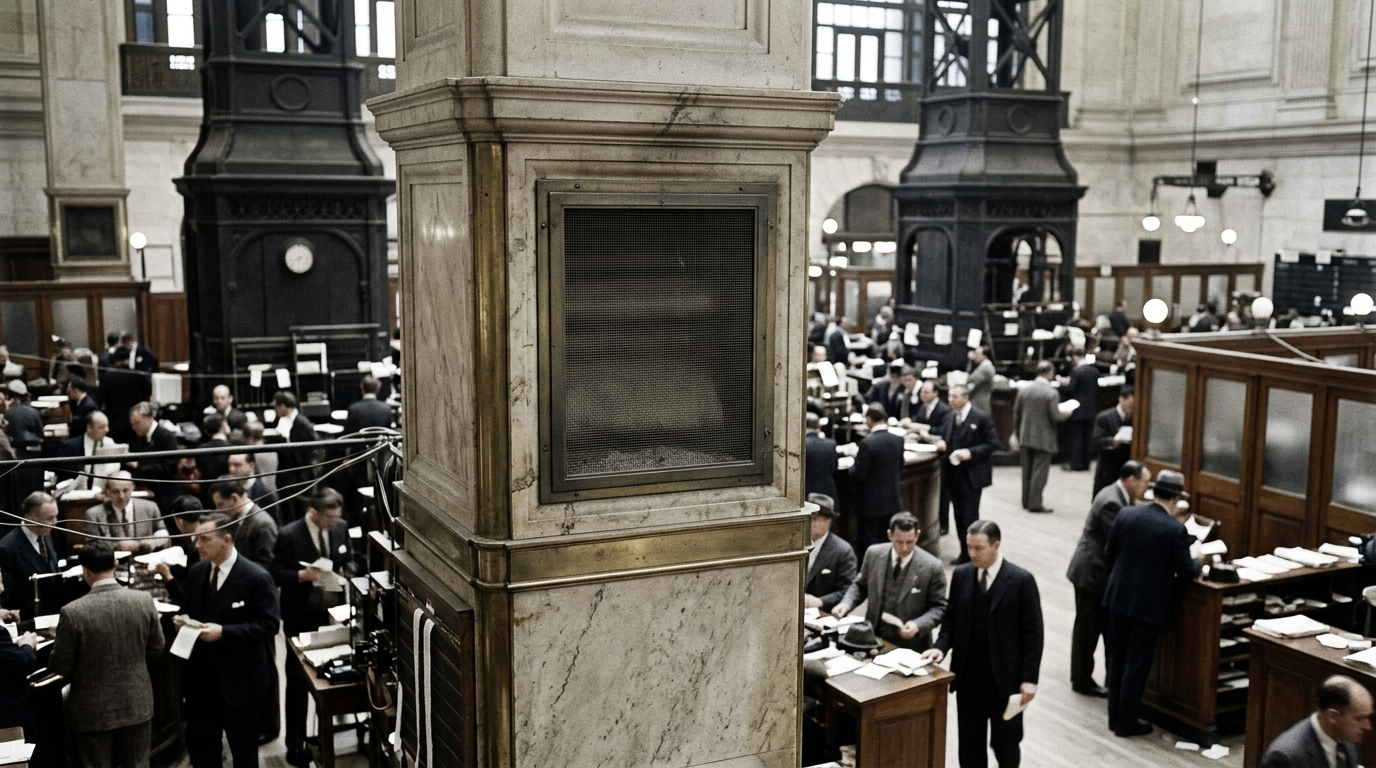
The New York Stock Exchange was one of the first major public buildings in the world to adopt a massive cooling system. Designed by engineer Alfred Wolff, the system used three ammonia-absorption machines to cool the sprawling trading floor.
At the time, this was seen as a luxury for the elite. However, it inadvertently solved a biological bottleneck that had plagued the market for decades. Before 1903, the NYSE was a seasonal victim of the New York summer. Investors were not just uncomfortable; they were making different decisions because of the climate.
The Evidence: Heat and the Bottom Line
A landmark study by researchers at the University of Ottawa and the University of Auckland analysed over a century of NYSE data to track this phenomenon. Their findings, published in the journal Finance Research Letters, confirmed that temperature significantly affected returns during the pre-air conditioning era.
The data showed a clear negative relationship: as the mercury rose, market returns fell. On particularly sweltering days, the fatigue and irritability of the floor traders led to a lack of liquidity and a general reluctance to buy.
Unlike modern algorithmic trading, the turn-of-the-century market relied entirely on human stamina. Once Alfred Wolff’s cooling system began pumping chilled air through the vents at 18 Broad Street, that correlation vanished. The NYSE effectively became a weather-proof environment, allowing logic to prevail over perspiration.
Real-World Applications
- Office Design: Modern firms use climate control not just for retention, but to maintain consistent cognitive throughput.
- Retail Psychology: Shopping malls maintain specific temperatures to ensure customers remain in a state of high-energy browsing.
- Remote Work: Home office environments that lack climate control see a measurable dip in analytical performance during heatwaves.
The Global Comparison
Industry experts note that this phenomenon is not unique to New York. Research into the Taiwan Stock Exchange—a market that operated without universal cooling for longer than its Western counterparts—showed similar patterns. Even in the modern era, markets in developing nations often show a weather-return correlation until their primary trading hubs are fully climatised.
Does weather still affect the stock market today?
While air conditioning solved the physical heat problem on the floor, cloud cover still has a measurable impact. Studies show that stock returns tend to be lower on cloudy days in various international markets, likely due to the psychological effect of low sunlight on investor optimism.
Was the NYSE the first building to have AC?
It was one of the first. While Willis Carrier is credited with the modern invention in 1902 for a printing plant, the NYSE was the first large-scale application of comfort cooling for a high-occupancy public space.
Did the 1903 installation change trading volume?
Yes. Historical records suggest that trading activity became more consistent throughout the summer months once the floor became a refuge from the humid New York streets.
Connections and Context
- Thermal Comfort: The specific range of temperature where humans are most productive is roughly 21 to 23 degrees Celsius.
- The Carrier Effect: Willis Carrier’s invention was originally intended to keep paper from expanding and contracting in a Brooklyn printing plant.
- The broad street building: The NYSE building itself was a marvel of the Beaux-Arts style, designed specifically to house these massive new technologies.
Key Takeaways
- Physicality and Finance: Biology influences markets; a trader’s physical state is a hidden variable in market fluctuations.
- Technological Decoupling: Air conditioning allowed the NYSE to operate independently of the local environment for the first time.
- Cognitive Cost: Heat stress leads to lower risk tolerance and diminished returns, a trend that only ended with mechanical cooling.
- Infrastructure Matters: The 1903 installation was a turning point that transformed the NYSE into a year-round global powerhouse.
Wall Street’s greatest innovation wasn't a new type of bond or a clever derivative; it was a giant refrigerator that allowed men in wool suits to think clearly in July.
Frequently Asked Questions
Sources & References
- 1Appetite JournalReferences a study published in Finance Research Letters that investigated the impact of temperature on stock market returns, specifically mentioning the NYSE.sciencedirect.com
- 2The Old Print ShopIdentifies Alfred Wolff as an engineer known for his work on cooling systems.oldprintshop.com
 WikipediaProvides historical context on the development and early applications of air conditioning, including its use in public buildings.en.wikipedia.org