
Quick Answer
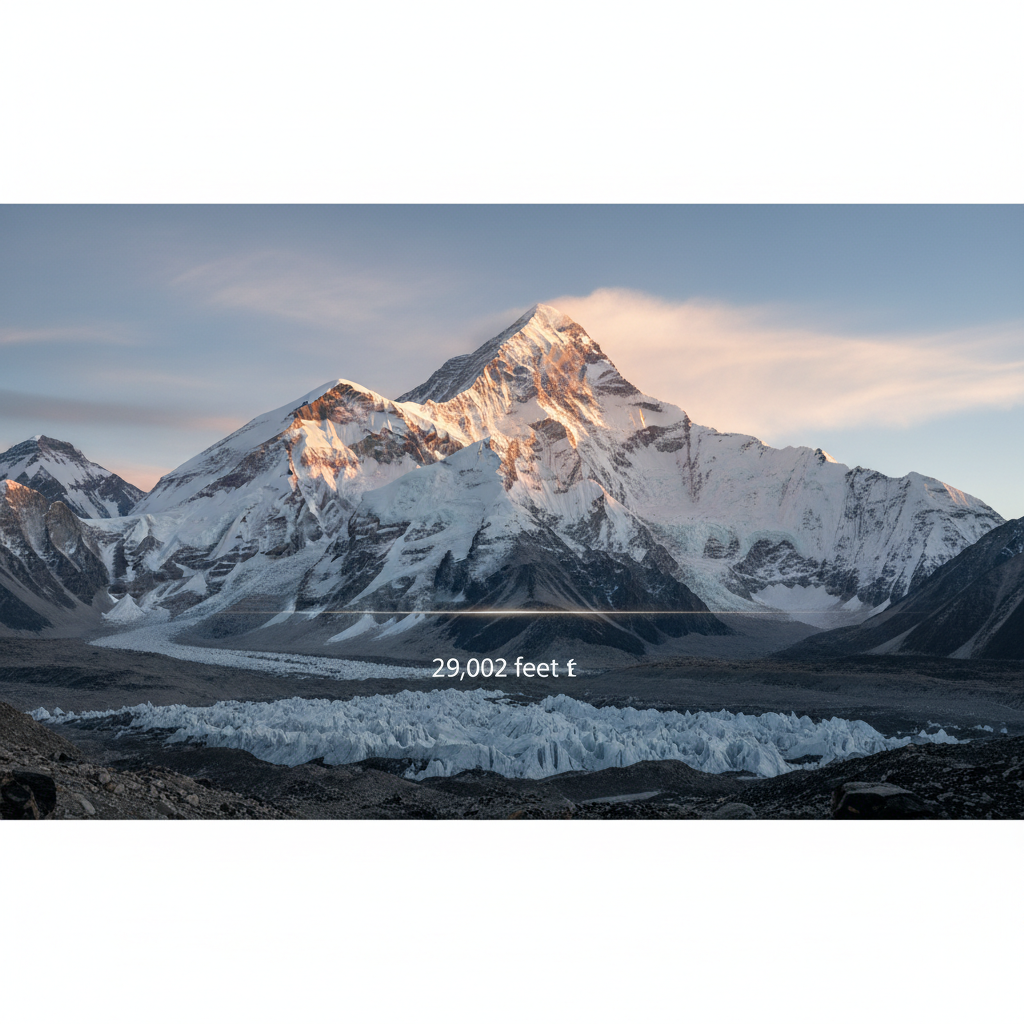
Mount Everest's first official height was recorded as 29,002 feet, not because that was its exact measurement, but because saying exactly 29,000 feet sounded too much like a guess. This is interesting because it shows how human perception and the need for believability can subtly influence even seemingly precise scientific data.
In a hurry? TL;DR
- 1Mount Everest's first official height was set at 29,002 feet, not 29,000, to appear more precise and believable.
- 2Surveyors added two feet to the calculated 29,000 feet to avoid public skepticism of a rounded number.
- 3This historical adjustment highlights how human perception of credibility can influence scientific reporting.
- 4Radhanath Sikdar, a mathematician, performed the complex calculations from over 100 miles away.
- 5The initial height of 29,002 feet was used for nearly a century before subsequent surveys.
- 6Precision, even if slightly inaccurate like the 2-foot addition, was prioritized over a seemingly estimated simple number.
Why It Matters
It's surprising that the first official measurement of Mount Everest cleverly added two feet to a round number to make it seem more credible.
In 1856, the Great Trigonometrical Survey of India calculated Mount Everest to be exactly 29,000 feet tall. Fearing that such a perfect number would be dismissed as a rounded guess, surveyors arbitrarily added two feet to the official record to ensure the public believed their precision.
Why 29,000 Feet Looked Like a Lie
The height of the world’s tallest peak is a matter of geodetic record, but its first official measurement was a masterpiece of psychological engineering. When Andrew Waugh, the Surveyor General of India, oversaw the calculations for Peak XV, the results came back at exactly 29,000 feet.
Waugh knew that a perfectly round number would be a public relations disaster. It looked like an estimate, not a scientific triumph. To protect the reputation of the Great Trigonometrical Survey, he reportedly added two feet to make the number look calculated rather than estimated. For decades, the official height remained 29,002 feet, making Waugh the first person to use a white lie to tell a geographical truth.
Key Figures and Measurements
Altitude: 29,002 feet (Original official height) Altitude: 29,031.7 feet (Current agreed height) Year assigned: 1856 Primary surveyor: Radhanath Sikdar Survey project: Great Trigonometrical Survey of India
Why It Matters
This history reveals that even the most rigid scientific data is subject to human perception. The surveyors understood that people value precision over accuracy; a messy, specific number feels more authentic than a clean, simple one.
The Man Behind the Math
While Andrew Waugh received the accolades, the heavy lifting was done by Radhanath Sikdar, a Bengali mathematician and human computer. Working from stations in the foothills of the Himalayas, over 100 miles away from the peak, Sikdar used giant theodolites to measure the angle of the mountain.
Unlike other colonial surveys that relied on local lore, the British team had to calculate heights from a distance because Nepal refused them entry. They had to account for light refraction, curvature of the earth, and varying temperatures. When Sikdar’s complex trigonometry spat out 29,000 feet on the dot, it was a mathematical fluke that felt like a failure of detail.
The Problem with Precision
The 29,002-foot figure held firm for nearly a century. It was not until 1954 that an Indian survey adjusted the height to 29,029 feet. Today, following a joint effort by Nepal and China in 2020 using GPS technology, the official height stands at 29,031.7 feet.
The irony is that 29,000 feet was likely closer to the truth than Waugh’s 29,002. However, the survey team was battling the limits of 19th-century credibility. According to records at the Royal Geographical Society, the surveyors were obsessed with the idea that their years of grueling labor would be dismissed by a skeptical public as mere guesswork.
Modern Implications: The Psychology of Numbers
This phenomenon is known today as the precision effect. Studies in behavioral economics suggest that consumers are more likely to trust a price of £29.87 than a round £30.00. The specific number implies a rigorous calculation based on costs, whereas the round number feels arbitrary.
Waugh’s two-foot addition was a Victorian precursor to this psychological quirk. By making the world’s tallest mountain look slightly less perfect, he made it significantly more real.
Key Takeaways
- Credibility: The number 29,002 was chosen specifically because 29,000 felt too convenient to be true.
- Human Factor: Science and data are often filtered through human psychology and the need for public trust.
- Technical Mastery: Despite the two-foot tweak, nineteenth-century mathematicians were remarkably accurate using only basic geometry and sightlines.
- Relentless Change: Everest’s height is never truly fixed; it fluctuates based on tectonic shifts, snow depth, and the technology used to measure it.
Frequently Asked Questions
Sources & References
 BritannicaMentions the 1856 measurement of Mount Everest by the Great Trigonometrical Survey of India, leading to the official height of 29,002 feet, and notes Andrew Waugh's role.britannica.com
 History.comDetails the 1856 measurement of Mount Everest by the Great Trigonometrical Survey of India, stating its calculated height as 29,000 feet and the subsequent addition of two feet to make it 29,002 feet.history.com
 WikipediaIdentifies Radhanath Sikdar as the chief computer of the Great Trigonometrical Survey of India who calculated the height of Mount Everest in 1852 to be 29,000 feet.en.wikipedia.org