
Quick Answer
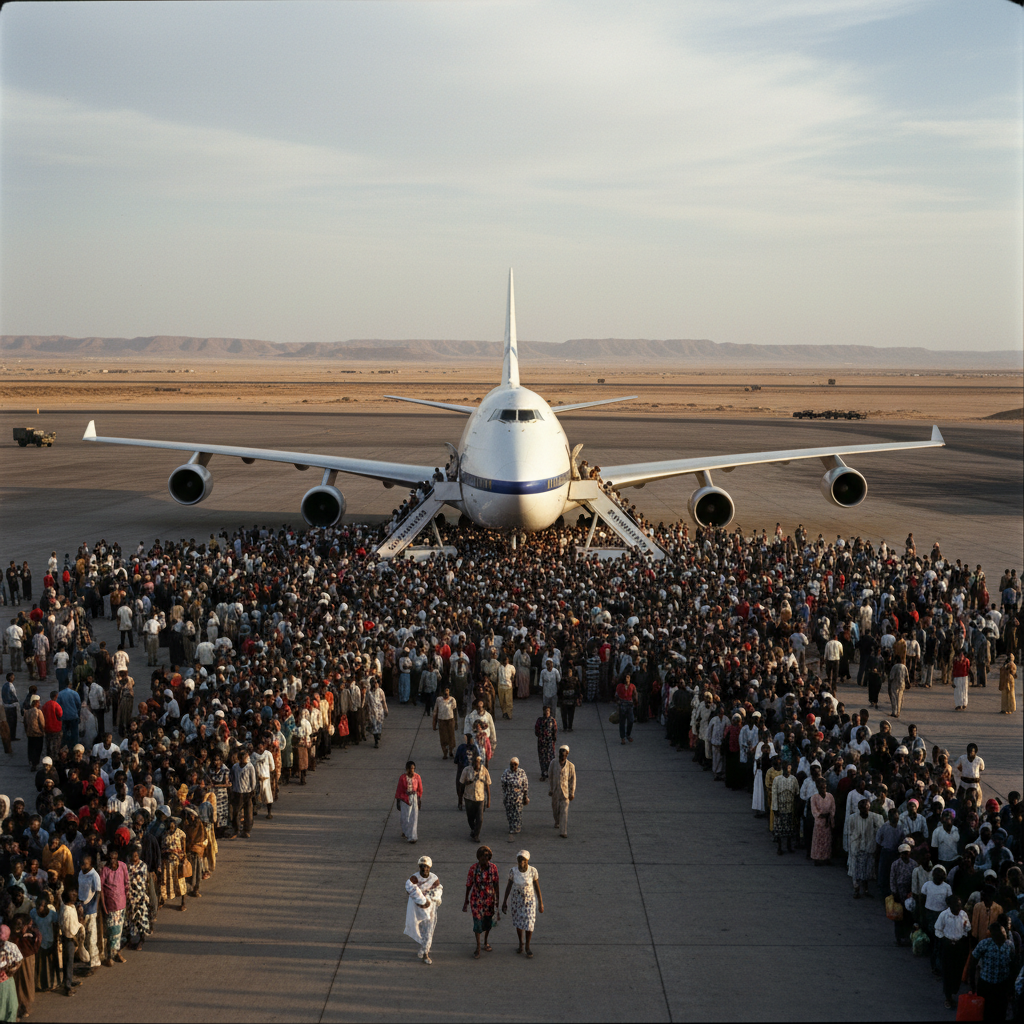
The most passengers ever on a commercial flight was 1,088, including two babies born mid-air. This incredible number was achieved on an El Al Boeing 747 during Operation Solomon, a remarkable rescue mission. It highlights the extraordinary lengths people will go to during a crisis, fitting vastly more souls onto a plane than is normally imaginable.
In a hurry? TL;DR
- 1A Boeing 747 set a record carrying 1,088 passengers during Operation Solomon, nearly tripling its standard capacity.
- 2The record flight was part of a humanitarian evacuation of Ethiopian Jews, prioritizing lives over comfort and standard protocols.
- 3To achieve the record, the 747's interior was stripped of seats and bulkheads, allowing passengers to sit densely on the floor.
- 4Reduced aircraft weight from removed seats and low fuel levels made the extraordinary passenger load possible.
- 5This event demonstrated the extreme adaptability of commercial aircraft in humanitarian crises.
- 6Two babies were born during the flight, adding to the final passenger count of 1,088.
Why It Matters
It's surprising that a single commercial airliner once carried over a thousand people, more than double its usual capacity, by removing all the seats.
On 24 May 1991, an El Al Boeing 747 set an unbreakable aviation record by carrying 1,088 passengers in a single flight during the evacuation of Ethiopian Jews. The manifest officially listed 1,086 passengers, but two babies were born during the four-hour journey to Israel.
Quick Answer
The world record for the most passengers on a commercial aircraft was set during Operation Solomon when 1,088 people squeezed onto a Boeing 747. This is nearly triple the aircraft's standard seating capacity.
The Vital Statistics
- Date: 24 May 1991
- Aircraft: Boeing 747 (modified)
- Official Manifest: 1,086 passengers
- Final Count: 1,088 (after two mid-air births)
- Standard Capacity: Approximately 400-450 passengers
- Total Mission Duration: 36 hours for the entire operation
Why It Matters
This event redefined the absolute physical limits of wide-body aircraft. It proved that in humanitarian crises, the engineering tolerances of commercial jets allow for radical adaptations that prioritise human life over every standard safety and comfort protocol.
The Physics of an Impossible Load
A Boeing 747 typically features a spacious cabin with galleys, lavatories, and substantial seating. To achieve the 1,088-person figure, El Al engineers stripped the aircraft of almost its entire interior.
By removing the heavy seats and bulkheads, the airline reduced the base weight of the plane significantly. This weight reduction was essential because 1,000 humans, even without luggage, represent a massive payload.
Unlike a standard flight where every passenger has 32 inches of legroom, these passengers sat on the floor, huddled together. This allowed for a density that would be physically impossible in any other commercial context.
The Operation Solomon Context
The flight was part of a covert military operation to transport the Beta Israel community from Ethiopia to Israel. With the Mengistu Haile Mariam government collapsing and rebels closing in on Addis Ababa, the window for evacuation was closing.
According to records from the American Jewish Joint Distribution Committee, thirty-four Israeli aircraft flew non-stop for 36 hours. They moved 14,325 people in total, but the El Al 747 flight became the enduring symbol of the mission.
The flight crews intentionally left the fuel levels low to further save weight for takeoff, planning to refuel only as much as was strictly necessary for the short hop across the Red Sea.
The Mid-Air Births
The final count of passengers changed while the plane was over the Red Sea. Two pregnant women went into labour during the flight. Because the cabin was so packed, medical teams had to work in cramped conditions on the floor of the upper deck.
By the time the wheels touched down at Ben Gurion Airport, the passenger list had grown from 1,086 to 1,088. This remains the only instance in aviation history where a flight landed with more people than it started with, and at such a massive scale.
Comparison to Modern Standards
To put this in perspective, modern ultra-long-haul flights are often criticised if they carry more than 400 people. The Airbus A380, the largest passenger plane ever built, is certified for a maximum of 853 passengers in an all-economy configuration.
Even that mammoth aircraft has never approached the 1,088 figure in actual service. The El Al flight exceeded the A380’s theoretical structural maximum by over 200 people, despite using the smaller Boeing 747 frame.
Practical Applications of High-Density Flight
- Disaster Relief: This record serves as a benchmark for NGOs and militaries calculating maximum evacuation capacities.
- Engineering Stress Tests: Boeing used data from these heavy-load flights to understand how airframes behave at the absolute edge of their weight envelopes.
- Urban Planning: The logistics of boarding and deplaning 1,000 people in minutes remains a case study in crowd management and emergency egress.
How did they fit that many people?
Every seat was removed from the aircraft. Passengers sat on the floor on thin mattresses. Because many of the passengers were children and many were malnourished, they occupied significantly less volume than a standard load of Western tourists.
Was it safe to fly?
In a traditional sense, no. It bypassed almost every civil aviation safety regulation regarding exit access and seatbelts. However, the alternative was leaving the passengers in a war zone. The pilots calculated that the risk of a cramped flight was lower than the risk of the ground conflict.
Did the plane suffer damage?
The aircraft survived the flight, but the cabin required a total overhaul afterward. The main concern was the lateral stability of the plane; with people not strapped in, a sudden bank or turbulence could cause the entire mass of passengers to slide to one side, potentially causing the pilot to lose control.
Where are they now?
The 1,088 passengers and their descendants are part of the nearly 160,000-strong Ethiopian-Israeli community. The two babies born on the flight are now in their early thirties.
Key Takeaways
- Record Set: 1,088 passengers on a Boeing 747.
- Context: Part of Operation Solomon, an emergency evacuation in 1991.
- Adaptability: The plane's interior was completely gutted to make room.
- Unique Outcome: Two babies were born during the four-hour journey.
- Legacy: It remains the highest passenger count in the history of aviation.
In the end, this was not a feat of luxury or engineering for engineering's sake. It was a 70s-era jumbo jet being used as a high-speed lifeboat, proving that when the stakes are high enough, a plane's capacity is limited only by the oxygen in the tanks and the courage of the crew.
Frequently Asked Questions
Sources & References
- 1Jewish Virtual LibraryDescribes Operation Solomon as a covert military operation that evacuated Ethiopian Jews to Israel in 1991.jewishvirtuallibrary.org
- 2Guinness World RecordsDetails the record set by an El Al Boeing 747 during Operation Solomon for carrying 1,088 passengers, including two babies born during the flight.guinnessworldrecords.com
- 3The American Jewish Joint Distribution Committee (JDC)Offers historical context and details regarding the number of people evacuated during Operation Solomon, stating 14,325 people were moved in 36 hours.jdc.org