
Quick Answer
The equals sign (=) was invented by a frustrated 16th-century Welsh mathematician, Robert Recorde. He was tired of repeatedly writing "is equal to" in his equations. This simple invention makes algebra and all sorts of calculations much quicker and easier to write down, showing how everyday symbols can stem from practical needs.
In a hurry? TL;DR
- 1Robert Recorde, a Welsh mathematician, invented the equals sign (=) in 1557 to simplify equations.
- 2He chose parallel lines because he believed nothing could be more equal than two parallel lines.
- 3Recorde introduced the symbol in his book 'The Whetstone of Witte,' aiming for clearer English mathematical notation.
- 4Before the equals sign, mathematical statements were written out in full sentences, making them lengthy and cumbersome.
- 5The symbol initially looked different, with longer lines, and took about 100-150 years to become a global standard.
- 6Recorde's invention transformed math into a more efficient, visual, and universally understood language.
Why It Matters
That a common symbol we use every day, the equals sign, was invented because a 16th-century Welshman simply couldn't be bothered to keep writing "is equal to" is rather amusing and surprisingly relatable.
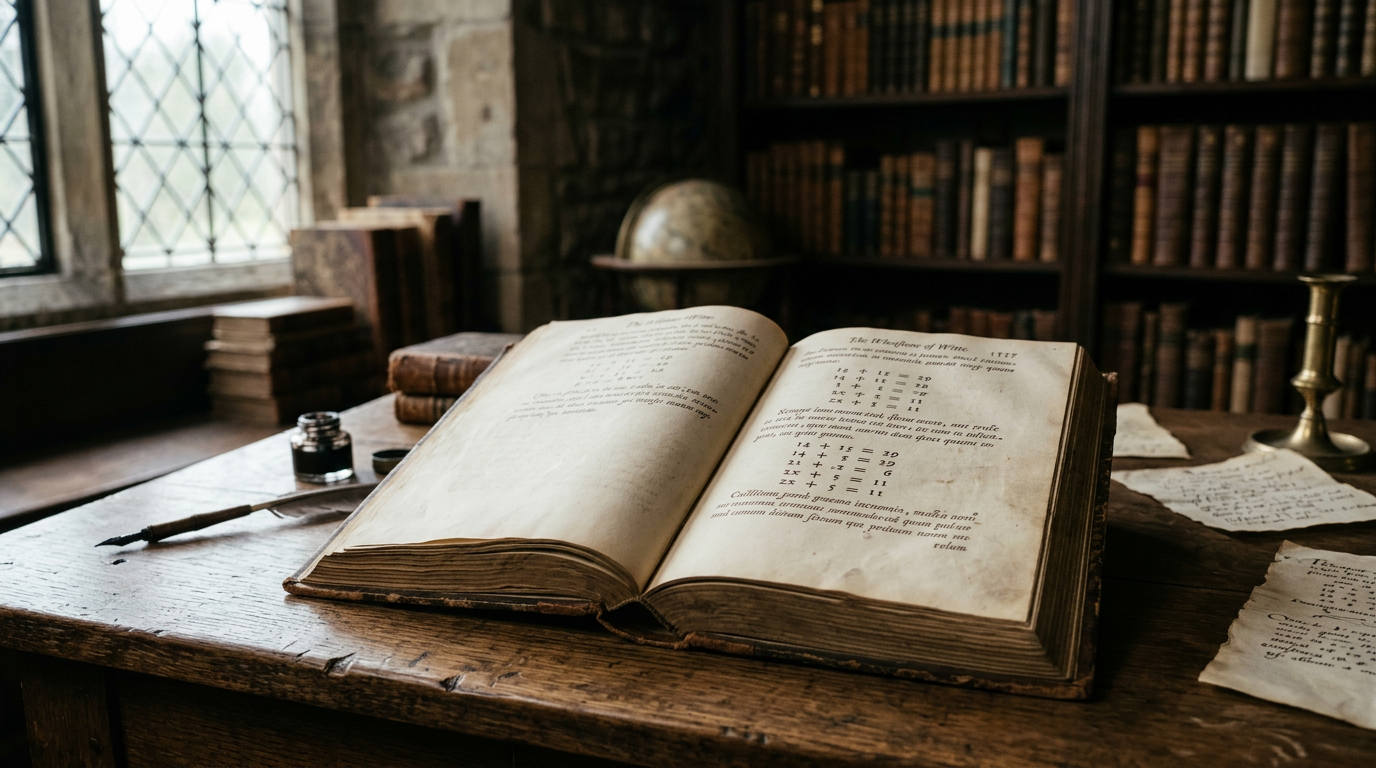
The equals sign was invented in 1557 by Welsh physician and mathematician Robert Recorde, who chose two parallel lines because nothing could be more equal. Tired of repeatedly scrawling the phrase is equal to, Recorde introduced the symbol in his algebra textbook, The Whetstone of Witte.
Key Facts and Origins
- Inventor: Robert Recorde
- Year of Invention: 1557
- Nationality: Welsh
- Original Publication: The Whetstone of Witte
- Geometric Logic: Used parallel lines because they are twin lines of one length
- Primary Adoption Period: Roughly 100 to 150 years for global standardisation
Why It Matters: The transition from linguistic descriptions to symbolic notation transformed mathematics from a cumbersome prose exercise into a high-speed universal language.
The Man Who Ran Out of Patience
Before the mid-16th century, doing math was an exercise in creative writing. If you wanted to state that two plus two resulted in four, you had to write it out in long-form Latin or your local vernacular. Robert Recorde, a Cambridge-educated scholar who served as the Comptroller of the Mint, reached a breaking point while writing his final book.
Recorde was a pioneer of the English language as much as he was a mathematician. Unlike his contemporaries who wrote in Latin to remain exclusive, Recorde wrote in English to teach the common person. However, even his accessible prose had limits.
To avoid the tedious repetition of the phrase is equal to, he drew two horizontal, parallel line segments. His logic was as elegant as the symbol itself: he chose them, as he wrote, because no two things can be more equal than a pair of parallel lines.
The Evolution of the Symbol
The version Recorde originally penned was significantly longer than the one on your keyboard today. In The Whetstone of Witte, the lines stretched across the page, resembling a very long, thin rectangle or a double-dashed line.
Despite its brilliance, the equals sign was not an overnight success. It faced stiff competition from other symbols. Some mathematicians preferred a vertical line, while others used the Greek letter epsilon or even a series of dots.
According to researchers at the University of St Andrews, the symbol didn't gain dominance until the mid-17th century. It took the influence of heavyweights like Isaac Newton and Gottfried Wilhelm Leibniz to cement Recorde’s parallel lines as the global standard.
Life Imitates Geometry
Recorde’s invention allowed for the development of complex equations that would have been unreadable if written in prose. Imagine trying to parse Einstein’s E=mc² if it were written as: Energy is equivalent to the mass of an object multiplied by the square of the speed of light.
By reducing a concept to a glyph, Recorde allowed the human brain to stop processing language and start processing relationships. This was the birth of modern computational efficiency. Unlike the plus sign, which evolved from the Latin word et, the equals sign was a deliberate geometric choice.
Practical Applications
- Mathematical Proofs: The = sign allows for a clear logical bridge between two states.
- Programming: In almost every coding language, the symbol is used for variable assignment or comparison.
- Social Symbolism: The parallel lines have been repurposed by human rights campaigns to represent social and legal equality.
Why did Robert Recorde choose two lines?
He believed that no two things could be more equal than parallel lines of the same length, making it a perfect visual metaphor for the concept.
What did people use before the equals sign?
Most wrote out phrases like aequales, esgal, or is equal to. Some used a dash or a colon, but there was no unified system.
Was Recorde famous in his lifetime?
He was a respected scholar and physician to royalty, but he actually died in a debtors' prison in London. Despite his genius in managing the Mint and inventing mathematical tools, his personal finances were a disaster.
Interesting Connections
- Terminology: Recorde is also credited with introducing the English word sine to trigonometry.
- Typography: The symbol has changed proportions over centuries; originally, it was much longer than the symbols for plus or minus.
- Cultural Legacy: Recorde’s book, The Whetstone of Witte, contains the first use of the word zenzizenzizenzic, which refers to a number raised to the eighth power.
Key Takeaways
- Clarity over Prose: The equals sign was born from a desire to reduce repetitive writing in textbooks.
- Geometric Logic: The choice of parallel lines was a philosophical statement on the nature of equality.
- Slow Adoption: It took over a century for the symbol to replace linguistic alternatives across Europe.
- Essential Efficiency: Without symbolic notation, the scientific revolution would have been slowed by the weight of its own descriptions.
Robert Recorde died in prison, but every time you look at a screen or a receipt, his shortcut for a tired hand remains the most stable bridge in human thought.
Frequently Asked Questions
Sources & References
 WikipediaRobert Recorde was a Welsh physician and mathematician credited with inventing the equals sign (=) in 1557.en.wikipedia.org
- 2Appetite JournalBefore the equals sign, mathematical expressions were often written out in words, leading to cumbersome prose.sciencedirect.com
- 3University of St AndrewsThe equals sign, introduced by Robert Recorde, did not gain widespread acceptance until the mid-17th century.mathshistory.st-andrews.ac.uk
 BritannicaRobert Recorde introduced the equals sign in his 1557 algebra textbook, The Whetstone of Witte.britannica.com