
Quick Answer
Monkeys are louder when they have smaller testicles. This surprising link suggests a trade-off: loud calls might be used to advertise fitness, so producing smaller testicles frees up energy for vocalisations. It's a curious glimpse into how animals allocate their limited evolutionary resources.
In a hurry? TL;DR
- 1Male howler monkeys face a trade-off: invest energy in large vocal organs (loudness) or large testicles (sperm production).
- 2Smaller testicles correlate with larger hyoid bones, enabling louder calls to deter rivals and attract mates.
- 3Monkeys in single-male harems tend to be louder with smaller testicles, relying on calls for defense.
- 4Monkeys in multi-male groups often have larger testicles, suggesting competition relies more on sperm production than loud calls.
- 5This illustrates how sexual selection forces species to specialize in distinct reproductive strategies.
- 6The research reveals a clear inverse relationship between hyoid bone size and testicular mass in howler monkeys.
Why It Matters
The surprising finding is that a monkey's impressive roar is directly linked to having smaller testicles, meaning they prioritise vocal displays over sperm production.
In the world of evolutionary biology, male competition is a numbers game. For the howler monkey, that game involves a strict trade-off: you can either have a booming voice or large testicles, but you cannot have both.
Quick Answer
The loudness of a howler monkey is inversely related to the size of its testes. Research shows that male monkeys with smaller testicles compensate for their lack of sperm production by developing larger vocal organs to scare off rivals and attract mates.
- Trade-off: Evolutionary energy is finite, forcing a choice between vocal tracts and reproductive organs.
- Hyoid bone: The size of this throat bone dictates volume and is inversely proportional to testicular volume.
- Social structure: Loud males with small testes usually live in harems with one male; quiet males with large testes live in multi-male groups.
- Scientific backing: The study was conducted by anthropologists at the University of Cambridge and published in 2015.
Why It Matters
This discovery provides a literal example of how nature balances the books, proving that sexual selection is a zero-sum game of biological investment.
Vital Statistics
- Species studied: Alouatta (Howler monkeys)
- Loudness: Up to 140 decibels (comparable to a jet taking off)
- Distance: Calls can be heard 4.8 kilometres away
- Key finding: 1 unit increase in hyoid size correlates to a significant decrease in testes mass
The Cost of a Big Mouth
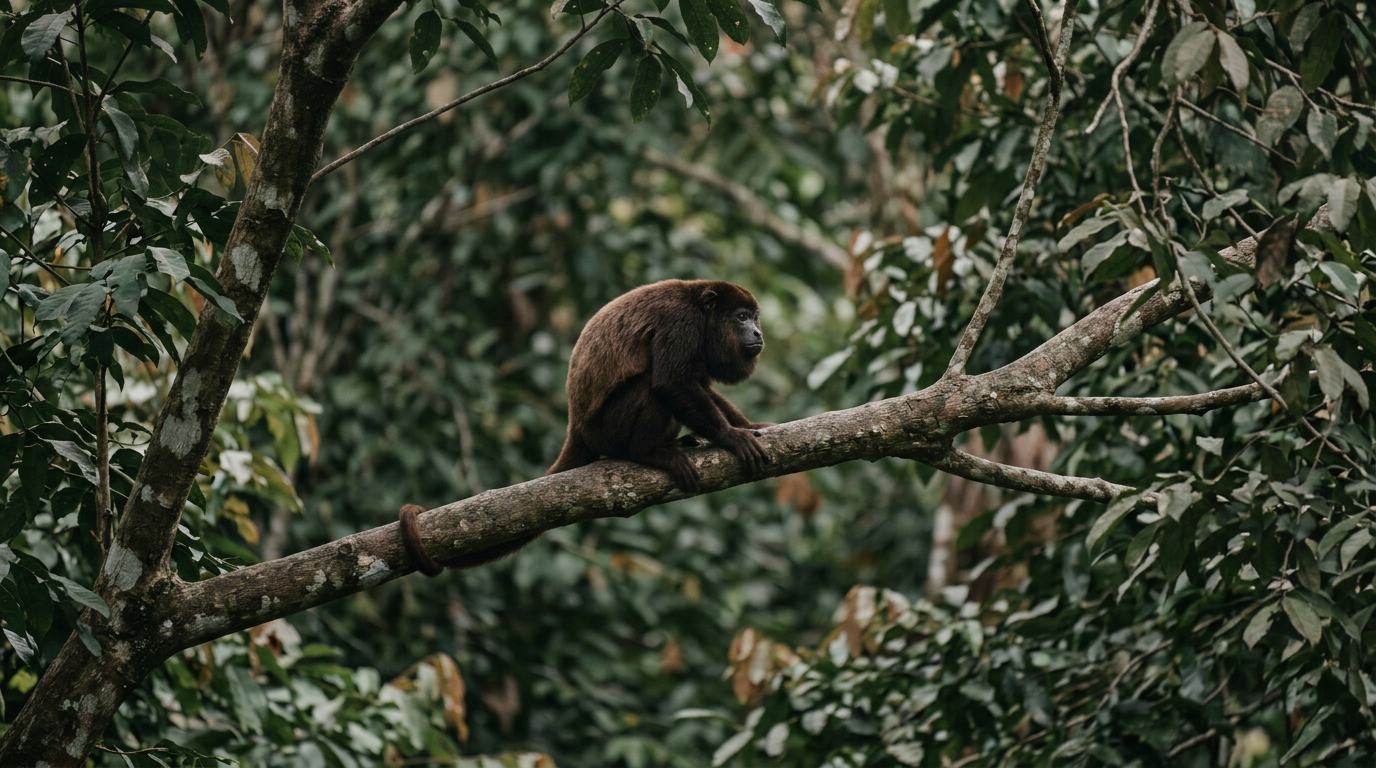
In 2015, a team of researchers led by Dr Jacob Dunn at the University of Cambridge set out to solve a specific anatomical puzzle. Howler monkeys are the loudest land animals in the world, equipped with a specialized hyoid bone that acts as a resonator.
The team used 3D laser scanners to measure the volume of hyoids from 255 monkeys across different species. When they compared these measurements to the size of the animals' testes, a clear pattern emerged across the genus.
The data revealed a biological seesaw. Species like the Guatemalan black howler have massive vocal resonators but tiny testicles. Conversely, species with smaller hyoids possess significantly larger reproductive organs. It is essentially an evolutionary choice between shouting the loudest to prevent a fight and having the equipment to win a reproductive race once the fight is over.
The Strategy of the Harem
The size difference is not a random glitch but a reflection of how these monkeys live. In the primate world, there are two primary ways to ensure your genes pass to the next generation.
Strategy One involves monopolising a group of females. If you can roar loud enough to keep other males at a distance, you do not need to produce massive amounts of sperm because there is no competition within your group. This is the path of the small-testicled, loud-mouthed alpha.
Strategy Two occurs in multi-male groups. When several males live with several females, the competition happens inside the female reproductive tract. In these scenarios, having a louder roar is less effective than having the biological capacity to produce more sperm than the male sitting on the next branch.
Biological Budgeting
Building and maintaining tissue requires significant metabolic energy. Unlike other primates that might invest in large canine teeth or body size, the howler monkey pours its resources into its throat or its scrotum.
Compared to other New World monkeys, the howler’s vocal apparatus is disproportionately heavy. According to the Cambridge study published in the journal Current Biology, the investment in a large hyoid is so taxing that the body simply cannot afford to grow large testes simultaneously.
Can a monkey grow both over time?
No. These traits are fixed at the species level based on their evolutionary path. An individual monkey cannot choose to trade one for the other during its lifetime.
Does this apply to humans?
While human vocal pitch is linked to testosterone levels, there is no direct evidence of a similar inverse trade-off between vocal organ size and testicular volume in our species.
How loud is the howl exactly?
The call of a howler monkey can reach 140 decibels. For context, human hearing damage begins at 85 decibels, and a chainsaw operates at about 110 decibels.
The Alpha’s Paradox
The irony of the howler monkey’s existence is that the most intimidating voice in the forest often masks the least impressive reproductive machinery. It is a bluff that has worked for millions of years. By investing in the acoustic equivalent of a massive security system, these monkeys avoid the physical and energetic toll of constant combat and high-volume sperm production.
Key Takeaways
- Compensation: Smaller testes are biologically compensated for by larger vocal resonators.
- Trade-offs: Evolutionary biology dictates that energy must be allocated to one trait at the expense of another.
- Social influence: Harem-based social structures favour loud voices; multi-male groups favour larger testes.
- Acoustic defense: A loud roar serves as a preemptive strike to keep rivals away, reducing the need for internal reproductive competition.