Quick Answer
The Eiffel Tower has gained an extra 700 tons since it was built, all thanks to 130 years of paint! Each fresh coating, applied to protect the iron structure from rust, has gradually added weight. It's a fascinating, if slightly quirky, consequence of maintaining such a monumental piece of engineering.
In a hurry? TL;DR
- 1The Eiffel Tower weighs approximately 700 tons more today due to 130 years of accumulated paint layers.
- 2Paint is vital to protect the tower's iron structure from rust and maintain its longevity against oxidation.
- 3New paint layers are applied over old ones every seven years, as stripping them is too expensive and risky.
- 4Approximately 60 tons of paint are applied by hand by 25 painters using traditional brushes during each repainting.
- 5The tower's paint has evolved through various colors, currently a specific shade of brown designed for the Parisian skyline.
Why It Matters
The Eiffel Tower is significantly heavier now than when it was built, thanks to decades of fresh paint layered on top of old.
Every seven years, the Eiffel Tower undergoes a massive cosmetic surgery that adds roughly 60 tonnes of weight to its frame. Over 130 years of maintenance, the accumulated layers of lead and modern coatings have made the Iron Lady approximately 700 tons heavier than the day she debuted at the 1889 World’s Fair.
The Vital Statistics
- Original Weight: 7,300 tonnes (ironwork only); 10,100 tonnes total.
- Current Paint Weight: Approximately 700 tonnes of cumulative layers.
- Maintenance Frequency: Current schedule is every 7 years.
- Paint Required Per Application: 60 tonnes.
- Surface Area: 250,000 square metres.
The Iron Lady’s Infinite Wardrobe
Gustave Eiffel knew that the greatest threat to his masterpiece was not wind or gravity, but oxidation. In his 1900 book The 300-Meter Tower, he noted that paint is the essential ingredient for the preservation of a metallic structure and that the care with which it is applied is the only guarantee of its longevity.
This philosophy has led to a cycle of perpetual renovation. Because stripping every previous layer of paint down to the bare puddling iron is prohibitively expensive and structurally risky, new coats are often applied over the old. The result is a metallic onion, where the tower grows thicker and heavier with every passing decade.
The Engineering of Preservation
The scale of this task is immense. According to the Societe d'Exploitation de la Tour Eiffel (SETE), the official management company, 25 painters must apply the 60 tonnes of paint by hand using traditional brushes. They cannot use spray guns because the wind would carry the pigment across the Champ de Mars, coating the surrounding neighbourhoods in a fine metallic mist.
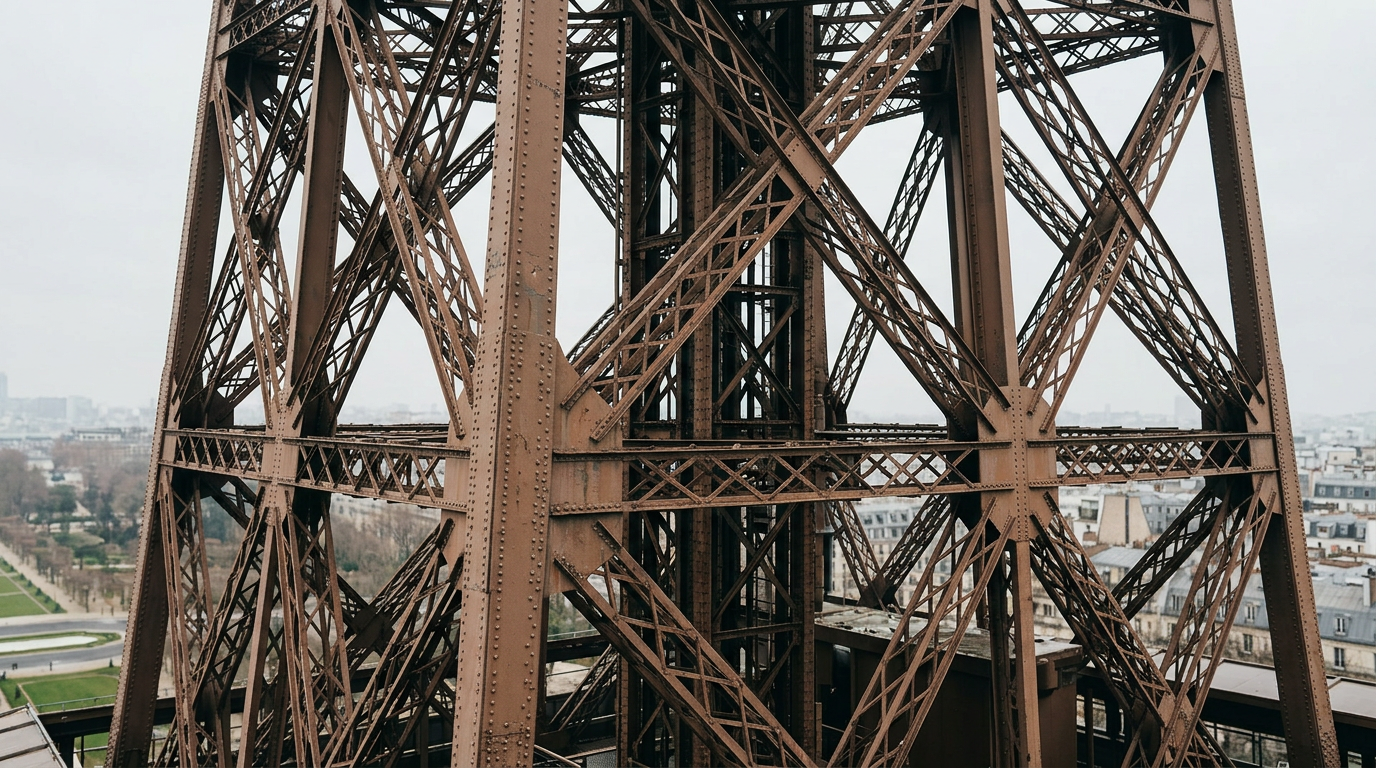
Unlike modern steel skyscrapers that use alloys to resist corrosion, the tower is made of latticed puddling iron. This material requires a physical barrier against the elements. If the paint fails, the iron begins to rust, expand, and lose structural integrity. To prevent this, specialists must scrape off the most damaged sections, but the healthy layers remain, contributing to the staggering 700-ton weight gain.
The Weight of History
While 700 tons sounds like a structural catastrophe, the tower was over-engineered from the start. Gustave Eiffel designed the base to support far more than the current load. In contrast to other Victorian-era structures that have succumbed to rust, the Eiffel Tower remains standing precisely because it is constantly gaining weight.
The tower is actually extremely light for its size. If you were to melt down the ironwork and spread it across the footprint of the base, the metal would only be six centimetres thick. The 700 tons of paint represent a significant percentage of the total mass, effectively acting as a protective skin that is now an inseparable part of the monument's skeleton.
Practical Scenarios
- Structural Load: Engineers must constantly recalculate wind resistance to ensure the added surface area and weight of the paint do not compromise the tower during storms.
- Environmental Impact: Recent campaigns have moved away from lead-based paints to eco-friendly alternatives to protect both the workers and the Parisian soil.
- Aesthetic Consistency: The heavy layering ensures that even under the harsh UV rays at 300 metres, the tower retains its iconic, non-reflective bronze finish.
Interesting Connections
- Red Paint: The tower was initially red because lead minium was the most effective anti-corrosive primer available in the 19th century.
- Expansion: The tower also grows in height. On a hot summer day, thermal expansion can cause the iron to grow by up to 15 centimetres.
- The 72 Names: Beneath the first balcony, Eiffel engraved the names of 72 French scientists and engineers, which must be carefully repainted by hand during every campaign.
Does the extra weight make the tower sink?
No. The tower sits on four massive cement blocks, and the pressure it exerts on the ground is roughly equivalent to a person sitting in a chair. The added 700 tons is negligible compared to the load-bearing capacity of the foundation.
Why don't they just sandblast it all off?
Sandblasting the entire 250,000 square metres would be an ecological nightmare, releasing decades of lead dust into the Parisian air. Stripping is only done in sections where the paint is peeling or too thick to bond safely.
How much does a painting campaign cost?
A full campaign typically costs around 4 million Euros, covering the paint, safety equipment, and the specialised labour required to work at extreme heights.
Key Takeaways
- Protection: The 700 tons of paint is not dead weight; it is the only thing preventing the iron from rusting away.
- Manual Labour: Every centimetre of the tower is still painted by hand to prevent environmental contamination.
- Over-Engineering: The tower's design is so robust that it easily accommodates the weight of 130 years of maintenance.
- Colour Evolution: The tower has gone through multiple shades, from deep red to yellow-orange, before settling on its current signature brown.
The Eiffel Tower is not a static monument; it is a living, breathing structure that grows heavier with every generation that seeks to preserve it.