
Quick Answer
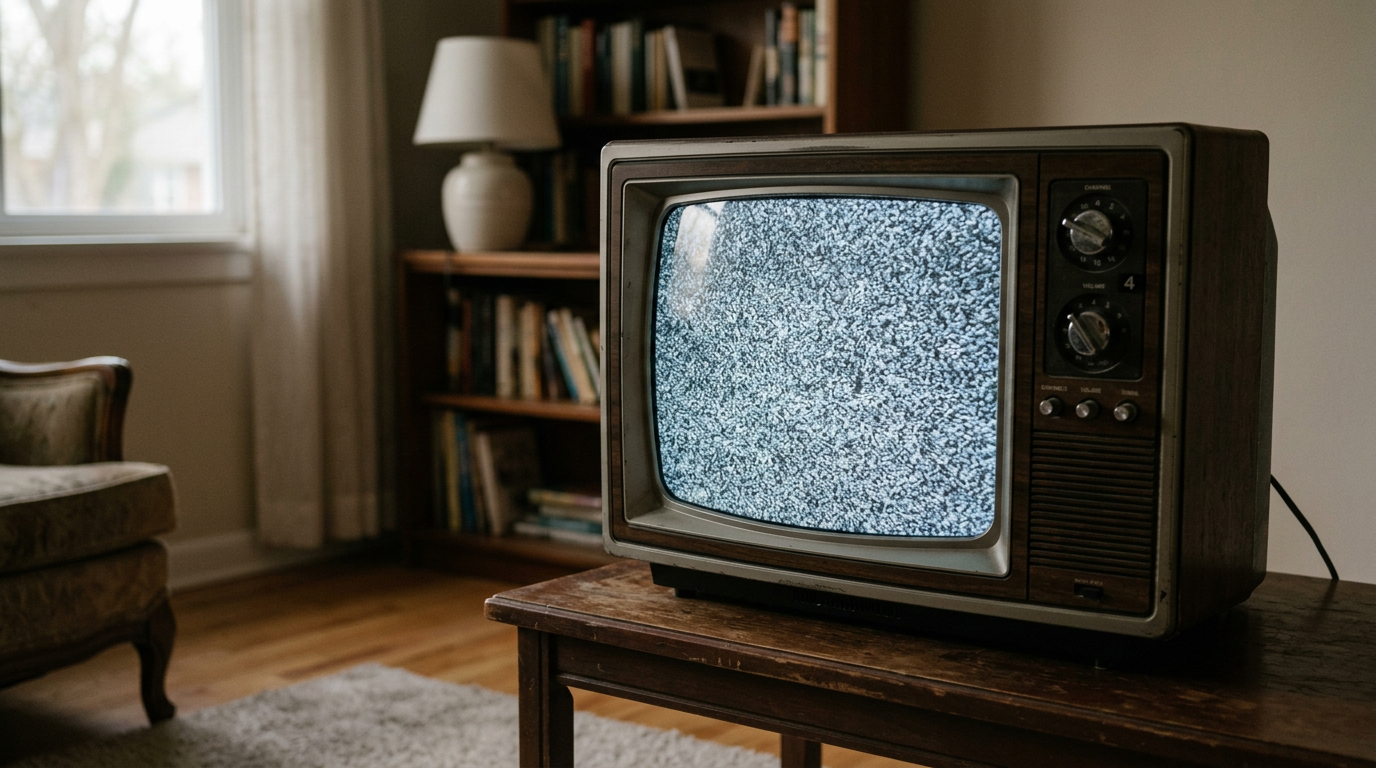
That old TV static you saw on an empty channel? A tiny fraction of it was actually the leftover glow from the Big Bang! It's fascinating because, for a moment, you were seeing a faint echo from the very birth of the universe, a visual connection to creation itself.
In a hurry? TL;DR
- 1About 1% of static on old analogue TVs is the Big Bang's afterglow, the Cosmic Microwave Background (CMB).
- 2This CMB radiation, 13.8 billion years old, is the universe's oldest light, filling all of space.
- 3Discovered accidentally in 1964 by Penzias and Wilson, initially blamed on pigeon droppings.
- 4Analogue TV tuners, not perfectly shielded, picked up this pervasive CMB signal.
- 5The faint CMB photons, stretched by cosmic expansion, contributed to the visual 'snow' on dead channels.
- 6Watching TV static offered a rare, direct glimpse of the universe's earliest moments.
Why It Matters
It's rather surprising that the fuzzy static on an old TV was actually a faint echo of the Big Bang reaching us from across billions of years.
Roughly one per cent of the flickering static on an empty analogue television channel is actually a live broadcast of the Big Bang. This visual noise, known as snow, contains the faint, stretched-out remnants of the first light to ever travel through the universe.
The Snapshot of Creation
- Source: Cosmic Microwave Background (CMB) radiation
- Age: Approximately 13.8 billion years old
- Temperature: 2.7 Kelvin (minus 270.45 degrees Celsius)
- First Detected: 1964 by Bell Labs researchers
- Composition of Static: 1% of analogue interference is CMB
Why It Matters
The white noise of a dead channel is the only time the average person will ever witness a direct, unmediated interaction with the beginning of time itself.
The Discovery: A Great Deal of Pigeon Droppings
In 1964, Arno Penzias and Robert Wilson were using a massive horn antenna at Bell Labs in Holmdel, New Jersey, to map radio signals from the Milky Way. They kept hitting a persistent, low-level hum that came from every direction at once.
The duo eventually realised they had accidentally discovered the Cosmic Microwave Background (CMB). This is the thermal radiation left over from the era of recombination, the moment about 380,000 years after the Big Bang when the universe cooled enough for atoms to form and light to travel freely.
Unlike other celestial signals that originate from specific stars or galaxies, the CMB is isotropic. This means it fills the entire sky with near-uniform intensity, making it an inescapable background hum for any sufficiently sensitive receiver.
From Deep Space to Your Living Room
Analogue televisions were designed to pick up electromagnetic waves transmitted through the air. However, the tuners were not perfectly shielded. When set to a channel with no local broadcast, the antenna would amplify any electromagnetic interference it could find.
Most of this noise came from local sources: lightning, nearby power lines, or internal heat within the television’s own circuitry. But because the CMB permeates every cubic centimetre of space, the antenna would also snag those 13.8-billion-year-old photons.
While the original light was incredibly hot and high-energy, the expansion of the universe over billions of years has stretched those waves into the microwave part of the spectrum. By the time they hit a rabbit-ear antenna, they are incredibly weak, but still present enough to contribute to the chaotic dance of black and white dots on the screen.
The Evidence: Quantifying the Glow
According to researchers at NASA and the European Space Agency, the CMB is the most ancient light in existence. While it was once as hot as the surface of a star, it has cooled to just a few degrees above absolute zero.
Modern satellites like COBE (Cosmic Background Explorer) and Planck have mapped this radiation with extreme precision. These maps show tiny fluctuations in temperature that eventually grew into the clusters of galaxies we see today.
Compared to digital signals, which use error correction to ignore background noise, analogue systems were raw. They lacked the filters to distinguish between a local weather report and the thermal echoes of the creation of the cosmos.
Practical Implications of Interference
- Astronomy: The CMB provides a blueprint of the early universe, allowing scientists to calculate the age and composition of space.
- Telecommunications: Engineers must account for this background noise when designing deep-space communication networks to ensure signals aren't lost in the cosmic hum.
- Digital Transition: The shift to digital broadcasting means we can no longer see the CMB on our screens, as modern tuners filter out non-digital data.
Can I still see this on a digital TV?
No. Digital televisions process signals as data packets. If the signal is too weak or contains too much noise, the processor simply displays a black screen or a No Signal message rather than the raw interference.
Does the static come from space?
Only a small portion. About 99% of the static is caused by atmospheric interference, man-made electronic noise, and the thermal movement of electrons within the TV itself.
Is the radiation dangerous?
Not at all. The energy levels are incredibly low. You are constantly bathed in CMB radiation regardless of whether a TV is nearby; the television just happened to be a device capable of making it visible to the human eye.
Key Takeaways
- Cosmic Legacy: Analogue static was a rare point where high-level astrophysics met everyday domestic life.
- Accidental Science: One of the most important discoveries in the history of science was found by researchers trying to fix a noisy antenna.
- The End of an Era: The transition from analogue to digital has effectively silenced the visual representation of the Big Bang in our homes.
The next time you see a grainy black-and-white image of a bygone era, remember that the most ancient thing in the frame isn't the history being recorded, but the snowy interference surrounding it.
