
Quick Answer
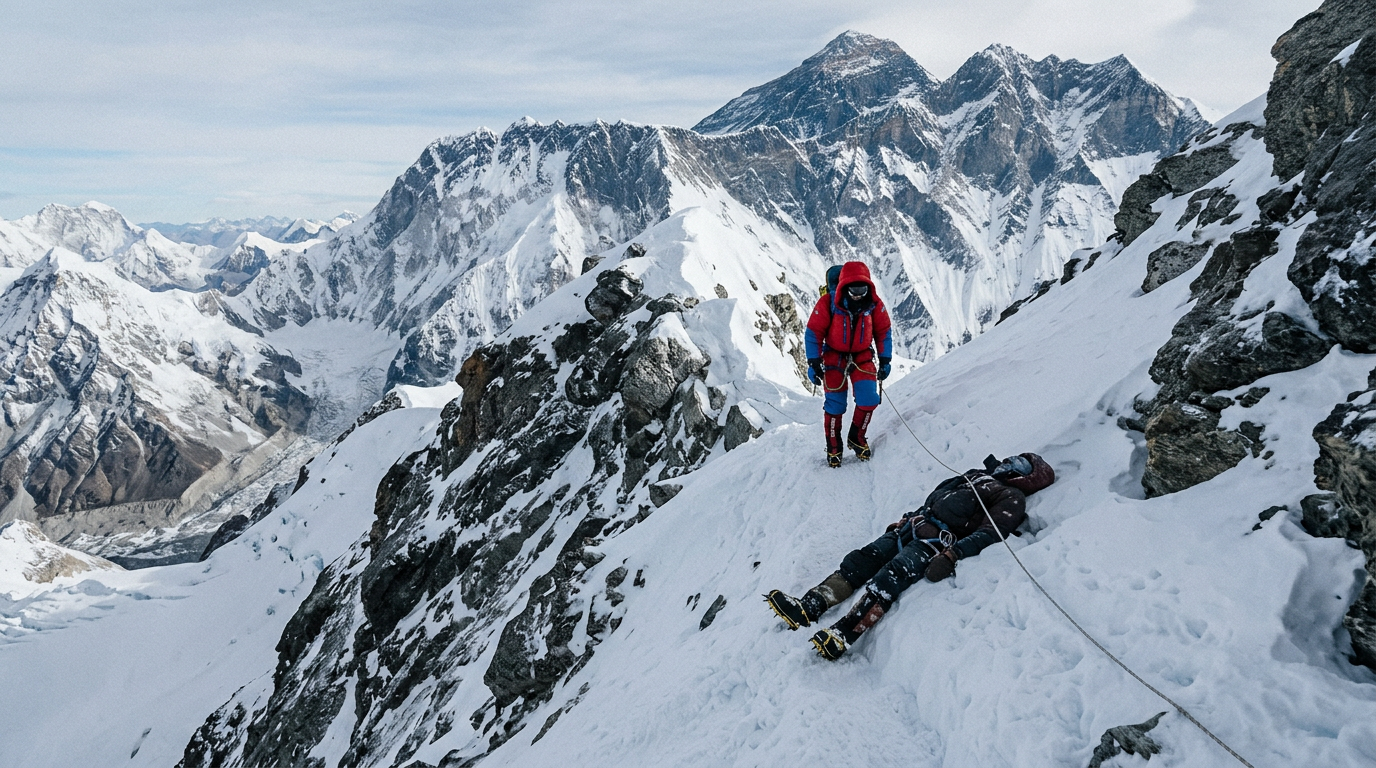
Over 200 bodies are still on Mount Everest. This grim fact is a stark reminder of the mountain's extreme dangers, as some of these deceased climbers have become recognisable, albeit macabre, landmarks. Navigators use them to find their way, a poignant testament to the perils faced by those attempting the summit.
In a hurry? TL;DR
- 1Over 200 bodies remain on Mount Everest, serving as grim landmarks due to extreme recovery dangers in the 'Death Zone' above 8,000m.
- 2Recovery costs for bodies range from $30,000-$70,000, requiring 6-10 Sherpas, making it a high-risk, often impossible task.
- 3The bodies are preserved by extreme cold and altitude, becoming recognizable markers like 'Green Boots' for climbers on the ascent.
- 4Most deaths occur during descent due to exhaustion, and moving bodies is often considered a suicide mission for rescue teams.
- 5These frozen remains underscore the severe risks of Everest and serve as a constant reminder of mortality for climbers.
- 6The decision to leave bodies is based on the lethal difficulty and immense effort required for recovery in the extreme environment.
Why It Matters
The frozen remains of over 200 climbers on Mount Everest have become grimly useful landmarks for those attempting to reach its summit.
Mount Everest is the highest open-air morgue on Earth, housing more than 200 bodies that remain frozen in situ. Due to the extreme difficulty of recovery in the Death Zone, many of these fallen climbers have become macabre, permanent landmarks used by others to navigate the ascent.
The Quick Answer
More than 200 bodies remain on Mount Everest because the oxygen-deprived environment makes recovery operations lethally dangerous for rescue teams. These remains often stay perfectly preserved by the cold, serving as grim waypoints like Green Boots for those attempting the summit.
Key Statistics of the Death Zone
- Total Estimated Bodies: 200 to 300
- The Death Zone Altitude: Above 8,000 metres
- Success to Fatality Ratio: Approximately 3 percent
- Recovery Cost: 30,000 to 70,000 USD
- Recovery Team Size: 6 to 10 experienced Sherpas
Why It Matters
The presence of these bodies transforms the world’s highest peak into a site of active memorialisation and practical navigation, forcing climbers to confront the physical reality of their own mortality with every step toward the summit.
The Landmarks of the North Ridge
The most famous of these landmarks was known as Green Boots. For two decades, climbers on the Northeast ridge path had to step over the neon-green footwear of a climber believed to be Tsewang Paljor, an Indian constable who perished in the 1996 blizzard.
His body rested in a limestone cave at 8,500 metres. Because the cave provided a natural shelter from the wind, it became a standard resting point. Climbers would check their progress against his position, a silent, frozen sentinel marking the final stretch to the top.
Another well-known figure was Sleeping Beauty, the remains of Francys Arsentiev, the first American woman to summit without supplemental oxygen. She died during her descent in 1998. Her body remained visible from the main trail for nine years until an expedition moved her lower down the mountain, out of the direct line of sight.
The Logistics of Eternal Rest
Why are they not brought down? The answer is a matter of physics and biology. At 8,000 metres, the human body is effectively dying. Every movement requires immense effort. A frozen body can weigh over 100 kilograms, and dragging that weight across jagged ice and vertical drops is often a suicide mission for the recovery team.
According to research published in the British Medical Journal, most deaths on Everest occur during the descent, when exhaustion is at its peak. When a climber collapses in the Death Zone, they are rarely moved. The effort to carry a body down requires six to ten Sherpas, many of whom risk their own lives for a task that offers no guarantee of success.
The Ethics of the Ascent
The presence of these bodies has sparked intense debate regarding the commercialisation of Everest. Unlike other professional sports, mountaineering on Everest involves walking past the dead in a way that has become strangely normalised.
Experts agree that the psychological impact is profound. Climbers must compartmentalise the sight of a brightly coloured down jacket poking out of the snow, knowing that the person inside had the same ambitions and gear as they do. It is a stark reminder that at 29,032 feet, the mountain dictates the terms of survival.
Practical Implications for Modern Climbers
- Navigation: Bodies often indicate the correct path through featureless snowfields.
- Psychological Preparation: Guides now brief clients on the likelihood of seeing remains to prevent mid-climb panic.
- Gear Identification: Older remains help historians track the evolution of climbing technology and the specific years of failed expeditions.
Interesting Connections
- The Rainbow Valley: A section of the mountain named for the brightly coloured parkas and gear of the many climbers who have fallen there.
- George Mallory: The legendary climber whose body was missing for 75 years until it was discovered in 1999, remarkably preserved by the dry, freezing air.
- Burial Rites: In Tibetan culture, the mountain is sacred (Chomolungma), and the presence of the dead is seen as a complex intersection of human ambition and divine territory.
Why don't helicopters pick up the bodies?
The air is too thin at 8,000 metres for most helicopters to generate enough lift. While some specialised high-altitude rescues have occurred, hovering long enough to winch a body is extremely difficult and dangerous.
How long do the bodies last?
In the sub-zero temperatures and low humidity of Everest, bodies can remain almost perfectly preserved for decades. They do not decompose in the traditional sense; they desiccate and freeze.
Does the government pay for body removal?
No. Body recovery is usually funded by the climber’s family or their insurance company. It is a private and incredibly expensive undertaking.
Key Takeaways
- More than 200 bodies are currently on Mount Everest.
- Many remains serve as geographic markers for active expeditions.
- The Death Zone makes physical recovery nearly impossible due to oxygen levels.
- The ethics of leaving bodies in situ remains a primary debate in the mountaineering community.
The summit of Everest remains a place where the line between a successful expedition and a permanent residency is measured in a few breaths of oxygen and a few degrees of temperature. Those who remain are not just statistics; they are a permanent part of the mountain's topography.
Frequently Asked Questions
Sources & References
 WikipediaThis source verifies that 'Green Boots' was the body of a climber in neon-green footwear, believed to be Tsewang Paljor, resting in a limestone cave at 8,500 meters on Mount Everest, and served as a landmark for two decades.en.wikipedia.org
- WikipediaThis source confirms that Francys Arsentiev, known as 'Sleeping Beauty,' was the first American woman to summit Everest without supplemental oxygen and died during her descent in 1998, with her body remaining visible from the main trail for nine years before being moved.en.wikipedia.org