
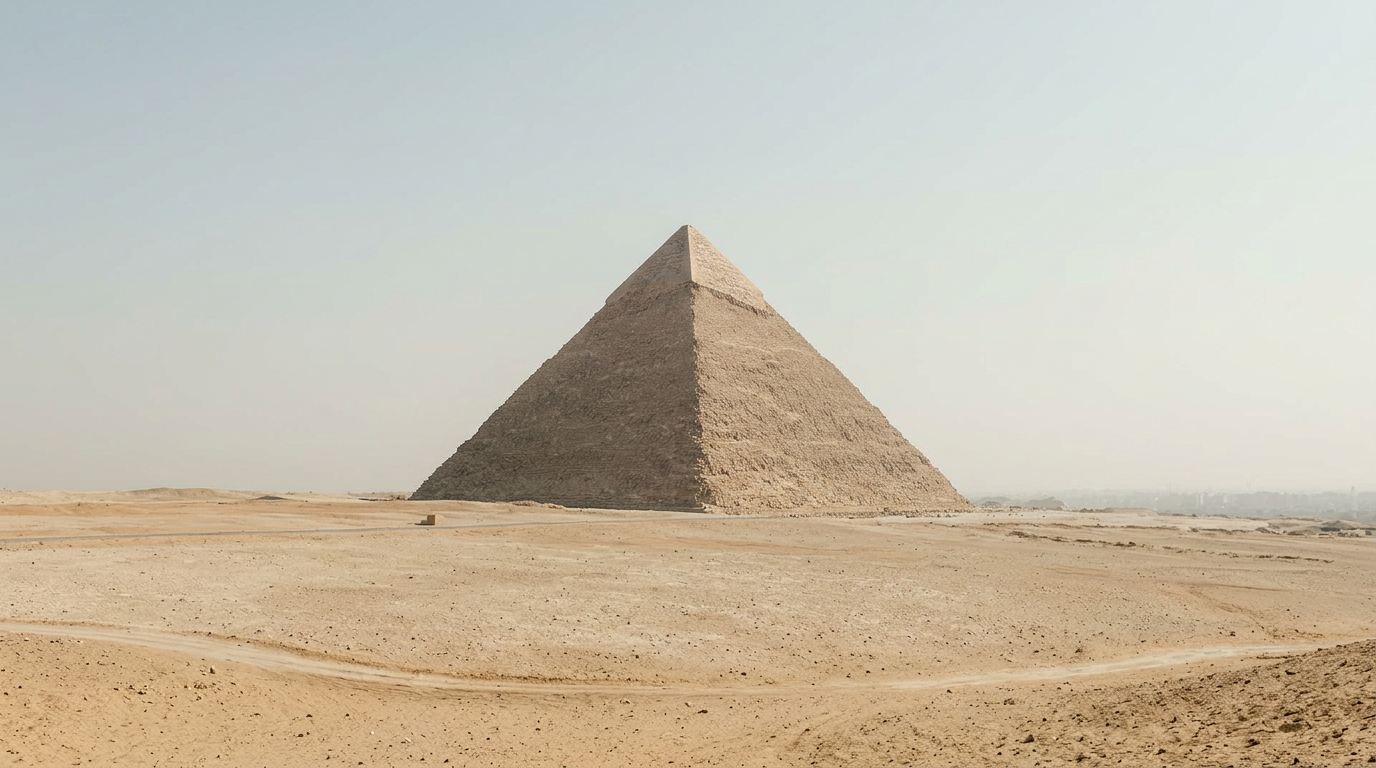
Quick Answer
Cleopatra lived closer to the Moon landing than to the building of the Great Pyramid. This is because the pyramid was already ancient history, over 2,500 years old, when Cleopatra was alive. It highlights the immense span of ancient Egyptian civilisation, making her reign feel surprisingly modern in comparison to its origins.
In a hurry? TL;DR
- 1Cleopatra lived closer to the 1969 Moon landing than to the Great Pyramid's construction.
- 2The Great Pyramid predates Cleopatra by over 2,500 years, a gap longer than from her to today.
- 3Ancient Egypt wasn't a single era; the pyramid builders lived millennia before Cleopatra.
- 4Our perception of 'Ancient Egypt' compresses a vast timeline, obscuring these immense chronological distances.
- 5Cleopatra was a Hellenistic ruler looking back at the pyramids as ancient relics, not contemporaries.
- 6The time between the Great Pyramid and Cleopatra is longer than ten US histories stacked together.
Why It Matters
Cleopatra lived so much later than the pyramids that the ancient Egyptians who built them would be more alien to her than we are to her.
Cleopatra VII, the final ruler of the Ptolemaic Kingdom, lived closer to the invention of the iPhone and the 1969 Moon landing than to the construction of the Great Pyramid of Giza. While she is often grouped with the dawn of Egyptian civilization, she was actually a late-stage figure inhabiting a world already ancient to her.
- Chronological Gap One: The Great Pyramid was completed around 2560 BCE.
- Chronological Gap Two: Cleopatra was born in 69 BCE, roughly 2,491 years after the pyramid.
- Chronological Gap Three: The Apollo 11 Moon landing occurred in 1969 CE, just 2,038 years after Cleopatra’s birth.
- Cultural Context: Cleopatra was closer to us in time than to the builders of the structures she governed.
Why It Matters
This chronological skew forces us to rethink the scale of human history, revealing that Ancient Egypt was not a single era but a span of time so vast it dwarfs the entirety of the modern age.
The Illusion of Ancient History
We tend to compress the past into thematic blocks. In the popular imagination, the Pharaohs, the pyramids, and the Greco-Roman period all exist in a singular, dusty room marked Ancient Egypt. However, this is a profound misunderstanding of the timeline.
The Great Pyramid of Giza was already two and a half millennia old when Cleopatra took the throne. To put that in perspective, the time between the pyramid’s completion and Cleopatra’s reign is longer than the time between Cleopatra’s death and the present day.
The Numbers of the Nile
According to data maintained by the University of Oxford’s Ashmolean Museum, the Old Kingdom—the era of the great pyramid builders—concluded around 2181 BCE. Cleopatra, the last of the Ptolemies, did not begin her reign until 51 BCE.
The delta between these two points is staggering. By the time Cleopatra walked the streets of Alexandria, the Great Pyramid was already an ancient tourist attraction. She viewed these monuments with the same sense of historical distance that a modern Londoner might feel when looking at the remains of Roman Britain, only the gap was significantly wider.
Unlike the rulers of the Old Kingdom who built the pyramids, Cleopatra spoke Greek and was the first of her dynasty to bother learning the Egyptian language. She was a product of the Hellenistic age, a period of global trade and philosophy that looked more like the early modern world than the bronze-age civilization of Khufu.
The Geometry of Time
To visualize this, consider that the United States has existed for less than 250 years. You would need to stack ten American histories end-to-end to reach back to Cleopatra, but you would need twelve stacks to get from Cleopatra back to the completion of the Great Pyramid.
Practical Applications of Historical Scaling
Understanding this gap changes how we consume media and education. When we see films that mix aesthetic elements of the Old Kingdom with the political drama of the Roman era, we are seeing a historical mashup equivalent to placing a Silicon Valley tech mogul in the middle of the Viking Age.
Historical scaling helps in:
- Museum Curation: Recognizing that artifacts in an Egyptian wing may be further apart in time than a Renaissance painting and a digital photograph.
- Archaeological Context: Understanding why Roman-era graffiti is found on monuments that were already thousands of years old when the Romans arrived.
- Narrative Writing: Creating more accurate depictions of how Cleopatra would have perceived her own heritage.
Interesting Connections
The word pyramid comes from the Greek pyramis, as the Greeks compared the structures to their own wheat cakes. The Egyptian word was actually mer.
While Cleopatra is the most famous Egyptian queen, she was technically a foreigner. Her family, the Ptolemies, were descendants of one of Alexander the Great’s generals. This makes her closer in lineage to the philosophers of Athens than to the architects of Giza.
Did Cleopatra ever visit the Great Pyramid?
Yes, as a ruler of Egypt, she was well aware of the Giza plateau. During her famous voyage up the Nile with Julius Caesar, they would have passed these monuments, which were already ancient icons of a bygone superpower.
How old was the Great Sphinx when Cleopatra was born?
The Sphinx is generally believed to have been built during the reign of Khafre, around 2500 BCE. This means it was roughly 2,400 years old when Cleopatra was born, making it as old to her as the Parthenon is to us today.
Was there anyone living between the Pyramid era and Cleopatra?
Yes, thousands of years of civilization. The gap includes the entire Middle and New Kingdoms, the reigns of Tutankhamun and Ramesses the Great, and the rise and fall of several other empires like the Hittites and Assyrians.
Key Takeaways
- Timeline: Cleopatra (69 BCE) is closer to the Moon landing (1969 CE) than the Great Pyramid (2560 BCE).
- Duration: Ancient Egypt lasted longer as a civilization than the time that has passed since its fall.
- Perspective: The pyramids were ancient history to the people we consider ancient.
- Geography: Alexandria, Cleopatra’s capital, was a Hellenistic city, distinct from the Memphis of the Old Kingdom.
Frequently Asked Questions
Sources & References
 WikipediaThis source verifies that Cleopatra VII was born in 69 BCE and was the last active ruler of the Ptolemaic Kingdom of Egypt.en.wikipedia.org
 Encyclopaedia BritannicaThis source confirms that the Great Pyramid of Giza was built in the 4th dynasty for King Khufu and completed by about 2560 BCE.britannica.com
- 3NASA ScienceThis source confirms that the Apollo 11 mission, which landed humans on the Moon, occurred in July 1969.nasa.gov