
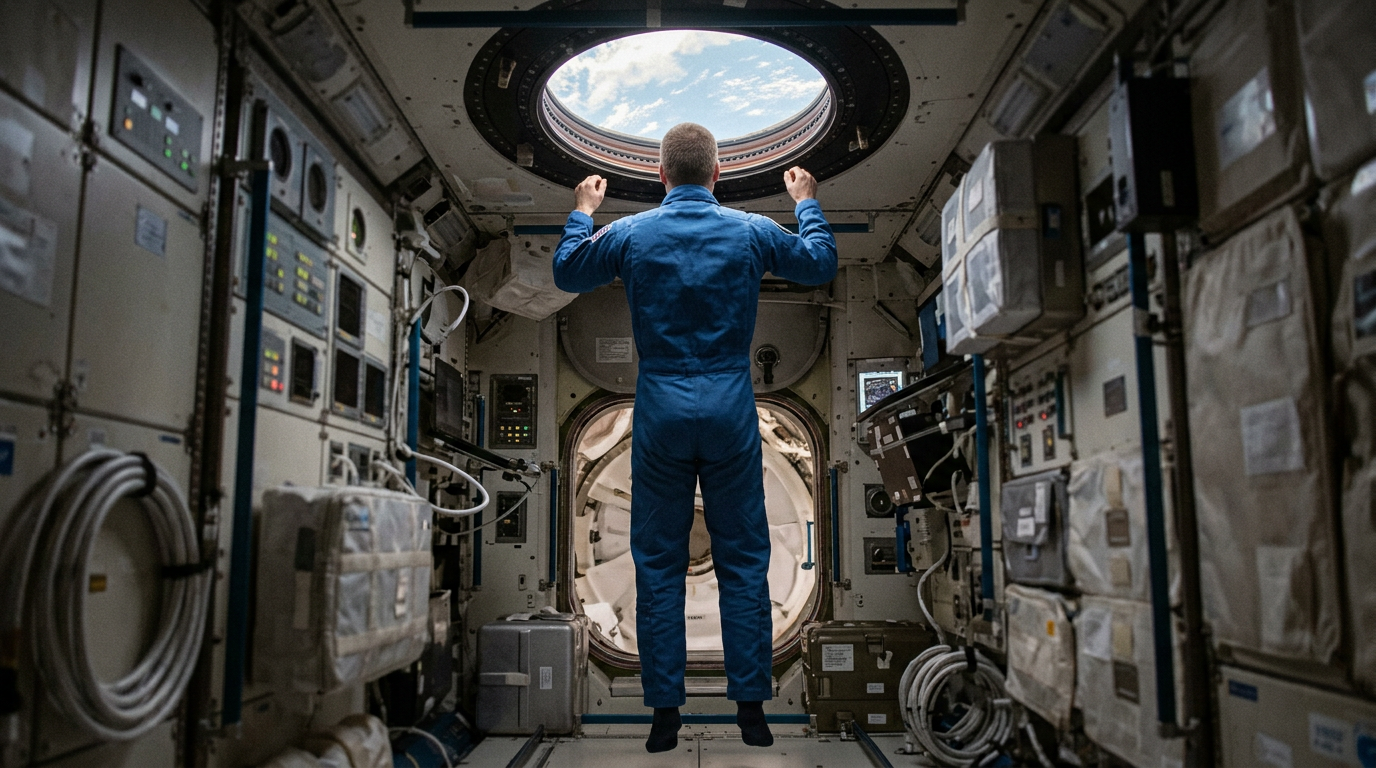
Quick Answer
Astronauts actually get taller in space! Without Earth's gravity to compress their spines, they can stretch up by as much as 5cm. It’s a temporary change, as they shrink back down upon returning, but it's a pretty neat reminder of how gravity influences our bodies every single day.
In a hurry? TL;DR
- 1Astronauts grow up to 5cm taller in space due to spinal decompression from lack of gravity.
- 2Microgravity allows spinal discs to expand, temporarily increasing astronaut height by 2-3%.
- 3This gained height reverts to normal within days or weeks upon returning to Earth's gravity.
- 4Spinal decompression can cause significant lower back pain for astronauts in the initial days of spaceflight.
- 5Understanding this height change is crucial for designing spacecraft and ensuring astronaut comfort and fit.
- 6Research, like the Twins Study, confirms this height increase and its relation to spinal muscle weakening.
Why It Matters
It's surprising that astronauts can temporarily grow up to 5cm taller in space because gravity no longer squashes their spines.
Astronauts physically expand while living in orbit, gaining as much as 5 centimetres in height because the absence of gravity allows the spinal column to decompress. This growth is temporary, as the return to Earth’s gravitational pull forces the vertebrae back into their original positions within days or weeks.
The Short Version
- Spinal Decompression: Microgravity removes the constant downward pressure on the vertebrae, allowing spinal discs to expand.
- Height Gain: NASA reports that astronauts typically grow between 2% and 3% taller during their missions.
- The Return: This extra height vanishes shortly after landing as Earth's gravity re-compresses the spine.
- Health Impact: The rapid expansion can lead to significant lower back pain during the first few days in space.
Why It Matters
Understanding how the human body reacts to microgravity is essential for long-term space travel, particularly as agencies eye multi-year missions to Mars that could permanently alter skeletal health.
The Growth Spurt in Orbit
When we stand on Earth, gravity pulls our bodies downward. This force compresses the intervertebral discs—the rubbery pads between the bones of the spine. Over the course of a day, these discs lose moisture and flatten slightly, which is why you are technically a few millimetres shorter at night than when you wake up.
In space, this compression vanishes. The discs absorb more fluid and expand, effectively lengthening the spine. According to research conducted by NASA’s Human Research Program, this can result in an astronaut gaining up to 5 centimetres (2 inches) in height. While this might sound like a perk, it creates logistical and physical challenges. Spacesuits are designed with a specific clearance, and if an astronaut grows too much, their suit may no longer fit correctly.
The Study of Spinal Elongation
A significant breakthrough in understanding this phenomenon came from the NASA Twins Study. While astronaut Scott Kelly spent nearly a year on the International Space Station, his identical twin, Mark Kelly, remained on Earth as a control subject. Upon his return, Scott was roughly two inches taller than his brother.
Researchers at the University of California, San Diego, used MRI scans to study astronauts before and after missions. Their findings, published in the journal Spine, revealed that the increase in height isn't just about the discs expanding. The muscles supporting the spine, specifically the multifidus muscles, actually weaken and atrophy because they no longer have to work against gravity to keep the body upright.
Practical Applications
Space agencies use this data to develop countermeasure exercises. Astronauts spend roughly two hours a day on treadmills and resistance machines that mimic the load of gravity. This is not just for muscle mass; it is to keep the spine under enough tension to prevent excessive elongation.
On Earth, this research helps doctors treat patients with chronic back pain or those who are bedridden for long periods. By observing how the spine reacts to a total lack of load, physical therapists can develop better decompression therapies for civilian use.
Interesting Connections
- Spacesuit Design: The Extravehicular Mobility Unit (EMU) has adjustable sizing rings to accommodate the fact that the wearer will get taller once they leave the atmosphere.
- Daily Fluctuations: Even on Earth, you lose about 1% of your height every day due to gravity, regaining it while you sleep.
- Moon Walking: Because the Moon has one-sixth of Earth's gravity, astronauts there would still experience some compression, but far less than they do at home.
Does the height gain stay forever?
No. Once an astronaut returns to Earth, gravity immediately begins to compress the spine again. Most return to their pre-flight height within a few days or weeks.
Does it hurt to get taller?
Yes, many astronauts report significant lower back pain during their first few days in space. The nerves and muscles are stretched as the spine expands, which can be quite uncomfortable until the body adjusts.
Can everyone grow 5 centimetres?
The amount of growth varies by individual. Factors include the length of time spent in space, the initial health of the spinal discs, and the person’s original height.
Key Takeaways
- Cause: The absence of gravitational loading allows spinal discs to hydrate and expand.
- Measurement: Astronauts gain roughly 3% of their total body height.
- Side Effects: Spinal elongation is linked to muscle atrophy and a higher risk of post-flight injury.
- Reversibility: The effect is entirely temporary and depends on the environment.
We are built for 1G. Take us out of that environment, and our skeletons literally begin to unravel, proving that our physical stature is not a fixed trait, but a constant negotiation with the planet beneath our feet.
Frequently Asked Questions
Sources & References
 Encyclopaedia BritannicaBritannica explains that astronauts experience an increase in height (up to several centimeters) while in orbit because the absence of gravity allows intervertebral discs to expand, with this change being temporary.britannica.com
 WikipediaBackground and contexten.wikipedia.org
 Scientific AmericanScientific research and analysisscientificamerican.com
 BBCReporting and verificationbbc.co.uk