
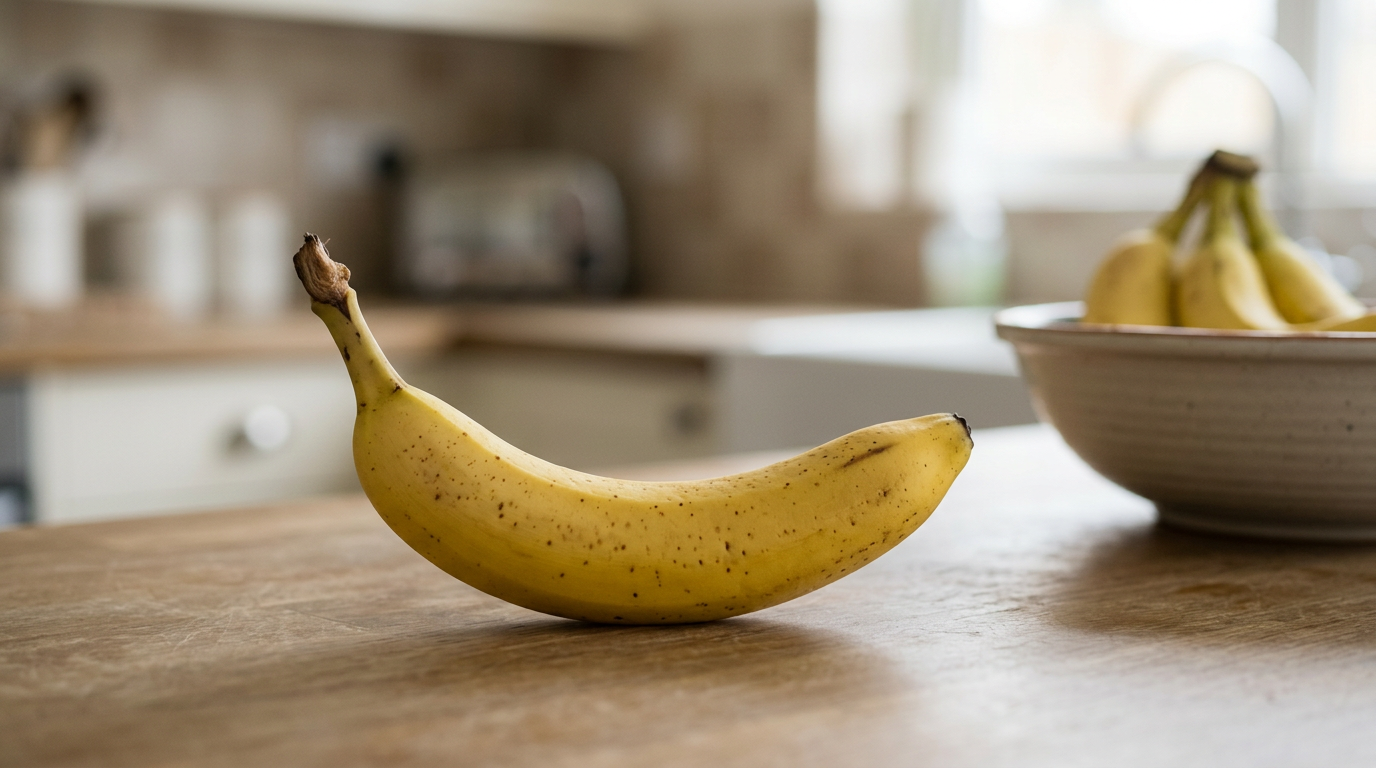
Quick Answer
You can eat bananas without worry, even though they're slightly radioactive. This is because they contain potassium-40, a natural radioactive element found everywhere. The amount is incredibly tiny, posing no health risk. It's a fun, everyday example of the natural radiation we're all exposed to.
In a hurry? TL;DR
- 1Bananas are naturally radioactive due to potassium-40, a common isotope, but pose no health risk.
- 2Each banana contains about 15 Becquerels of potassium-40, emitting a minuscule 0.1 microsieverts dose.
- 3Your body regulates potassium, excreting excess, so eating bananas doesn't increase your internal radiation.
- 4The 'Banana Equivalent Dose' (BED) is an informal unit to explain small radiation amounts.
- 5A chest X-ray is like eating ~700 bananas; a flight is like ~400, showing comparative doses.
- 6Other foods like Brazil nuts and potatoes are also naturally radioactive, some more than bananas.
Why It Matters
It's surprising that a common fruit like a banana is naturally radioactive due to its potassium content.
Every banana you eat contains a tiny amount of potassium-40, a naturally occurring radioactive isotope. While this sounds alarming, the radiation levels are so low that they pose zero risk to human health.
Quick Answer
Bananas are radioactive because they are rich in potassium, a small fraction of which exists as the unstable isotope potassium-40. This creates a measurable but harmless level of ionizing radiation emitted by the fruit.
The Banana Data
- Isotope: Potassium-40 (K-40)
- Average activity: 15 Becquerels (Bq) per banana
- Dose per fruit: 0.1 microsieverts (µSv)
- Half-life: 1.25 billion years
- Daily intake risk: Zero
Why It Matters
Understanding banana radioactivity helps contextualize natural background radiation, providing a relatable benchmark for discussing nuclear safety and environmental science.
The Science of the Yellow Fruit
The radioactivity in bananas is not the result of contamination or artificial ripening processes. It is a fundamental property of the element potassium. In nature, potassium is composed of three isotopes. Most of it is stable potassium-39, but 0.0117 percent is potassium-40, which is radioactive.
Because bananas are famous for their high potassium content, they naturally concentrate this isotope. When the potassium-40 atoms decay, they release electrons (beta particles) and occasionally gamma rays. This makes every banana a very weak, edible source of radiation.
The Banana Equivalent Dose
In the late 1990s, the concept of the Banana Equivalent Dose (BED) was created as an informal measurement tool. It was designed to explain very small radiation doses to the public by comparing them to the amount of radiation received from eating one banana.
For perspective, a chest X-ray is equivalent to eating about 700 bananas. A flight from London to New York exposes a passenger to the radiation equivalent of roughly 400 bananas due to increased cosmic ray exposure at high altitudes.
Natural Radiation Sources
Bananas are far from the only radioactive items in your pantry. Many common foods contain potassium-40 or other isotopes like radium-226.
- Brazil Nuts: These are significantly more radioactive than bananas because their deep root systems absorb radium from the soil.
- Potatoes: Like bananas, these are high-potassium tubers that emit measurable beta radiation.
- Carrots and Lima Beans: Both contain trace amounts of K-40.
- Granite Worktops: Many kitchens emit low levels of radon gas, a byproduct of uranium decay within the stone.
Detection and Security
The radioactivity of bananas is high enough to occasionally trigger false alarms at international ports. Radiation portal monitors, used to detect the smuggling of nuclear materials, sometimes flag shipping containers filled with bananas or ceramic tiles.
Security personnel use isotope identifiers to distinguish the harmless gamma signature of potassium-40 from more dangerous materials like plutonium or highly enriched uranium.
Practical Applications
- Public Science Education: Educators use bananas to demonstrate Geiger counters in classrooms without needing hazardous materials.
- Health Communication: Doctors use the BED to help patients understand the negligible risk of dental X-rays.
- Nuclear Calibration: Small amounts of potassium chloride are sometimes used to calibrate sensitive laboratory equipment.
Interesting Connections
- Human Bodies: Humans are also radioactive. Because we require potassium to function, the average adult contains about 140 grams of potassium, making us significantly more radioactive than a single banana.
- Evolution: Some scientists argue that natural background radiation, including that from potassium, has played a role in driving genetic mutations throughout evolutionary history.
- The Sun: Most of our daily radiation comes from space, not our food. The atmosphere shields us from the worst of it, but solar radiation is a constant factor of life on Earth.
Is it dangerous to sleep next to a bunch of bananas?
No. The radiation emitted is so weak that it is easily blocked by air or skin. You receive more radiation from the natural potassium in your own body than you would from a nearby banana.
How many bananas would it take to cause radiation poisoning?
It is biologically impossible to die from banana radiation. You would need to eat roughly 10 million bananas in one sitting to receive a lethal dose, at which point the radiation would be the least of your medical concerns.
Do organic bananas have less radiation?
No. Radioactivity is a property of the potassium atom itself. Whether the banana is organic, GMO, or wild-grown, the ratio of potassium-40 remains the same.
Key Takeaways
- Natural Source: Banana radioactivity comes from potassium-40, a naturally occurring isotope.
- Comparison Tool: The Banana Equivalent Dose helps people understand low-level radiation risks.
- Biological Regulation: Your body regulates potassium levels, meaning the radiation does not accumulate.
- Commonality: Radioactivity is a standard feature of the natural world and many common foods.
Learn more about everyday science by exploring our guides on [how sunlight creates vitamin D], [the chemistry of coffee], and [why the ocean is salty].
Frequently Asked Questions
Sources & References
 WikipediaBackground and contexten.wikipedia.org
 Scientific AmericanScientific research and analysisscientificamerican.com
 BBCReporting and verificationbbc.co.uk
- WikipediaThis source explains that the Banana Equivalent Dose (BED) is an informal unit of measurement used to explain very small doses of ionizing radiation to the public, comparing them to the amount of radiation received from eating one banana.en.wikipedia.org