
Quick Answer
Bubble wrap was originally invented as a funky, textured wallpaper in 1957. Sadly, no one wanted to adorn their homes with it, and the idea flopped. It's quite funny to think that this failed fashion statement later became the king of protective packaging, saving countless fragile items.
In a hurry? TL;DR
- 1Bubble wrap was invented in 1957 as a textured, 3D wallpaper that ultimately failed to gain market traction.
- 2After its wallpaper flop, the inventors rebranded it as Air Cap and attempted to market it as greenhouse insulation, which also struggled.
- 3Bubble wrap's major breakthrough came when it was used to protect the delicate IBM 1401 computer during shipping in 1960.
- 4The successful pivot to protective packaging transformed bubble wrap into a multi-billion dollar industry staple.
- 5This story highlights how market demand, not original intent, often determines an invention's true value.
- 6The product's success hinged on its physical properties for protection, rather than its initial aesthetic appeal.
Why It Matters
It's surprising that bubble wrap, now essential for protecting fragile items, was initially conceived as a rather unappealing textured wallpaper.
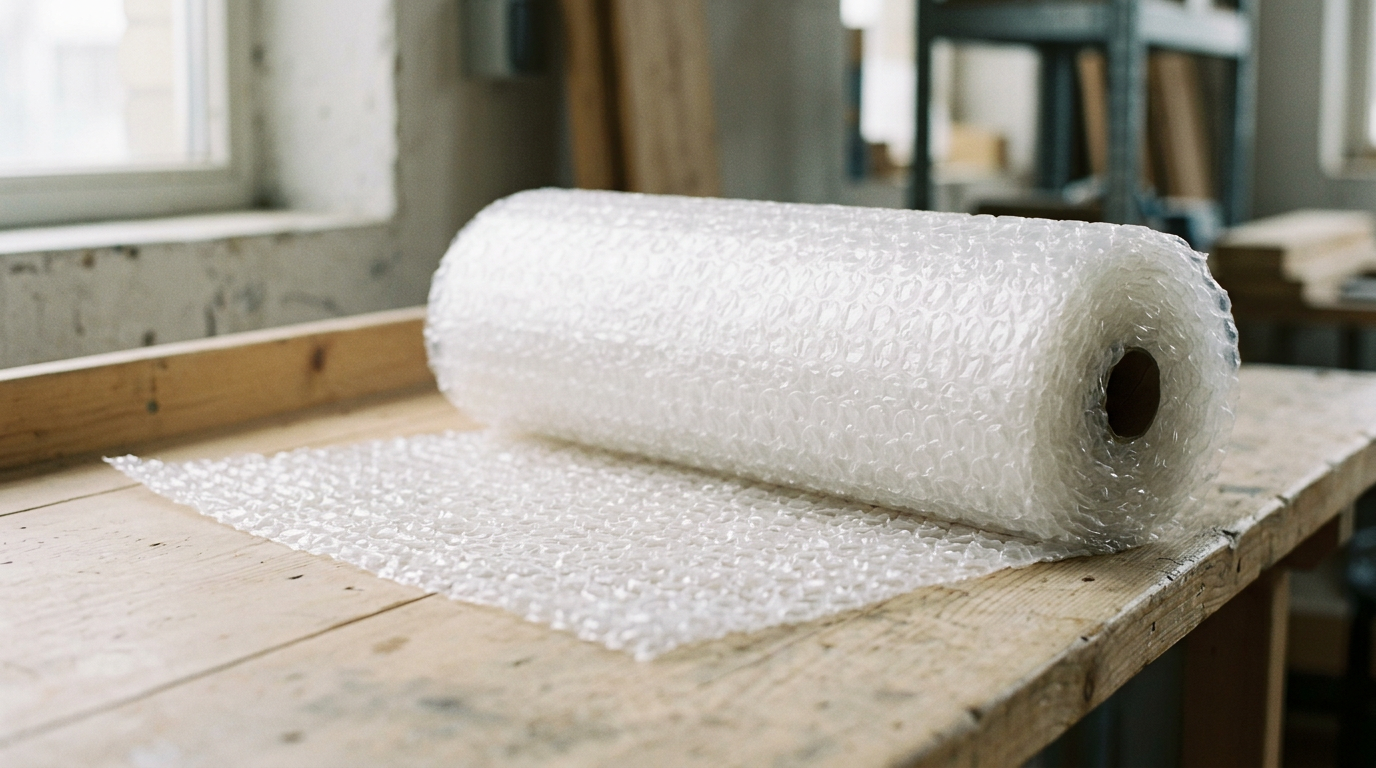
Before it became the world’s most addictive packing material, bubble wrap was intended to be high-end home decor. In 1957, inventors Alfred Fielding and Marc Chavannes sealed two shower curtains together, trapping a layer of air bubbles to create a textured, three-dimensional wallpaper.
Quick Answer
Bubble wrap was originally engineered as a tactile wallpaper and later marketed as greenhouse insulation before finding its purpose as protective packaging. It was the result of a failed design experiment that eventually saved the shipping industry.
TL;DR
- Inventors: Alfred Fielding and Marc Chavannes
- Original Purpose: Textured 3D wallpaper for the 1950s avant-garde
- Second Pivot: Greenhouse insulation
- Big Break: Protecting the IBM 1401 computer in 1960
- Current Status: A multi-billion dollar industry staple
Why It Matters
This pivot represents one of the most successful product rebrands in history, proving that the value of an invention is often determined by the market, not the original intent of the creator.
Key Facts and Figures
Year Invented: 1957 Company Name: Sealed Air Corp Number of Bubbles: Millions produced per minute Primary Customer Pivot: IBM (1960) Annual Revenue: Sealed Air Corp now generates billions globally
The Wallpaper That Flopped
Fielding and Chavannes were not looking to revolutionise the post office. Working in a garage in Hawthorne, New Jersey, they were attempting to capture the zeitgeist of the 1950s interior design world. They believed the future of home decor lay in texture rather than just patterns.
By running two plastic films through a heat-sealing machine, they accidentally created a sheet of trapped air pockets. While the texture was consistent and the seal was tight, the aesthetic did not resonate with homeowners. The 1950s housewife was not ready to cover her walls in plastic bubbles.
From Greenhouses to Mainframes
When the wallpaper idea failed, the duo rebranded the product as Air Cap and marketed it as insulation for greenhouses. Air is a poor conductor of heat, making it a logical choice for temperature control. However, this too failed to gain significant traction due to durability issues and competition from traditional materials.
The breakthrough came three years later when Frederick W. Bowers, a marketer at the newly formed Sealed Air Corp, pitched the material to IBM. The tech giant had just announced the IBM 1401, one of the first mass-produced computers. These machines were delicate, expensive, and prone to damage during transit.
Unlike traditional wood shavings or crumpled newspaper, Air Cap provided a lightweight, shock-absorbing layer that kept sensitive electronics static-free and intact. IBM signed on, and the shipping industry was fundamentally altered.
The Engineering of Pop
The science behind the product is deceptively simple. According to researchers at the University of Alabama, the protective power of the bubble comes from the distribution of pressure. When an object hits a bubble, the air inside compresses, absorbing the kinetic energy that would otherwise shatter the item.
Today, Sealed Air Corp produces enough bubble wrap annually to wrap the entire Earth in a plastic cocoon multiple times. While the original product was made of polyethylene, modern versions use multi-layer films to prevent the air from leaking out over long durations, a process known as barrier coating.
Practical Applications
- Electronics: Protecting circuit boards from vibration and impact.
- Fine Art: Wrapping sculptures and framed works to prevent surface abrasion.
- Stress Relief: While not an intended use, the psychological satisfaction of popping bubbles is a global cultural phenomenon.
- Temperature Control: Still used in niche applications for lining cold-chain shipping boxes.
Interesting Connections
- Etymology: The name Bubble Wrap was trademarked by Sealed Air Corp, though it has become a genericised trademark used by the public for any air-cushion packaging.
- Art World: In contrast to its failed start as wallpaper, bubble wrap has been used by contemporary artists like Bradley Hart, who injects paint into individual bubbles to create pixelated portraits.
- Psychology: Studies suggest that popping bubble wrap can reduce muscle tension and provide a meditative sensory experience.
Why was bubble wrap rejected as wallpaper?
The 1950s aesthetic favoured clean lines and sophisticated patterns. A plastic, bubbly wall covering felt too industrial and strange for the domestic interior design market of the era.
Who owns the bubble wrap brand?
Sealed Air Corporation remains the owner of the Bubble Wrap brand. They transitioned from a small garage operation to a Fortune 500 company on the back of this single invention.
Can bubble wrap be recycled?
Most bubble wrap is made of low-density polyethylene (LDPE). While it is recyclable, it cannot be placed in standard kerbside bins as the thin film can jam sorting machinery; it usually requires specialised drop-off points.
Key Takeaways
- Created in 1957: Originally meant to be a 3D wallpaper for modern homes.
- Twice failed: It failed as decor and as greenhouse insulation before finding its niche.
- IBM saved the product: The need for safe computer transport turned it into a global standard.
- Engineering success: The trapped air provides a superior weight-to-protection ratio compared to traditional packing materials.
Frequently Asked Questions
Sources & References
 WikipediaBackground and contexten.wikipedia.org
 Scientific AmericanScientific research and analysisscientificamerican.com
 BBCReporting and verificationbbc.co.uk
 Smithsonian MagazineThis source confirms that bubble wrap was originally intended to be textured wallpaper and that inventors Alfred Fielding and Marc Chavannes created it in 1957 by sealing two shower curtains together to trap air bubbles.smithsonianmag.com