
Quick Answer
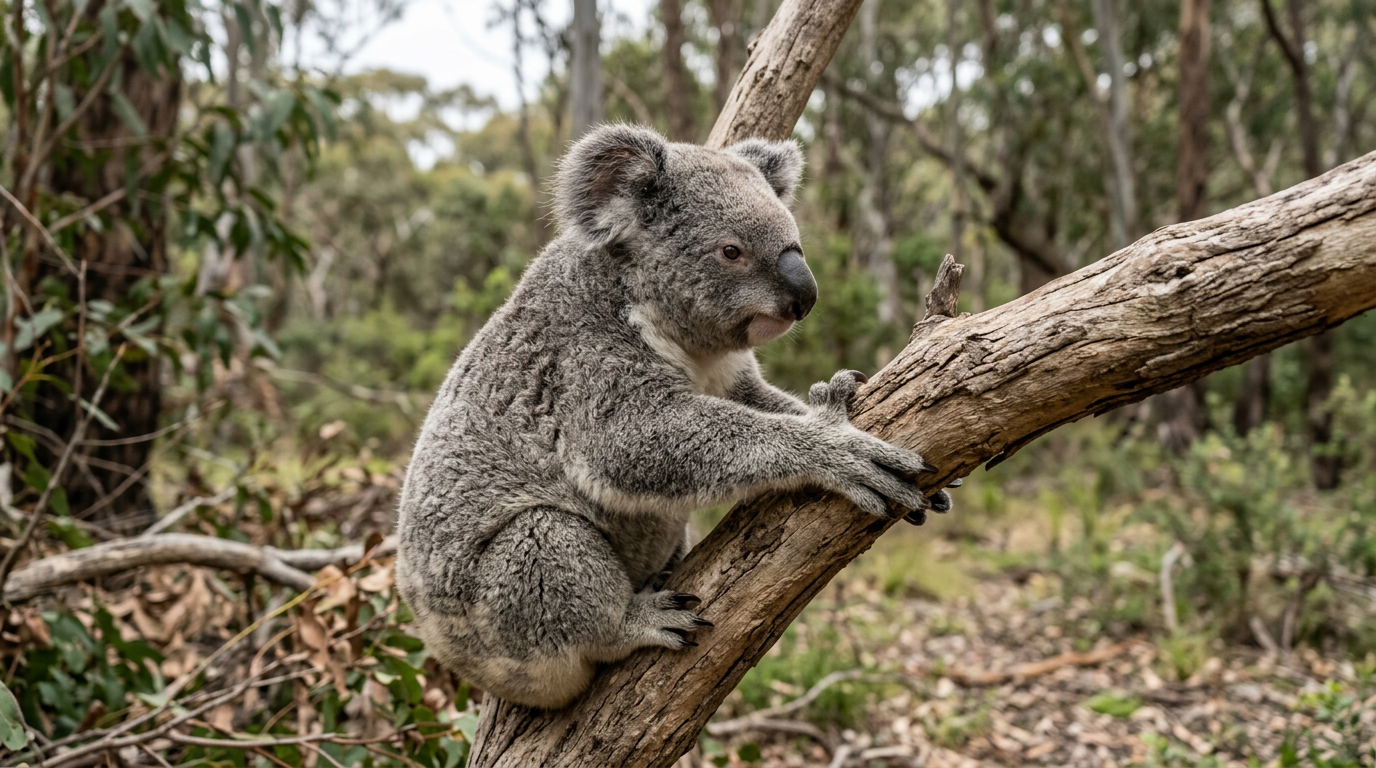
Koalas have fingerprints that look so much like ours, they've apparently confused police at crime scenes. It's pretty surprising because koalas and humans are so distantly related, yet we both developed these complex, identical patterns on our fingertips to help us grip things.
In a hurry? TL;DR
- 1Koalas possess fingerprints with loops, whorls, and arches nearly identical to human patterns.
- 2This trait evolved independently in koalas for enhanced grip and tactile sensitivity while climbing and feeding.
- 3Koala fingerprints are so similar to human ones they could confuse crime scene investigators by leaving false positive traces.
- 4This is a prime example of convergent evolution, where unrelated species develop similar complex traits.
- 5The detailed ridges on koala fingers increase friction, aiding precise manipulation of branches and leaf selection.
- 6Unlike other marsupials, koalas developed fingerprints, challenging assumptions about this trait being exclusive to primates.
Why It Matters
It's surprising that koalas, who last shared a common ancestor with humans over 100 million years ago, have fingerprints so similar to ours that they could potentially confuse crime scene investigators.
Koalas share an evolutionary trait with humans that is as specific as it is unexpected: their fingerprints are virtually indistinguishable from our own, even under microscope magnification. This biological quirk is so pronounced that police in Australia have long joked about koalas inadvertently contaminating crime scenes.
The Quick Answer
Koalas possess unique dermatoglyphs (fingerprints) that feature loops, whorls, and arches nearly identical to human patterns. Despite our last common ancestor living over 100 million years ago, these marsupials developed human-like ridges to enhance grip while climbing and feeding.
Key Facts and Data
- Species: Phascolarctos cinereus (Koala)
- Pattern Type: Dermatoglyphs (ridges on skin)
- Evolutionary Gap: 100 million years since last common ancestor
- Discovery Year: 1996 (Biological Sciences, University of Adelaide)
- Primary Function: Tactile sensitivity and mechanical grip
Why It Matters
This is a premier example of convergent evolution, where two unrelated species develop the same complex trait independently to solve the same problem. It challenges the assumption that complex fingerprints are a strictly primate characteristic.
The Crime Scene Conundrum
In 1996, Maciej Henneberg, a biological anthropologist at the University of Adelaide, revealed that koala fingerprints could easily be mistaken for those of a human. Henneberg noted that even though most people assume these patterns are unique to primates, the koala’s ridges feature the same bifurcations and endings found in human prints.
Police forensic kits are designed to pick up these specific oil and sweat patterns. Because koalas inhabit suburban areas in Australia, their presence near outdoor crime scenes is not just a theoretical concern. Unlike other animals with pads, the koala’s print mimics the scale and complexity of a human adult’s finger, potentially leading to false positives in manual forensic screening.
The Mechanics of the Grip
The reason for this similarity boils down to physics. Koalas are picky eaters that subsist almost entirely on eucalyptus leaves. To find the best leaves, they must reach out and grasp small branches with extreme precision.
Researchers at the University of Adelaide suggested that the fingerprints evolved as a way to increase friction. By creating a textured surface on the finger pads, the koala gains better control over its movements. The ridges also house sensory receptors that allow the animal to feel the texture and quality of a leaf before committing to a bite.
Unlike other marsupials like kangaroos or wombats, which have smoother paws, the koala needs the mechanical advantage of a textured grip to survive in the canopy.
Real World Scenarios
- Forensic Training: Forensic students in Australia are often shown koala prints alongside human ones to demonstrate the necessity of high-resolution analysis.
- Evolutionary Mapping: Biologists use the koala as a case study to prove that fingerprints are not a requirement of being a primate, but rather a requirement of being a climber.
- Veterinary Identification: While not widely used, fingerprints offer a potential way to track individual koalas in the wild without invasive tagging.
Interesting Connections
- The word dermatoglyph comes from the Greek derma (skin) and glyph (carving).
- Most other mammals, including dogs and cats, have paws with pads that lack these distinct ridges.
- Chimpanzees and bonobos also have fingerprints, but because they are our closest relatives, their similarity is expected rather than surprising.
Can a koala actually be framed for a crime?
While a koala print might confuse a preliminary search, a professional forensic examiner looking at the entire hand shape would quickly realise the print did not come from a human palm.
Do other marsupials have fingerprints?
No. Closely related species like the wombat lack these ridges, suggesting the trait evolved specifically for the koala’s arboreal lifestyle.
Are koala fingerprints unique to each individual?
Yes. Just like human fingerprints, the specific arrangement of ridges on a koala’s finger is unique to that specific animal, though no global database exists to track them.
Key Takeaways
- Koalas are the only non-primates with fingerprints that mimic human patterns.
- The similarity is so close that it can theoretically mask human prints at crime scenes.
- The trait is a result of convergent evolution, driven by the need for a precise grip.
- This discovery was formalised by researchers at the University of Adelaide in the mid-90s.
Nature rarely repeats itself so precisely, yet the koala stands as a reminder that biology often finds the same solution to the same problem, regardless of the species.
Frequently Asked Questions
Sources & References
 WikipediaBackground and contexten.wikipedia.org
 Scientific AmericanScientific research and analysisscientificamerican.com
 BBCReporting and verificationbbc.co.uk
- 4Phascolarctos cinereusThis University of Michigan Museum of Zoology site confirms the scientific name of the koala as Phascolarctos cinereus and describes their arboreal adaptations, which include excellent grasping abilities on trees.animaldiversity.org