
Quick Answer
Sloths can hold their breath for an astonishing 40 minutes, beating even dolphins! They achieve this incredible feat by drastically slowing their heart rate, almost to a standstill. This adaptation is fascinating as it reveals how these famously unhurried animals possess a remarkable underwater survival skill, proving they're surprisingly capable swimmers when they need to be.
In a hurry? TL;DR
- 1Sloths can hold their breath for up to 40 minutes, significantly longer than dolphins, by drastically slowing their heart rate.
- 2This extended breath-holding ability is achieved through bradycardia, reducing their heart rate to conserve oxygen.
- 3Sloths are surprisingly adept swimmers, using water for travel and achieving speeds three times faster than on land.
- 4Their aquatic endurance is a survival strategy, allowing them to escape predators and navigate fragmented habitats.
- 5Unlike active marine mammals like dolphins, sloths conserve energy by remaining largely still underwater.
- 6This physiological efficiency showcases sloths' slowness as a highly evolved survival adaptation.
Why It Matters
It's fascinating that sloths, known for their slowness, can hold their breath for an astonishingly long time, even longer than dolphins, by drastically slowing their heart rate.
Sloths can submerge themselves underwater for up to 40 minutes at a time. This feat is possible because they can slow their heart rate to one-third of its normal pace, allowing them to outlast even the common bottlenose dolphin in a breath-holding contest.
Quick Summary
- Sloths are surprisingly capable swimmers that use the water to travel between forest patches.
- They possess a bradycardic response, dropping their heart rate to significantly conserve oxygen.
- While a dolphin typically surfaces every 8 to 10 minutes, a sloth can remain submerged for nearly three-quarters of an hour.
- This aquatic endurance is a survival mechanism rather than a primary lifestyle trait.
Why It Matters
Understanding the sloth’s physiological efficiency reframes our perception of their slow nature as a highly evolved survival strategy rather than a biological defect.
The Breath-Holding Data
| Metric | Three-Toed Sloth | Bottlenose Dolphin |
|---|---|---|
| Max Breath Hold | 40 Minutes | 8-15 Minutes |
| Typical Heart Rate | 70-80 BPM | 100+ BPM |
| Submerged Heart Rate | Less than 20 BPM | Variable |
| Primary Movement | Arboreal / Swimming | Aquatic |
The Aquatic Sloth
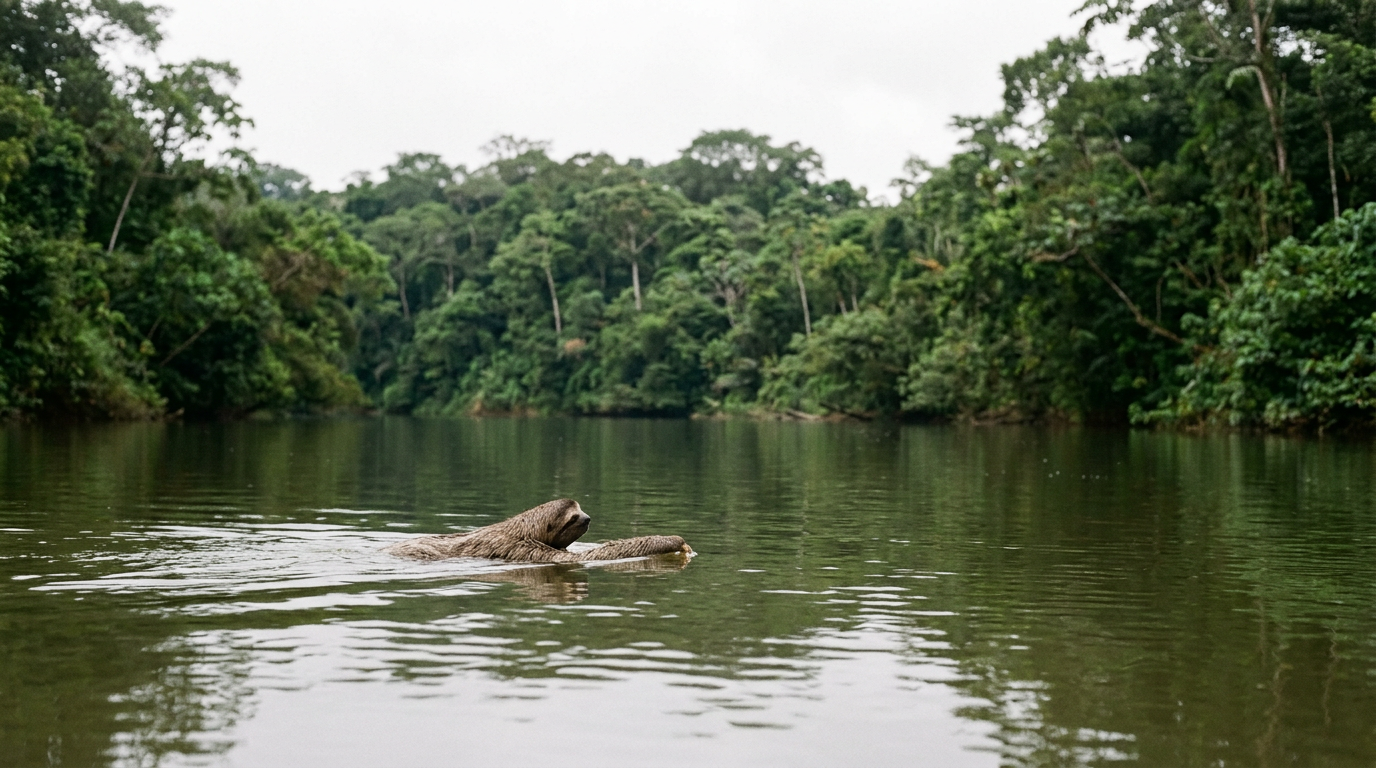
The image of a sloth usually involves a slow-motion crawl through the canopy of a tropical rainforest. However, the three-toed sloth is an adept swimmer. When the forest floors flood or a river blocks their path, they drop into the water and use their long arms to perform a version of the breaststroke.
According to research conducted by the Sloth Conservation Foundation, sloths are three times faster in the water than they are on land. This mobility is essential for finding mates or new foraging grounds in fragmented habitats. The ability to hold their breath isn't just a party trick; it is a defensive requirement for an animal that moves too slowly to outrun a predator on the ground.
The Science of Slowing Down
The secret to the sloth’s endurance lies in metabolic suppression. When a sloth enters the water, it triggers a physiological shift known as bradycardia. While many mammals experience a slight drop in heart rate when submerged, the sloth’s heart rate plummets to a fraction of its resting state.
Unlike dolphins, which are active hunters requiring constant oxygen to power their muscles, sloths remain largely buoyant and still. Their large stomachs, which can account for a third of their body weight, are often filled with fermenting vegetation that produces gas, acting like a natural life jacket.
Comparative Context
In contrast to the sloth, the bottlenose dolphin is a high-energy mammal. While dolphins are built for the water, their metabolic demands are immense. According to studies published in the journal Experimental Biology, dolphins usually surface every few minutes to replenish oxygen stores depleted by high-speed swimming.
The sloth, by contrast, succeeds through extreme passivity. While a dolphin is a Ferrari idling at high RPMs, the sloth is a bicycle parked in the shade. The sloth’s ability to outlast a dolphin isn't about lung capacity—it is about how slowly they spend the oxygen they have.
Practical Scenarios
Crossing a River
When a sloth reaches a body of water, it does not hesitate. It uses its natural buoyancy to float and its powerful forelimbs to paddle. If a bird of prey circles above, the sloth simply exhales and sinks beneath the surface, waiting out the threat for half an hour if necessary.
Surviving Floods
During the rainy seasons in the Amazon, the forest floor disappears. Sloths that find themselves trapped in lower branches use their breath-holding ability to navigate submerged corridors, moving between trees without having to climb to the canopy where they are more visible to jaguars.
Interesting Connections
- The word sloth comes from the Middle English slowthe, simply meaning laziness, though their biology is anything but lazy.
- Sloths have more neck vertebrae than giraffes, allowing them to keep their head above water while their body is submerged at odd angles.
- Manatees are the sloth’s closest ecological rivals in terms of slow-motion aquatic living, though they are not related.
Do sloths enjoy swimming?
It is less about enjoyment and more about efficiency. Swimming is significantly less energy-intensive for a sloth than crawling across the ground, where their weak hind legs struggle to support their weight.
Can two-toed sloths hold their breath as long?
While both two-toed and three-toed sloths can swim, the three-toed variety is generally noted for better aquatic performance and longer submersion times.
Why don't they drown if they fall asleep?
Sloths have a unique grip mechanism where their tendons lock shut. They can hang from a tree or hold a branch underwater without using any muscle power, meaning they don't lose their grip even if they are unconscious or deceased.
Key Takeaways
- Endurance over power: Sloths prove that metabolic efficiency can beat specialized aquatic biology in duration.
- Heart rate control: Dropping the heart rate to 1/3 of its normal pace is the primary mechanism for their 40-minute limit.
- Evolutionary history: Their swimming skills are likely linked to extinct semi-aquatic ancestors.
- Survival through stillness: The sloth’s lack of movement is its greatest defensive asset, both in the trees and under the waves.
Frequently Asked Questions
Sources & References
 Encyclopaedia BritannicaThis source corroborates that sloths are skilled swimmers and can hold their breath underwater for as long as 40 minutes.britannica.com
 WikipediaBackground and contexten.wikipedia.org
 Scientific AmericanScientific research and analysisscientificamerican.com
 BBCReporting and verificationbbc.co.uk