
Quick Answer
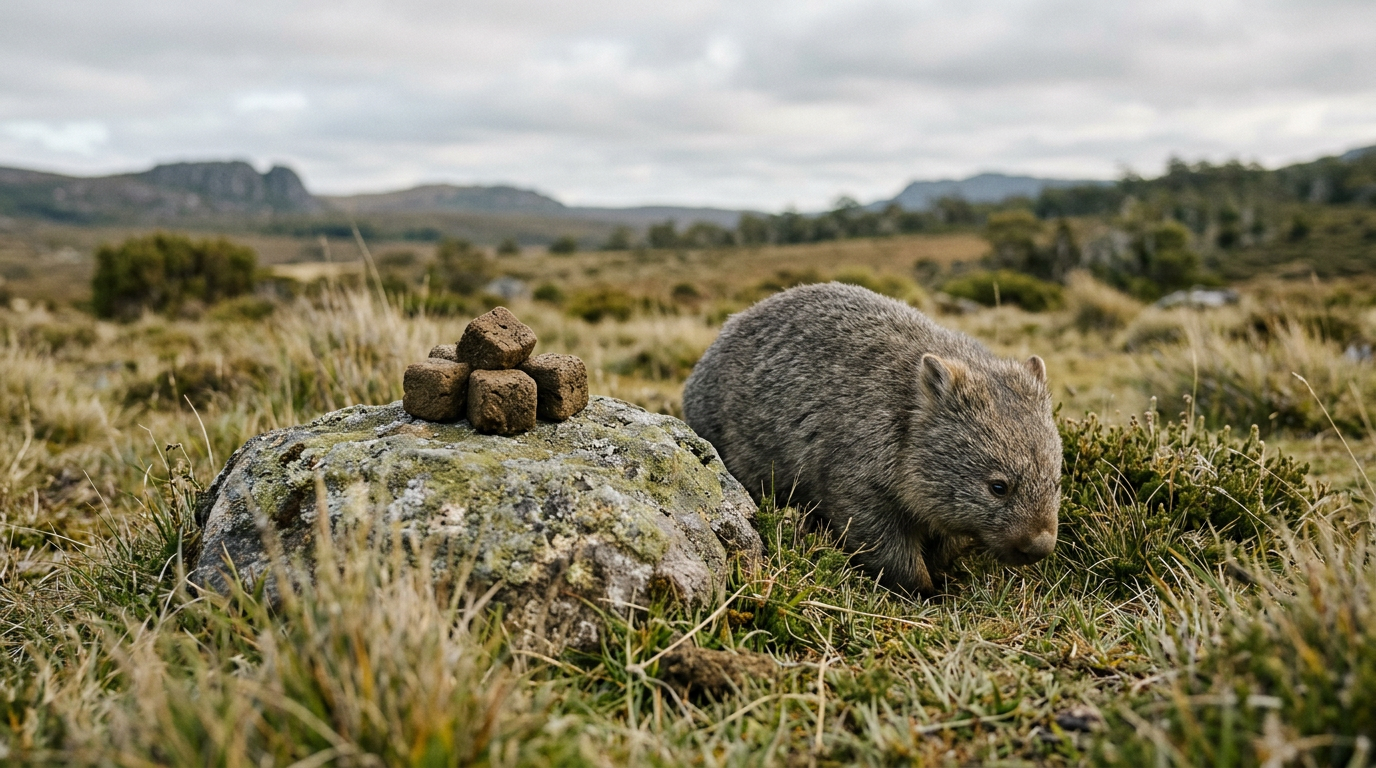
Wombats poop cubes! Scientists think this unique shape stops their droppings from rolling away, which is important for marking their territory on slopes. It's a brilliant example of nature finding a simple, effective solution to a practical problem, showing evolution's clever knack for design.
In a hurry? TL;DR
- 1Wombats produce cube-shaped droppings, unique in the animal kingdom, to prevent them from rolling away when marking territory.
- 2The wombat's intestine has varying stiffness zones that shape dry faeces into distinct cubes during digestion.
- 3This unique adaptation allows wombats to create stable territorial markers on elevated surfaces like logs and rocks.
- 4Wombat droppings are engineered for architectural stability over the typical energy efficiency seen in other mammals.
- 5Research into wombat gut mechanics is informing manufacturing engineers on creating precise shapes from soft materials.
- 6Wombats produce 80-100 cube droppings nightly for territorial signaling, aided by their slow metabolism.
Why It Matters
Wombats' cube-shaped droppings are an astonishing example of evolution engineering complex geometry to solve the practical problem of territorial marking.
The bare-nosed wombat is the only creature on Earth known to produce cube-shaped faeces, an evolutionary quirk that prevents their droppings from rolling away. By stacking these organic bricks on rocks and logs, wombats create distinct territorial markers that stay exactly where they are placed.
The Geometry of Survival
- Shape: Roughly six-sided cubes with distinct edges.
- Quantity: A single wombat can produce 80 to 100 cubes in one night.
- Purpose: Territorial signaling and scent communication.
- Mechanism: Non-uniform muscle contractions in the final section of the intestine.
- Discovery: The fluid dynamics of the process were first mapped in detail in 2018.
Why It Matters
This unique biological feat solves a specific topographical problem, proving that evolution can engineer complex geometry using nothing but soft tissue and muscle tension.
The Physics of the Cube
For decades, the mechanics of the wombat’s square output remained a biological mystery. How does a round anus produce a sharp-edged cube? The answer lies not at the exit point, but within the final eight percent of the wombat’s intestine.
Unlike human intestines, which possess a uniform elasticity, the wombat’s gut features two stiff zones and two flexible zones. As the waste dries out in the colon—a process where wombats excel due to their extremely slow metabolism—these varying levels of tension mould the faeces into rigid, flat-sided blocks.
Architecture for Communication
Wombats are solitary, nocturnal, and highly territorial. They have poor eyesight but an acute sense of smell. To navigate their social landscape without constant physical confrontation, they leave scented calling cards on elevated surfaces like fallen trees or the mounds of dirt outside their burrows.
If a wombat produced spherical droppings, its territorial markers would simply roll off these precarious perches. By producing cubes, the wombat ensures its scent remains at nose-height for any passing intruders. It is a low-energy way to say "this burrow is occupied" in a landscape where flat surfaces are a luxury.
Real-World Applications
The study of wombat intestines is not just a curiosity for biologists. Engineers are studying these biological systems to improve manufacturing techniques. Currently, creating cubes or non-spherical shapes usually requires moulding or cutting. The wombat provides a blueprint for how a soft, tubular system can produce consistent, geometric solids, which could eventually influence 3D printing and soft robotics.
Related Concepts
- Evolutionary Adaptation: How animals develop specific traits for survival.
- Fluid Dynamics in Biology: The study of how liquids and solids move through living systems.
- Animal Communication: The various ways species signal status and territory.
Key Takeaways
- The cube shape is a result of varying muscle stiffness in the intestine, not the shape of the anus.
- Wombats use the flat sides of their droppings to prevent them from rolling off rocks and logs.
- The discovery was led by researchers at Georgia Tech using mechanical stress tests on intestinal tissue.
- This adaptation allows for effective scent communication across large, rugged territories.
- The process relies on an extremely slow digestive cycle that removes almost all moisture from the waste.
While it may seem like a biological punchline, the wombat’s cube is a masterclass in functional design, turning a daily necessity into a stable, structural tool for communication.
Frequently Asked Questions
Sources & References
 WikipediaBackground and contexten.wikipedia.org
 Scientific AmericanScientific research and analysisscientificamerican.com
 BBCReporting and verificationbbc.co.uk
- BBC EarthThe BBC Earth article explains that wombats create cube-shaped droppings to mark their territory, preventing the faeces from rolling off rocks and logs.bbc.com