
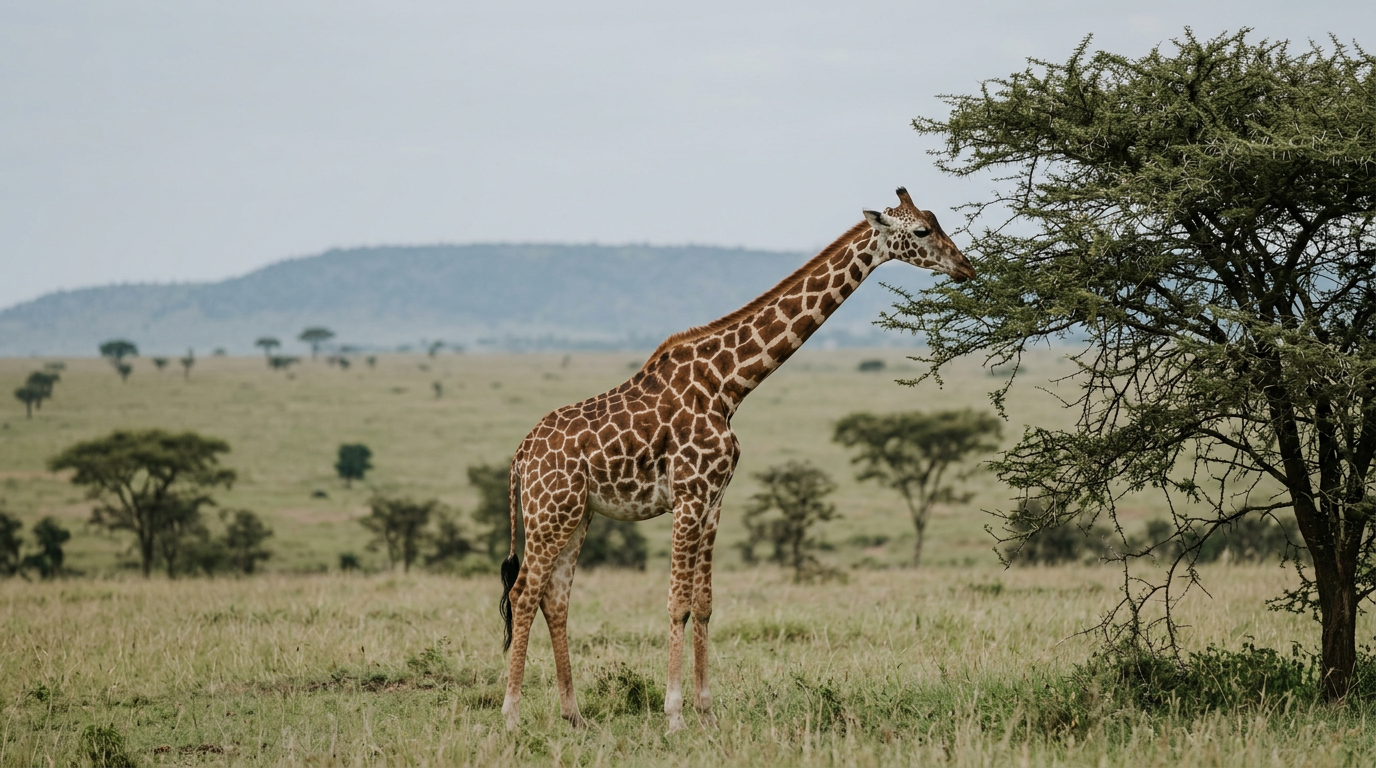
Quick Answer
Remarkably, giraffes have precisely seven neck bones, just like humans. This might seem unbelievable given their enormous height, but it's true. Each of these seven vertebrae is simply much, much longer than ours, showcasing a surprising evolutionary link and how different body plans can be achieved with similar fundamental structures.
In a hurry? TL;DR
- 1Giraffes, like humans and most mammals, have exactly seven neck vertebrae.
- 2Instead of more bones, giraffe necks achieve length through extreme elongation of each individual vertebra.
- 3The giraffe's seven elongated vertebrae create a less flexible neck requiring stiff, sweeping movements.
- 4A massive nuchal ligament supports the giraffe's neck weight, minimizing muscular effort.
- 5This skeletal consistency highlights how mammals adapt via scaling, not by altering fundamental body plans.
- 6Studying the giraffe neck offers insights into evolutionary adaptation and biomechanics for fields like robotics.
Why It Matters
It's surprising that giraffes and humans have the same number of neck bones, despite their wildly different sizes.
A giraffe possesses exactly seven cervical vertebrae in its neck, which is the identical number found in humans, mice, and almost every other mammal on Earth. Despite reaching lengths of over two metres, the giraffe neck relies on extreme elongation of individual bones rather than adding more segments to the skeletal structure.
Quick Facts and Figures
- Vertebrae Count: 7 cervical vertebrae
- Average Bone Length: Up to 28 centimetres per vertebra
- Neck Weight: Approximately 272 kilograms
- Total Height: Up to 5.5 metres
- Evolutionary Rule: Shared by 99 percent of mammalian species
The Rule of Seven
Mammalian evolution is remarkably rigid when it comes to the neck. From the tiny shrew to the massive blue whale, the count remains fixed at seven. This biological consistency is governed by Hox genes, which determine the body plan of an embryo during development.
Unlike birds, which can have as many as 25 neck vertebrae to allow for extreme flexibility, mammals opted for stability. According to research published in the journal PeerJ, the giraffe neck is not a feat of addition, but a masterpiece of scaling. Each individual bone has simply been stretched to accommodate the animal's towering height.
The Biomechanical Cost of Height
Maintaining a two-metre neck with only seven joints creates significant mechanical challenges. Because each bone is so long, the neck is less flexible than one might assume. A giraffe cannot turn its head with the fluid agility of a swan; instead, it moves its neck in stiff, sweeping arcs.
To support this heavy lever, giraffes possess a massive nuchal ligament. This cord of elastic tissue acts like a heavy-duty rubber band, allowing the animal to hold its head up with minimal muscular effort. Without this specialized anatomy, the sheer weight of the seven elongated bones would be impossible to manage.
Why It Matters
Understanding this skeletal parity helps researchers track how species adapt to their environments without changing their fundamental genetic makeup. The giraffe neck is a primary example of convergent evolution and niche specialization. It allows the animal to reach food sources that competitors cannot touch, all while maintaining the same basic hardware as a human sitting at a desk.
Practical Applications
- Robotics: Engineers study the giraffe's nuchal ligament to design more efficient heavy-lifting cranes and robotic limbs.
- Evolution Education: It serves as a perfect classroom example of how shared ancestry links seemingly unrelated species.
- Cardiovascular Research: Because giraffes must pump blood two metres straight up, they provide insights into managing high blood pressure.
Interesting Connections
- Blood Pressure: A giraffe's heart is twice as strong as a human's to overcome the gravity of its long neck.
- Sleep Habits: Because of the difficulty of getting back up, giraffes often sleep for only 30 minutes a day, frequently standing up.
- Necks as Weapons: Male giraffes engage in necking, a form of combat where they swing their heavy, seven-boned necks like sledgehammers to establish dominance.
Does a giraffe have more neck bones than a swan?
No. A swan has between 22 and 25 neck vertebrae, allowing for a much higher degree of flexibility. The giraffe has far fewer bones but they are significantly larger.
Are giraffe neck bones the same shape as human ones?
They are structurally similar but proportionally different. A giraffe's cervical vertebrae are much more elongated and have specialized ball-and-socket joints to allow for a greater range of motion despite the low bone count.
Can a giraffe break its neck?
Yes. Despite their thickness, the bones are susceptible to fractures during high-impact combat or falls. Because the neck houses the spinal cord and critical arteries, such injuries are usually fatal.
Key Takeaways
- Mammalian Blueprint: Humans and giraffes share the exact same number of neck bones (seven).
- Growth Strategy: Giraffes evolved through bone elongation, not by adding extra skeletal segments.
- Genetic Constraint: The count is fixed by Hox genes, which are nearly universal across the mammalian class.
- Mechanical Support: A specialized nuchal ligament is required to support the massive weight of the elongated vertebrae.
Frequently Asked Questions
Sources & References
 Encyclopaedia BritannicaThis source confirms that giraffes have only seven cervical (neck) vertebrae, which are greatly elongated, a characteristic shared with almost all other mammals.britannica.com
 WikipediaBackground and contexten.wikipedia.org
 Scientific AmericanScientific research and analysisscientificamerican.com
 BBCReporting and verificationbbc.co.uk