
Quick Answer
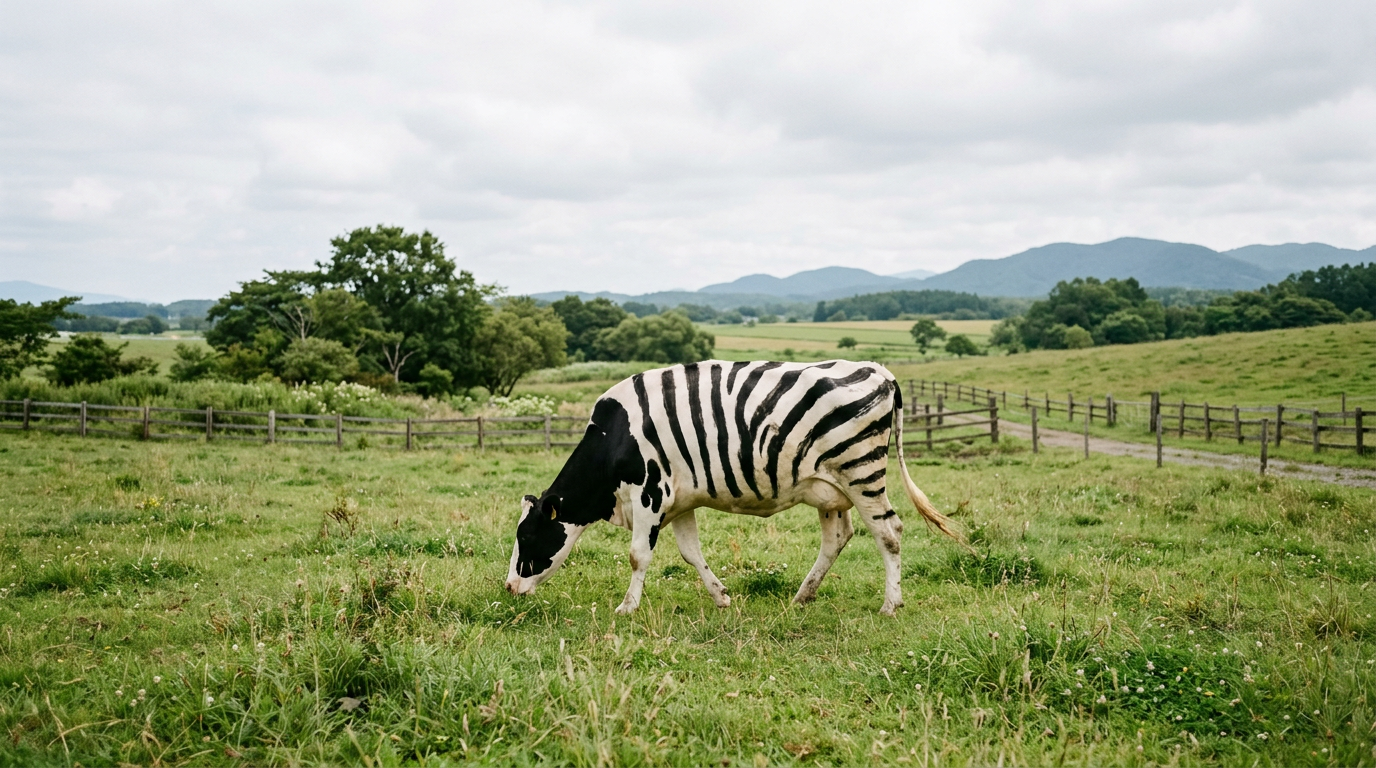
Painting cows with zebra stripes drastically cut down on biting flies, suggesting this bold pattern helps zebras ward off insects. This discovery is fascinating because it offers a functional, evolutionary explanation for zebra stripes, beyond just making them look striking. It also has potential applications for pest control in livestock farming.
In a hurry? TL;DR
- 1Painting cows with black and white stripes reduced biting fly landings by nearly 50%, suggesting stripes deter pests.
- 2This study indicates zebra stripes evolved primarily as a defense against disease-carrying insects, not for camouflage or social reasons.
- 3The stripes likely confuse flies' visual perception, hindering their ability to accurately land on the animals.
- 4This finding offers a low-tech, non-toxic pest control method for livestock, reducing reliance on chemical pesticides.
- 5The research has practical applications in animal welfare and sustainable agriculture, minimizing economic losses from fly-induced stress.
- 6The 'confusion effect' of stripes disrupts flies' landing guidance, making them less likely to attach to the host.
Why It Matters
This research offers a surprisingly practical explanation for the zebra's stripes, revealing them as a clever, low-tech bug repellent with potential benefits for modern farming.
Painting black and white stripes onto a cow reduces biting fly attacks by nearly 50 per cent. This visual trick suggests that the zebra’s iconic pattern evolved primarily as a biological shield against disease-carrying insects rather than for social bonding or camouflage.
The Core Data
- Reduction in fly landings: 50 per cent decrease compared to solid-coloured cows.
- Target pest: Tabanoidea, commonly known as horse flies or biting flies.
- Research Institution: Aichi Agricultural Research Centre and Kyoto University.
- Study Date: Published in PLOS ONE, 2019.
- Application: Animal welfare and reduction of pesticide use in livestock.
Why It Matters
This discovery transforms our understanding of evolutionary biology from abstract theories of camouflage into a functional, low-tech solution for modern agriculture.
The Zebra Suit Experiment
For decades, biologists debated why zebras wear stripes. Charles Darwin and Alfred Russel Wallace famously disagreed on the matter, weighing theories ranging from heat regulation to social recognition. However, a team of Japanese researchers decided to test the most pragmatic theory: pest control.
The researchers took six black cows and assigned them three distinct looks: traditional black, painted with white stripes, and painted with black stripes (to control for the smell of the paint). The results were immediate and startling. The striped cows saw a massive drop in fly landings, while the solid and black-striped cows were swarmed.
The Confusion Effect
The effectiveness of the stripes lies in the way flies perceive motion. Unlike predators that might be confused by a dazzle effect, flies struggle with landing logistics.
According to the study authors, the stripes likely disrupt the fly's polarotactic perception. As a fly approaches a striped surface, the alternating high-contrast pattern messes with its ability to judge distance and deceleration. They essentially fail to stick the landing, either overshooting the target or veering off at the last second.
Beyond the Savannah
While the study provides a compelling look at evolutionary biology, its practical applications are grounded in animal welfare. Traditional fly management involves heavy pesticide use, which is expensive and leads to environmental runoff.
Painting stripes or using striped fly blankets offers a non-toxic alternative. If a simple aesthetic change can achieve a 50 per cent reduction in pests, it provides a blueprint for more sustainable farming practices that don't rely on chemical intervention.
Practical Applications
- Livestock Management: Farmers in Japan have begun experimenting with striped coats to reduce the need for chemical sprays.
- Equestrian Gear: Striped horse rugs have surged in popularity, moving from a fashion statement to a functional veterinary tool.
- Human Apparel: Some outdoor gear manufacturers have integrated high-contrast patterns into hiking clothing to deter horse flies in marshy areas.
Interesting Connections
- Dazzle Camouflage: During World War I, ships were painted with complex geometric stripes. Unlike traditional camo, the goal was not to hide the ship, but to make it impossible for U-boats to track its speed and heading.
- The Horse Fly Eye: Horse flies have sophisticated eyes that are highly sensitive to polarised light, which reflects off dark, solid coats.
- Evolutionary Convergence: Other animals, like certain species of deer, use spots or stripes during their most vulnerable youth stages, potentially serving a similar protective purpose against insects.
Does the width of the stripe matter?
Yes, research suggests that thinner stripes are more effective at disrupting the landing patterns of flies than thick blocks of colour.
Does this mean stripes hide zebras from lions?
Not necessarily. Large predators like lions can usually spot zebras quite easily. The stripes are far more effective against small, winged invertebrates than large mammalian carnivores.
Is the paint safe for the cows?
The researchers used water-based lacquer that faded within days, ensuring no long-term skin irritation for the animals involved in the study.
Key Takeaways
- Optical disruption: Zebra stripes function as a visual barrier that prevents flies from landing accurately.
- Massive reduction: Striped cows experienced roughly half the number of fly attacks as their solid-coloured peers.
- Economic impact: This discovery could lead to cheaper, chemical-free ways to protect global cattle populations.
- Evolutionary clarity: The study reinforces the idea that small pests, not just large predators, shape the evolution of species.
A zebra’s stripes are not a fashion choice or a way to blend into the grass. They are a sophisticated, millions-of-years-old piece of wearable technology designed to crash the navigation systems of the world’s most annoying pests.
Frequently Asked Questions
Sources & References
- 1PLOS BiologyThis peer-reviewed scientific paper details the experiment where painting black and white stripes on cows reduced biting fly attacks by nearly 50%, conducted by researchers from the Aichi Agricultural Research Centre and Kyoto University.journals.plos.org
 WikipediaThis Wikipedia page describes horse-flies (Tabanidae), the biting flies that were the target pest in the cow-striping study, noting their ability to inflict painful bites on livestock.en.wikipedia.org