
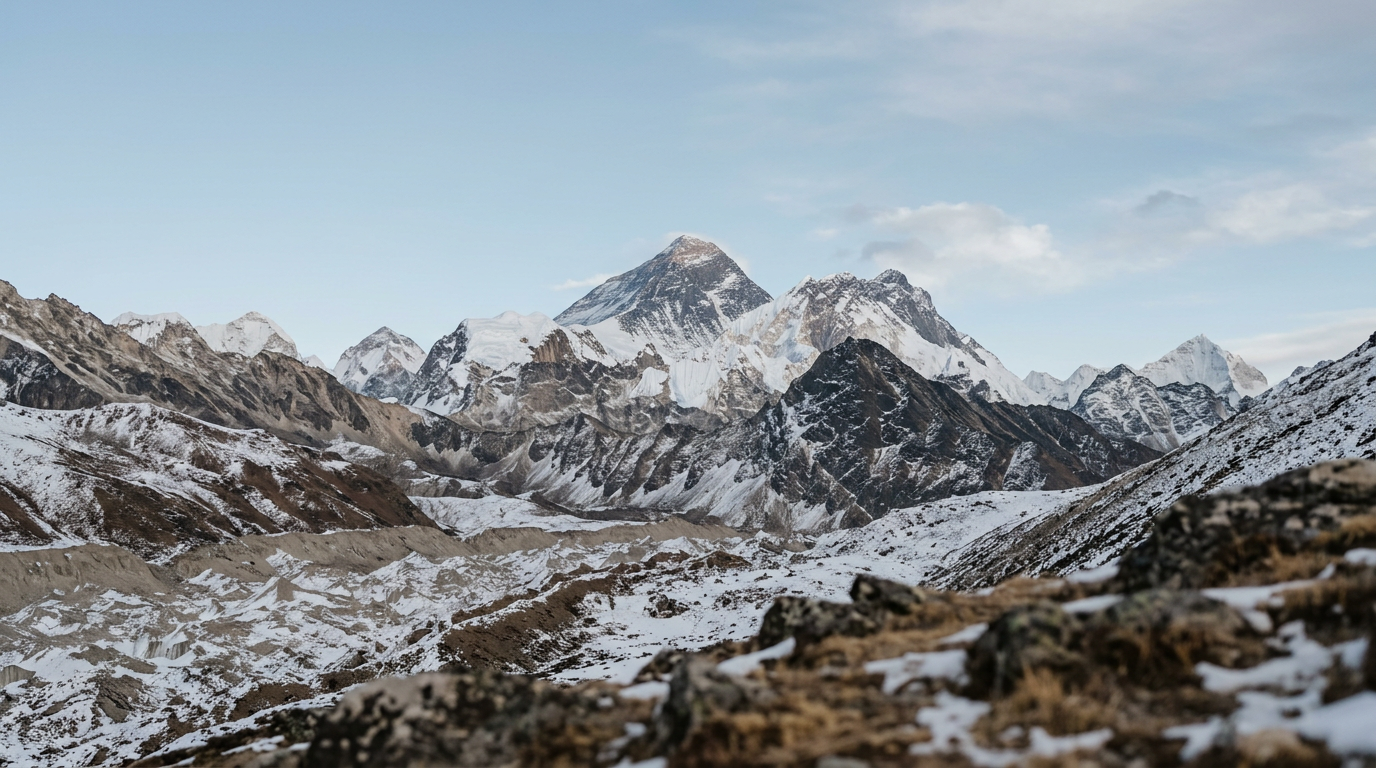
Quick Answer
Surveyors deliberately rounded Mount Everest's height up to 29,002 feet, not 29,000. They feared a neat, round figure would look like a rough guess, undermining the precision of their scientific calculations. This fascinating detail highlights the lengths they went to ensure their measurements were taken seriously.
In a hurry? TL;DR
- 1Publishing a round 29,000 feet for Everest in 1856 could appear as a lazy estimate, so surveyors published 29,002 feet instead.
- 2Victorian science viewed perfectly round numbers with suspicion, suggesting a lack of rigorous effort rather than precise calculation.
- 3Andrew Waugh, Surveyor General, added two feet to the Everest calculation to enhance its perceived accuracy and credibility.
- 4Radhanath Sikdar, a brilliant mathematician, performed the precise calculations for Everest's height using complex trigonometric methods.
- 5The 1856 survey measured Everest from over 100 miles away due to Nepal's closure to foreigners, requiring advanced optical instruments.
- 6Perception of precision is crucial; a slightly imperfect number often appears more credible than a perfectly rounded one in data.
Why It Matters
It's interesting how surveyors deliberately added two feet to Everest's height to make the number appear more accurate and less like a casual guess.
In 1856, the Great Trigonometrical Survey of India calculated Mount Everest to be exactly 29,000 feet high, but officials recorded the height as 29,002 feet to prevent the public from assuming they had simply rounded up the figure.
The Problem With Perfect Numbers
The story of the two-foot lie is a masterclass in the psychology of precision. When Andrew Waugh, the Surveyor General of India, received the calculations for Peak XV (now Everest), the math produced a suspiciously clean 29,000 feet.
Waugh knew that in the world of rigorous Victorian science, a round number was a red flag. It suggested a lack of effort or a rough approximation rather than a decade of hard labor across the subcontinent. To ensure the world respected the data, they added two feet, making it the first time in history that two plus two equalled credibility.
Key Data: The Great Trigonometrical Survey
- Year of discovery: 1856
- Original calculation: 29,000 feet (8,839.2 metres)
- Published height: 29,002 feet
- Modern official height: 29,031.7 feet (8,848.86 metres)
- Survey lead: Andrew Waugh
- Chief computer: Radhanath Sikdar
The Human Calculator
While George Everest gave the mountain his name, the heavy lifting was done by Radhanath Sikdar, a mathematical prodigy from Bengal. Sikdar was the chief computer for the survey, a job title that, in the mid-19th century, referred to a person, not a machine.
Sikdar used spherical trigonometry to account for the Earth's curvature, light refraction, and varying temperatures. According to records from the Royal Geographical Society, his calculations were so precise that the 29,000-foot result was legitimate, but Waugh feared the public would view it as a placeholder. By adding two feet, he gave the measurement the aesthetic of accuracy.
Measuring a Giant From 100 Miles Away
The surveyors could not actually stand on the mountain. Nepal was closed to foreigners at the time, meaning the team had to use theodolites—massive brass telescopes weighing up to 500 kilograms—from observation points over 100 miles away.
Unlike other peaks measured at the time, Everest presented unique atmospheric challenges. The team had to compensate for the way air density bends light, a phenomenon that can make a mountain appear taller or shorter depending on the time of day.
The Two-Foot Legacy
The 29,002-foot figure remained the official height until 1955, when an Indian survey adjusted it to 29,029 feet. Even today, the height is a point of international diplomacy. In 2020, China and Nepal finally agreed on a new official height of 29,031.7 feet after years of disagreement over whether to include the snow cap or just the rock head.
This historical quirk highlights a bias that still exists in modern peer-reviewed journals. A study published in the Journal of Consumer Research found that consumers are more likely to believe a product costs 29,002 pounds than exactly 29,000, as the specific number implies a calculated cost rather than an arbitrary markup.
Practical Applications of Precision Bias
- Negotiation: Research suggests that making a precise opening offer (e.g., asking for 48,500 rather than 50,000) leads to better outcomes because the other party assumes you have done your homework.
- Project Estimates: Providing a deadline of 12 days feels more considered than two weeks.
- Scientific Reporting: Researchers often include specific decimals to avoid the appearance of data smoothing or cherry-picking.
Interesting Connections
- The name game: Sir George Everest actually pronounced his name Eve-rest, not Ever-est. He also complained that the mountain should keep its local name, Sagarmatha or Chomolungma.
- Moving mountains: Everest is still growing at a rate of about 4 millimetres per year due to the collision of the Indian and Eurasian tectonic plates.
- Gravity anomalies: Because the mountain is so massive, it actually has its own gravitational pull, which can slightly deflect the plumb bobs used by surveyors.
Key Takeaways
- Perception of truth: A round number is often perceived as an estimate, while a specific number is perceived as a fact.
- Aesthetic accuracy: The surveyors added two feet not to lie about the height, but to protect the integrity of their work from public doubt.
- Persistent growth: Everest continues to change height, meaning every measurement is merely a snapshot in geological time.
- Human error: Even the most rigorous scientific projects are subject to the social anxieties of the people running them.
Frequently Asked Questions
Sources & References
 WikipediaThis source verifies that the Great Trigonometrical Survey measured Mount Everest as 29,000 feet in 1856, and that Andrew Waugh added two feet, publishing the height as 29,002 feet to avoid the impression of a rounded estimate.en.wikipedia.org
 Encyclopaedia BritannicaThis source confirms that the Great Trigonometrical Survey measured Peak XV (Everest) in 1856, calculated its height as 29,000 feet, and that Andrew Waugh publicly declared it as 29,002 feet to give the figure more credibility.britannica.com
 Smithsonian MagazineThis source corroborates that the Great Trigonometrical Survey's original calculation for Mount Everest in 1856 was exactly 29,000 feet, and Surveyor General Andrew Waugh decided to announce the height as 29,002 feet to prevent it from appearing to be a rounded number.smithsonianmag.com