
Quick Answer
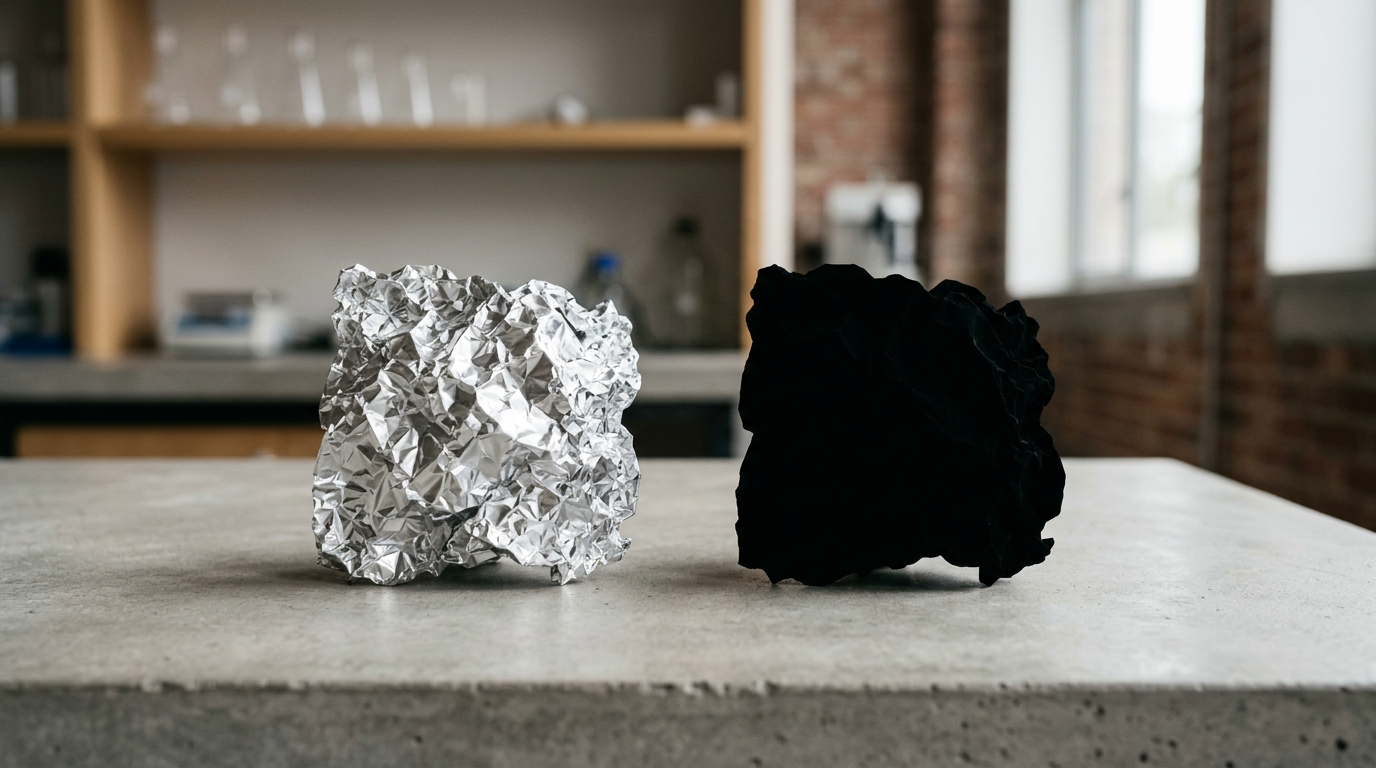
Vantablack is a super-dark material that soaks up nearly all light. This means even crumpled objects coated in it look like flat, empty holes. It's fascinating because it messes with our perception, making it hard to tell what's real by removing the shadows and details we usually rely on to see shape and depth.
In a hurry? TL;DR
- 1Vantablack absorbs 99.965% of visible light, making objects coated in it appear as flat, featureless voids.
- 2It's made of vertically aligned carbon nanotubes that trap light, dissipating it as heat.
- 3Vantablack challenges depth perception by eliminating the light and shadow cues our brains use.
- 4The material is useful for calibrating sensitive cameras and in space telescopes to block stray light.
- 5Unlike paint, Vantablack acts as a structural light trap rather than relying on pigments.
- 6Its extreme darkness has led to controversy in the art world due to exclusive usage rights.
Why It Matters
Vantablack is surprising because it makes even crumpled objects look like flat, featureless voids by absorbing almost all light.
Vantablack is a material so dark that it absorbs 99.965 percent of visible light, effectively turning three-dimensional objects into two-dimensional black holes. When coated in this substance, a crumpled piece of aluminium foil appears to be a flat, featureless void because the human eye cannot detect the shadows and contours of its surface.
Vantablack by the Numbers
- Light Absorption: 99.965 percent of visible spectrum
- Composition: Vertically Aligned NanoTube Arrays
- Density: 1,000 million nanotubes per square centimetre
- Thickness: Roughly 20 to 30 micrometres
- Thermal Conductivity: Highly efficient heat transfer
Why it matters
The material challenges our fundamental understanding of depth perception by stripping away the visual cues of light and shadow that our brains use to navigate the physical world.
The birth of the void
Vantablack was developed by Surrey NanoSystems in 2014. Unlike traditional paints that rely on pigments, this material is a forest of carbon nanotubes grown in a laboratory setting. Each tube is about 10,000 times thinner than a human hair.
When light hits the material, it becomes trapped between these tubes, bouncing around until it is dissipated as heat. The result is a surface that lacks any discernible texture. According to researchers at the National Physical Laboratory, the material is so effective that it can be used to calibrate extremely sensitive satellite cameras by providing a true black reference point.
The science of seeing nothing
Humans perceive depth through specular reflection—the way light bounces off edges and curves. When an object is coated in Vantablack, there is virtually no reflection. This creates a cognitive dissonance where the brain knows an object is three-dimensional, but the eyes report a flat silhouette.
In contrast to previous dark materials, which often relied on matte finishes or specific pigments, Vantablack functions as a structural trap. Whereas a standard black paint might reflect 5 to 10 percent of light, Vantablack reflects almost nothing. This makes it invaluable for space telescopes, where stray light from the sun or moon can wash out the faint glimmer of distant stars.
The Anish Kapoor controversy
While the science is impressive, the material gained mainstream notoriety through a heated art-world feud. In 2016, the artist Sir Anish Kapoor secured exclusive rights to use Vantablack in the field of art. This move sparked outrage among other creators who felt a colour—or the absence of one—should not be private property.
Artist Stuart Semple responded by creating the world’s pinkest pink and the world’s most glittery glitter, banning Kapoor from using them. This cultural standoff highlighted the strange intersection of material science and intellectual property, proving that even a void can have a significant impact on the creative community.
Practical applications
- Space Exploration: Lining the interior of telescopes to prevent internal light scattering.
- Luxury Goods: High-end watches like the H. Moser and Cie Venturer use Vantablack dials to make hands appear as if they are floating in space.
- Military Stealth: Reducing the visual and infrared signatures of vehicles or equipment.
- Thermal Camouflage: Hiding heat signatures because the material is as efficient at emitting heat as it is at absorbing light.
Can you touch Vantablack?
No. The nanotube structure is incredibly delicate. Touching the surface would crush the tubes, ruining the light-trapping effect and leaving a visible smudge that reflects light like ordinary carbon.
Is it the darkest thing in the universe?
While it is one of the darkest man-made substances, it is not the darkest thing in existence. That title belongs to black holes, which allow zero light to escape. Additionally, MIT researchers recently claimed to have created a material that absorbs 99.995 percent of light, narrowly beating Vantablack’s record.
Can I buy Vantablack paint for my house?
Surrey NanoSystems does not sell the original Vantablack to the general public because it requires a complex chemical vapour deposition process to apply. However, consumer-grade alternatives like Musou Black or Black 3.0 offer similar (though slightly less extreme) effects for home use.
Key Takeaways
- Composition: It is made of billions of microscopic carbon nanotubes.
- Visual Effect: It removes all surface detail, making 3D objects look like 2D holes.
- Scientific Use: It is primarily used to reduce glare in high-precision optical instruments.
- Thermal Property: It converts light into heat with near-perfect efficiency.
- Cultural Impact: It sparked a major debate over the ethics of exclusive rights to artistic materials.
Vantablack proves that the most powerful thing a material can do is disappear. By capturing almost every photon that hits it, this substance forces us to confront the fact that our reality is defined entirely by the light that manages to escape.
Frequently Asked Questions
Sources & References
 Encyclopaedia BritannicaThis source describes Vantablack as a coating made of carbon nanotubes, where light becomes trapped between the tubes and is converted into heat, resulting in minimal reflection.britannica.com
 WikipediaBackground and contexten.wikipedia.org
 Scientific AmericanScientific research and analysisscientificamerican.com
 BBCReporting and verificationbbc.co.uk