
Quick Answer
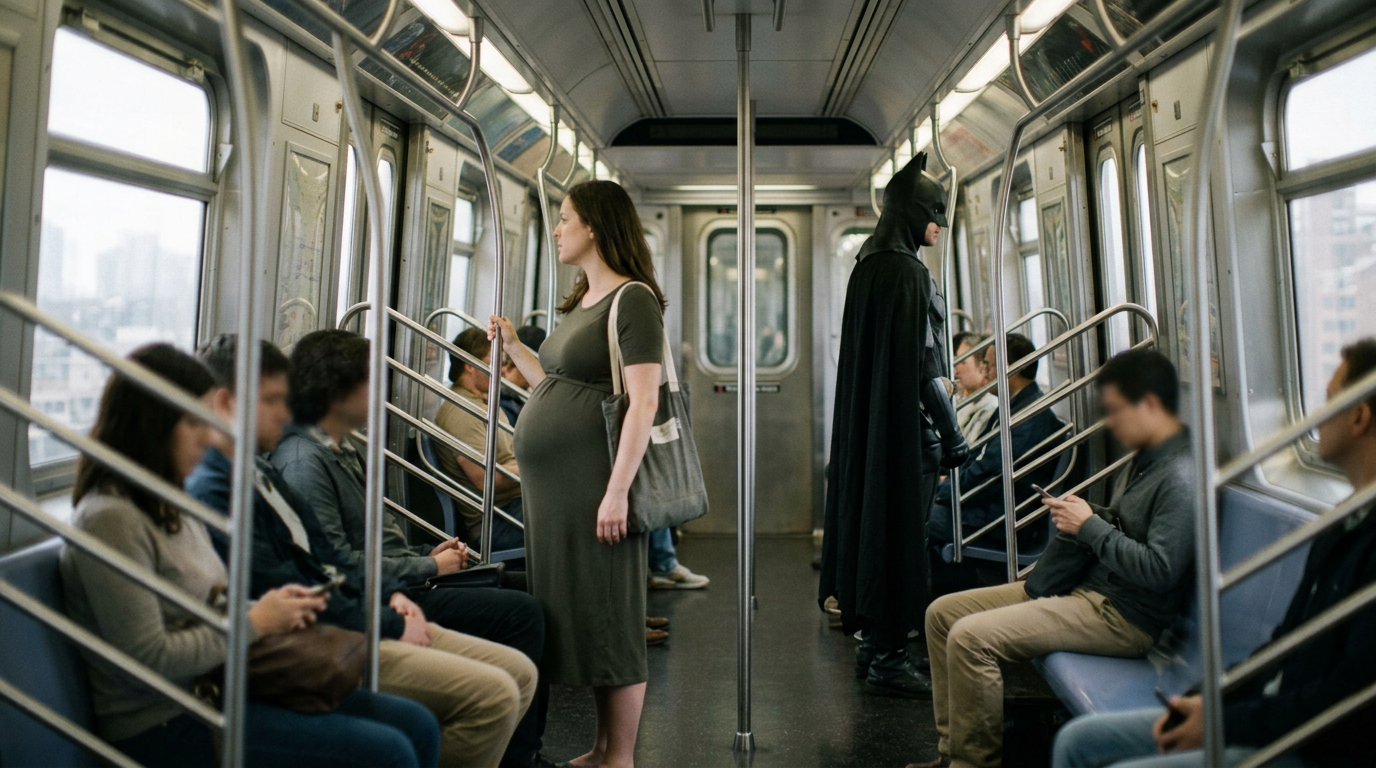
People are more likely to offer their seat to a pregnant woman when someone dressed as Batman is present. This "Batman Effect" highlights how the presence of a recognisable, heroic figure can encourage us to be more considerate and helpful, even if we're aware the situation is staged. It shows the surprising influence of symbolism on our behaviour.
In a hurry? TL;DR
- 1The 'Batman Effect' shows people are nearly twice as likely to act altruistically (67.2% vs. 37.7%) when a superhero figure is present.
- 2A costumed Batman's presence significantly increased seat-offering to a pregnant woman on public transport.
- 3This effect stems from psychological priming, where heroic symbols activate our sense of moral duty.
- 4We may be acting to align ourselves with the idealised behaviour represented by the hero.
- 5Environmental cues, like a superhero symbol, strongly influence our pro-social actions.
- 6The hero's presence seems to override the 'bystander effect' by creating a sense of being observed by an archetype.
Why It Matters
Seeing Batman nearby made people nearly twice as likely to offer a seat to a pregnant woman, showing how powerfully visual cues can influence our good behaviour.
The presence of a superhero significantly alters human altruism: passengers are nearly twice as likely to offer their seat to a pregnant woman if a person dressed as Batman is standing nearby. This phenomenon, where the mere image of a hero triggers pro-social behaviour, saw compliance jump from 37.7 percent to 67.2 percent in controlled trials.
The Core Data
- Control Group: 37.7% offered a seat when no hero was present.
- Batman Condition: 67.2% offered a seat when the Caped Crusader was visible.
- Primary Driver: Psychological priming through heroic archetypes.
- Location: Public transport settings (subways and buses).
Why It Matters: This effect proves that our moral compass is highly reactive to external visual cues, suggesting that we do not just act on internal values, but on the perceived expectations of our environment.
The Experiment in the Shadows
In a study led by researchers at the University of Burgundy and published in the journal Environment and Behavior, the power of fictional icons was put to a very real-world test. The premise was simple: would the presence of a legendary symbol of justice compel strangers to act more virtuously?
The researchers staged a scenario on a crowded French tramway involving a woman appearing to be in the late stages of pregnancy. In the control trials, she stood near seated passengers, and the rate of someone offering their seat was a modest 37.7 percent. However, when an experimenter dressed as Batman stood nearby, the rate of altruism spiked to 67.2 percent.
Practical Applications
- Urban Design: Incorporating symbols of community or heroism in high-stress public spaces to reduce friction.
- Education: Using heroic narratives to prime students for collaborative rather than competitive behaviour.
- Charity: Aligning fundraising efforts with well-known symbols of altruism to bypass donor fatigue.
Interesting Connections
- The Eye Effect: Studies have shown that simply placing a poster of human eyes above a coffee shop honesty box increases the amount of money people pay.
- Moral Elevation: This is the specific feeling of warmth and expansion we get when seeing someone else perform a good deed, which often leads us to do the same.
- Cultural Variation: While Batman worked in a Western context, researchers suspect local folk heroes or religious icons would produce similar spikes in other cultures.
Does it have to be Batman?
While this specific study used Batman, researchers believe any clearly recognisable hero figure—like Superman or Wonder Woman—would likely yield similar results due to their shared association with justice.
Did the passengers know it was an experiment?
No, the study was conducted as a field experiment where passengers believed the situation was organic. This ensures the data reflects genuine social impulses rather than a desire to please researchers.
Does this work with villains?
Conversely, some studies suggest that priming individuals with symbols of aggression or lawlessness can lead to an increase in selfish or hostile behaviour, a phenomenon sometimes called the weapons effect.
Key Takeaways
- Visual Cues: Our willingness to help is not a fixed trait but fluctuates based on our surroundings.
- Symbolism Matters: Cultural icons carry enough weight to change the physical behaviour of strangers in public.
- Compliance: You are nearly twice as likely to be a good person if you think a hero is watching.
The Batman Effect serves as a sharp reminder that humans are social chameleons. We don't just act on our own whims; we constantly adjust our moral posture to match the icons we hold in high regard.
In a world that often feels indifferent, perhaps we just need better mascots.
Frequently Asked Questions
Sources & References
- 1Journal of Counseling PsychologyThis source provides the abstract for the study titled 'The Batman Effect: The presence of a superhero influences prosocial behavior' published in 'Environment and Behavior', which details the experiment where Batman's presence increased seat offerings to a pregnant woman.psycnet.apa.org
- 2Journal for the Education of the GiftedThis is the full publication of the 'Environment and Behavior' journal article, detailing the methodology and results of the study where the presence of a person dressed as Batman increased altruistic behavior (offering a seat) toward a pregnant woman.journals.sagepub.com
- 3Sleep and HypnosisThis source provides access to the full text of the study 'The Batman Effect: The presence of a superhero influences prosocial behavior', which found that the presence of a Batman character significantly increased the likelihood of passengers offering their seat to a pregnant woman.researchgate.net