
Quick Answer
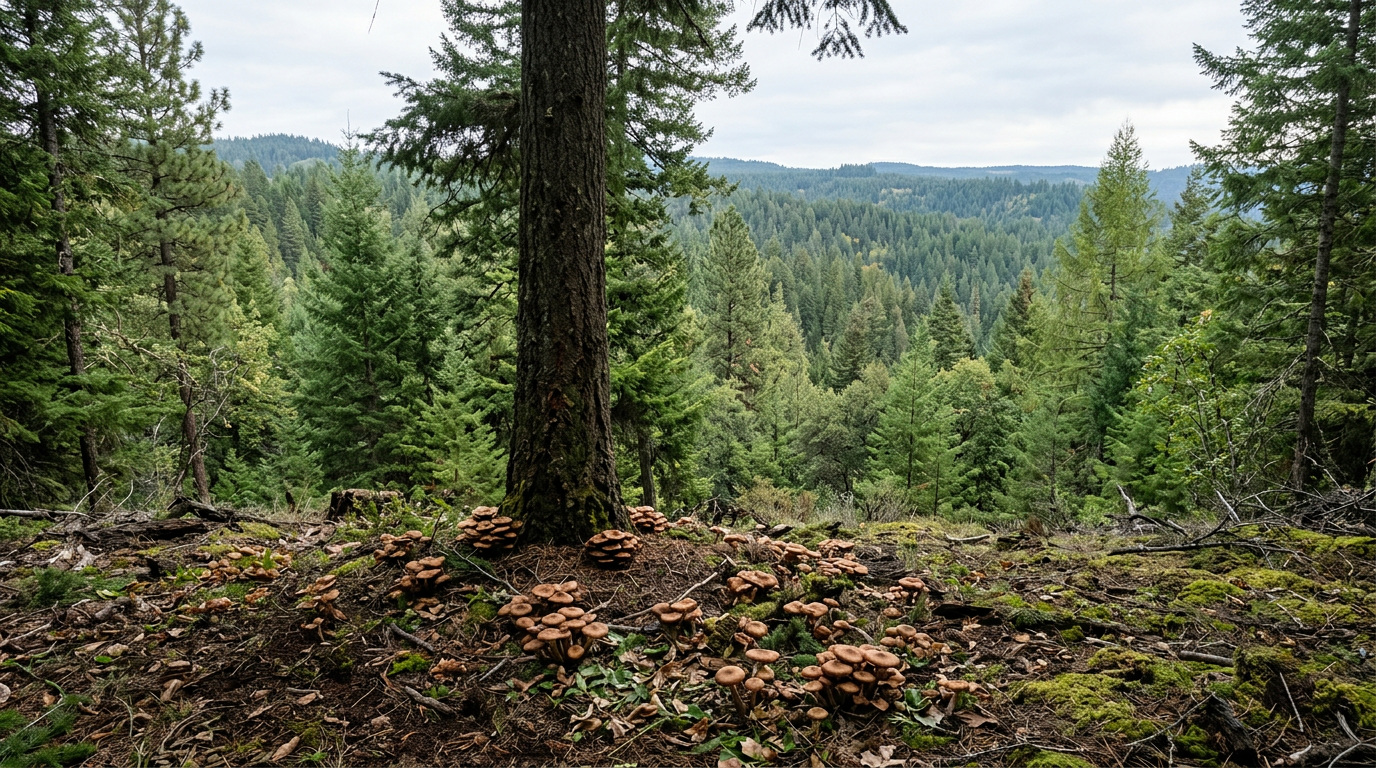
The largest living thing on Earth is a massive honey fungus in Oregon, spreading underground across almost 10 square kilometres. What's incredible is this single, ancient organism is mostly hidden, yet it's vital for the health of the entire forest ecosystem it inhabits.
In a hurry? TL;DR
- 1The world's largest organism is an Oregon honey fungus (Armillaria ostoyae), spanning nearly 10 sq km underground.
- 2This massive fungus is an ancient, interconnected network, likely thousands of years old.
- 3It actively kills trees by spreading beneath bark, acting as a slow-moving subterranean predator.
- 4The fungus's rhizomorphs transport nutrients, allowing it to connect and colonize vast areas.
- 5Its discovery challenges our perception of biological individuality, revealing hidden, ecosystem-defining networks.
- 6Understanding this fungus is key to comprehending forest health and complex subterranean life.
Why It Matters
It's fascinating that the biggest living thing on Earth isn't a giant animal or tree, but a hidden underground fungus that's been spreading for thousands of years.
The largest living organism on Earth is not a blue whale or a giant sequoia, but a specimen of Armillaria ostoyae, commonly known as the honey fungus, which spans 9.6 square kilometres in Oregon’s Malheur National Forest.
- Species: Armillaria ostoyae (Honey Fungus)
- Location: Blue Mountains, Oregon, USA
- Area: 2,384 acres (approximately 9.6 square kilometres)
- Estimated Age: 2,400 to 8,000 years old
- Biomass: Estimated at 7,500 to 35,000 tons
Why It Matters
We typically define individuals by their visible boundaries, but the Humongous Fungus proves that the most dominant life forms on the planet are often invisible, operating as massive, subterranean networks that dictate the health and survival of entire forest ecosystems.
The Discovery of a Hidden Giant
In 1998, scientists from the United States Forest Service set out to investigate the mysterious death of trees in the Blue Mountains of eastern Oregon. They were not looking for a record-breaking organism; they were trying to solve a local forestry problem.
Using aerial photography, researchers identified areas of dying trees and took root samples from 112 locations. Catherine Parks and her team expected to find various distinct fungal patches competing for resources. Instead, DNA testing revealed that the samples were genetically identical.
This was not a collection of individual fungi. It was a single, continuous biological entity that had been spreading through the soil for millennia.
Challenging the Definition of Life
The sheer scale of the Oregon fungus forces a rethink of biological individuality. Most people view a forest as a collection of separate trees, but the presence of Armillaria suggests the forest floor is a single, interconnected metabolic system.
This organism is estimated to be at least 2,400 years old, though some mycologists suggest it could be as old as 8,650 years. This would make it one of the oldest living things on the planet, predating the rise of many human civilisations.
Practical Applications and Forest Management
Understanding the honey fungus is critical for modern silviculture. Because the fungus thrives on the stumps of harvested trees, traditional logging practices can inadvertently fuel its growth.
Forest managers now use the Oregon site to study how to create resilient ecosystems. By planting tree species that are naturally resistant to Armillaria, such as Western Larch or Ponderosa Pine, they can slow the spread of the pathogen and maintain forest cover.
Interesting Connections
- Culinary Paradox: Despite its destructive nature, the honey fungus produces edible mushrooms, though they must be cooked thoroughly to avoid stomach upset.
- The Michigan Rival: Before the Oregon discovery, the record holder was a 37-acre Armillaria gallica in Michigan, nicknamed the Humongous Fungus in the early 1990s.
- Bioluminescence: Some species of Armillaria exhibit bioluminescence in their mycelium, creating a faint green glow known as foxfire in the forest at night.
Is the honey fungus dangerous to humans?
No. While it is a devastating pathogen for trees, it poses no direct threat to human health, though you should always be cautious when foraging for the edible mushrooms it produces.
How does it stay connected over such a distance?
The fungus uses rhizomorphs, which are highly organised bundles of mycelium. These act like a circulatory system, allowing the organism to maintain genetic and physiological unity across miles of varied terrain.
Can you see the organism?
You cannot see the whole organism at once. You might see the honey-coloured mushrooms at the base of trees in autumn, or the white, felt-like sheets of mycelium under the bark of dying trees, but the true giant remains hidden underground.
Key Takeaways
- The Oregon honey fungus is the largest known organism by area, covering nearly 10 square kilometres.
- It is a single genetic individual that spreads via underground rhizomorphs.
- Researchers identified it in 1998 using DNA fingerprinting techniques.
- It functions as a parasitic predator, killing trees to fuel its own ancient expansion.
- The organism challenges our standard definitions of size, age, and what constitutes a single living being.
Frequently Asked Questions
Sources & References
 WikipediaBackground and contexten.wikipedia.org
 Scientific AmericanScientific research and analysisscientificamerican.com
 BBCReporting and verificationbbc.co.uk
- WikipediaThis source confirms that a single specimen of Armillaria ostoyae in Malheur National Forest, Oregon, spans approximately 9.6 square kilometers (2,385 acres) and is estimated to be thousands of years old.en.wikipedia.org