
Quick Answer
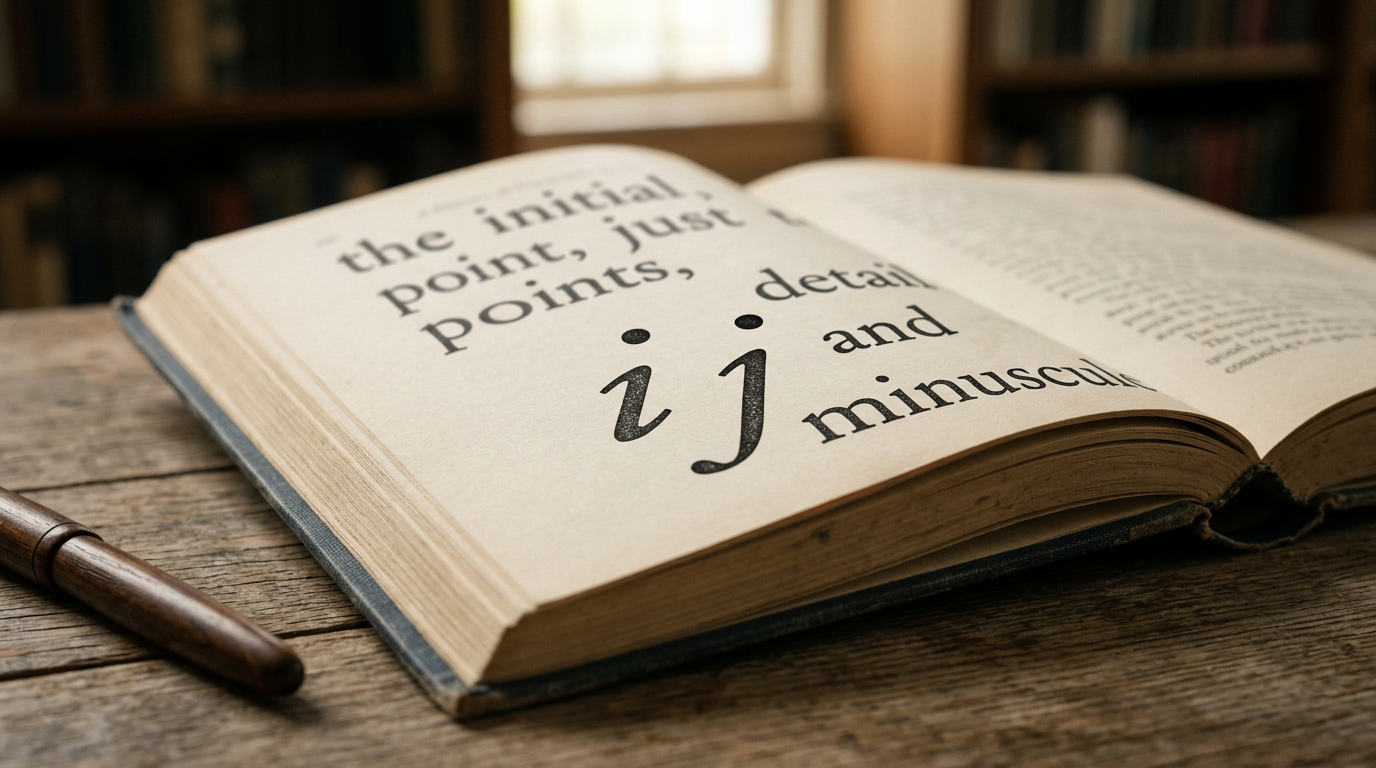
That little dot above an 'i' or 'j' is called a tittle. It might seem insignificant, but this tiny mark, famously mentioned in "every jot and tittle," was historically crucial for distinguishing letters and ensuring texts were clear and legible, especially in older handwriting.
In a hurry? TL;DR
- 1The dot over lowercase 'i' and 'j' is officially called a 'tittle'.
- 2Tittles originated in the Middle Ages to improve legibility in dense Gothic scripts.
- 3The phrase 'every jot and tittle' refers to the smallest details, originating from biblical terms.
- 4The tittle serves a functional purpose in typography and coding, aiding visual distinction.
- 5Handwriting analysis uses tittle characteristics to identify individuals.
- 6In math/physics, tittles are often replaced by hats or bars to denote different variables.
Why It Matters
The humble dot above an 'i' or 'j' has a specific name, the tittle, and its existence is a clever solution to a medieval scribal problem of legibility.
The small dot sitting atop a lowercase i or j is officially known as a tittle. This minuscule diacritic originated as a practical tool for medieval scribes to distinguish between similar-looking vertical strokes in dense gothic scripts.
The Essentials
- Official Name: Tittle
- Etymology: Derived from the Latin titulus, meaning a heading or label.
- Related Phrase: Every jot and tittle, referring to the smallest possible details.
- Purpose: Legibility and orthographic distinction.
- Closest Relative: The jot, derived from the Greek letter iota.
Why It Matters
The tittle is a masterclass in functional design. While it appears decorative today, its existence prevents the lowercase i from vanishing into the surrounding letters. It serves as a linguistic anchor, ensuring that the smallest unit of a word remains visible and distinct.
The Scribal Crisis of the Middle Ages
The tittle was born out of a crisis of legibility. During the 11th century, European scribes transitioned to a style known as Blackletter or Gothic script. This style was beautiful but notoriously difficult to read because it relied on heavy, uniform vertical strokes called minims.
In a word like minimum, a reader would face a sea of identical vertical lines. To help the eye navigate this thicket of ink, scribes began adding a small diagonal slash above the i. According to paleographers at the University of Leicester, this mark evolved from a stroke into the circular dot we recognise today by the time the printing press arrived in the 15th century.
Does the dot on a lowercase j have a different name?
No, the dot on both the i and the j is called a tittle. While the letters serve different phonetic purposes, their diacritic marks share the same structural name.
What happens if you remove the tittle?
In Turkish and Azerbaijani, there are two distinct versions of the letter: the dotted i and the dotless ı. Removing the tittle in these languages changes the pronunciation and the meaning of the word entirely.
Is a tittle the same as a cedilla or tilde?
No. While all are diacritics, the tittle is an integral part of the standard lowercase letter in English. A tilde or cedilla is usually an accent added to modify a letter's sound.
Key Takeaways
- Smallest Detail: The tittle is the smallest distinct mark in the English alphabet.
- Ancient Roots: The term titulus was used in Roman times to describe any small mark or title.
- Functional Origin: It was invented to break up the visual monotony of Gothic vertical strokes.
- Cultural Idiom: To care about every jot and tittle is to be obsessively precise.
The next time you are told to dot your i's and cross your t's, remember that you aren't just finishing a task. You are preserving a thousand-year-old solution to a readability problem that nearly broke the medieval world's ability to read its own books.
Frequently Asked Questions
Sources & References
 WikipediaThis source explains that the tittle is the small distinguishing mark or dot over the lowercase letters 'i' and 'j'.en.wikipedia.org
- 2Online Etymology DictionaryThis source connects the word 'tittle' to the phrase 'jot and tittle' and its biblical reference in Matthew 5:18, referring to the smallest detail.etymonline.com