
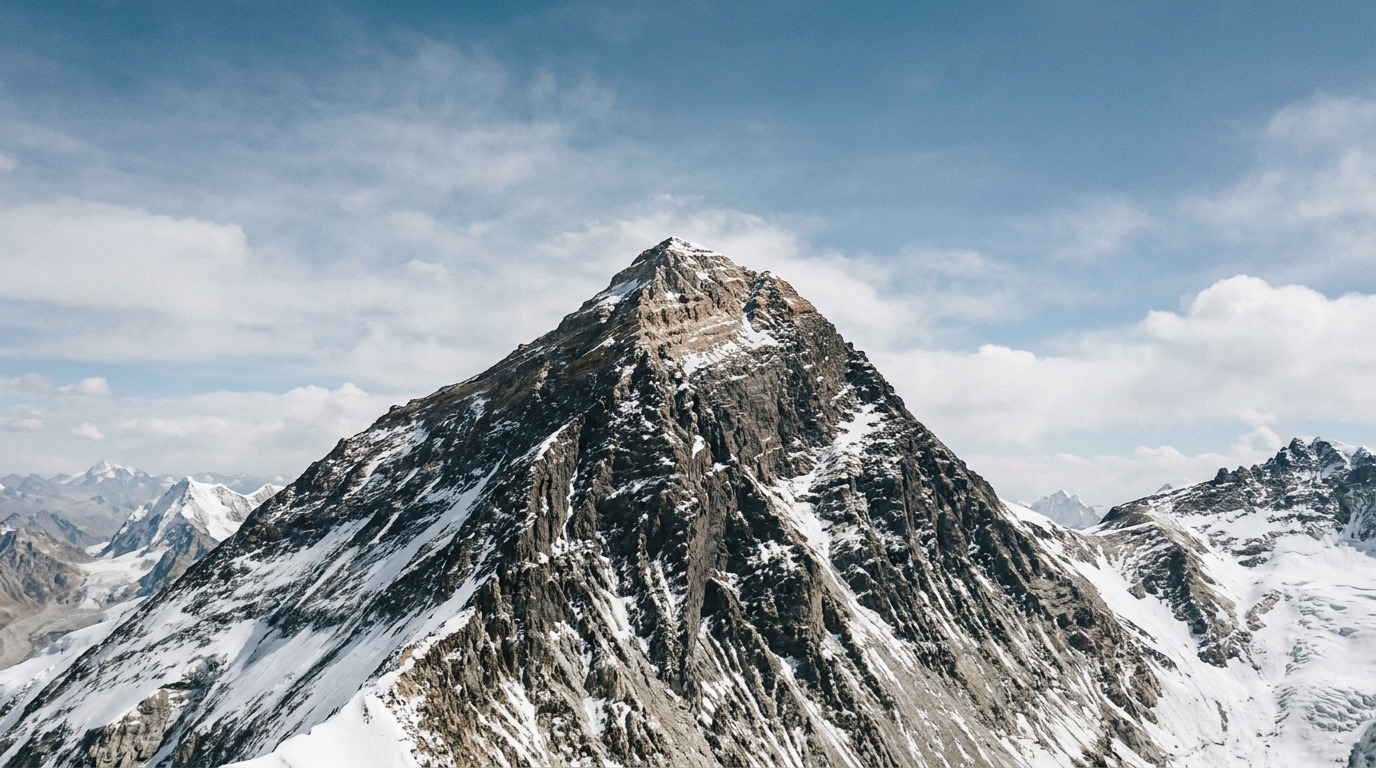
Quick Answer
The rock at the summit of Mount Everest was once the floor of an ancient ocean. Scattered among the limestone peaks are fossils of tiny marine creatures that lived 450 million years ago. It is incredible to realise that the highest point on Earth began in a warm, shallow sea. These remnants were thrust into the stratosphere as tectonic plates collided, lifting the ocean floor miles into the sky. Today, these ancient fossils serve as a permanent record of our planet’s dramatic geological transfor
In a hurry? TL;DR
- 1Understand that Mount Everest’s peak is composed of marine limestone, proving that the world's highest summit was once the floor of the ancient Tethys Ocean.
- 2Identify Everest as a fold mountain formed by the collision of the Indian and Eurasian plates, which thrust deep-sea sediment upward into the stratosphere.
- 3Recognize that the fossils found at the summit, such as trilobites and crinoids, date back to the Ordovician Period, approximately 450 million years ago.
- 4Acknowledge that the Himalayas are still actively rising due to the ongoing northward drift of the Indian plate, balanced against constant natural erosion.
- 5Note that Everest acts as a geological time capsule, preserving delicate marine fossils in unmetamorphosed rock despite undergoing intense tectonic pressure over millions of years.
Why It Matters
It is extraordinary that the world's highest peak is made of ancient seabed, proving that the Earth's surface is constantly shifting and has pushed the floor of a tropical ocean into the stratosphere.
The peak of Mount Everest, the highest point on land, is composed of marine limestone containing the fossilised remains of creatures that lived on the ocean floor 450 million years ago. Known as the Qomolangma Formation, this rock layer proves that the worlds highest summit was once part of the Tethys Ocean.
Key Facts and Figures
- Summit Altitude: 8,848.86 metres above sea level
- Rock Composition: Pelagic limestone and siltstone
- Geological Age: Ordovician Period (roughly 450 to 470 million years ago)
- Primary Fossils: Brachiopods, trilobites, and crinoids
- Tectonic Plate Movement: 4 to 5 centimetres of annual northward drift
Why It Matters
This geological anomaly serves as the ultimate evidence for plate tectonics, demonstrating that the Earths crust is not a static shell but a fluid system capable of thrusting the seabed into the stratosphere.
The Discovery at the Peak
The presence of sea life at 29,000 feet was first documented by Western science during the 1924 British Everest Expedition. Geologist Noel Odell collected samples from the Yellow Band and the summit pyramid, identifying small, calcified shells embedded in the dark, weathered rock.
Odell found fragments of crinoids, often called sea lilies, which are marine animals related to starfish. These creatures required warm, shallow tropical waters to survive, a stark contrast to the sub-zero, oxygen-depleted environment where their remains currently rest.
How the Seabed Scaled the Sky
The transformation began approximately 50 million years ago when the Indian Plate collided with the Eurasian Plate. This was not a subtle meeting. The force was so immense that the sediment of the Tethys Ocean—accumulated over hundreds of millions of years—was squeezed, folded, and thrust upward.
Unlike volcanic mountains formed by magma, Everest is a fold mountain. According to researchers at the University of Arizona, the Indian subcontinent continues to push into Asia today. This ongoing pressure means the Himalayas are still rising, albeit at a rate tempered by the relentless erosion of wind and ice.
Tectonic Memory
The rocks at the summit are essentially a geological time capsule. When a climber stands on the peak, they are standing on the remains of the Ordovician Period. At that time, life was almost entirely confined to the sea, and the landmasses we recognise today were part of the supercontinent Gondwana.
Real World Implications
Understanding these fossil layers allows geologists to map the historic movement of continents. By comparing the limestone on Everest to similar deposits in other parts of the world, scientists can reconstruct the size and temperature of the ancient Tethys Ocean.
This provides critical data for climate modelling. The carbon trapped in the limestone of the Himalayas plays a role in the long-term carbon cycle, as the weathering of these mountains eventually returns that carbon to the atmosphere and oceans.
Common Misconceptions
A frequent mistake is the assumption that Everest was pushed up by a volcano. It is entirely sedimentary and metamorphic. Another myth is that the fossils are from the Great Flood; in reality, the timeline of tectonic uplift spans millions of years, far exceeding any recorded human history.
Can you see the fossils with the naked eye?
Yes, though they are often fragmented. Climbers frequently report seeing the outlines of shells and skeletal remains of crinoids in the grey-white limestone of the summit pyramid.
Is it legal to take rocks from the summit?
No. Mount Everest is part of Sagarmatha National Park in Nepal and the Qomolangma National Nature Preserve in Tibet. Removing rock samples or fossils is strictly prohibited by both governments.
Are there other mountains with marine fossils?
Yes, many major ranges including the Alps and the Rockies contain marine limestone. However, Everest is unique because its marine layer occupies the highest possible terrestrial elevation on the planet.
Key Takeaways
- Ocean Origins: The top of Mount Everest consists of 450-million-year-old limestone.
- Fossil Records: The rock contains remains of trilobites, brachiopods, and sea lilies.
- Tectonic Force: The peak was elevated from the ocean floor by the collision of the Indian and Eurasian plates.
- Ongoing Growth: The mountain continues to rise at a rate of roughly 4 to 5 millimetres per year.
- Scientific Value: These rocks provide a map of the ancient Tethys Ocean and prehistoric climate conditions.
Next time you look at a photo of the worlds highest peak, remember you are looking at an ancient graveyard of the deep sea. The highest point on Earth was once its hidden floor.
Frequently Asked Questions
Sources & References
 Encyclopaedia BritannicaDescribes the geology and origin of Mount Everest, including the marine sedimentary rocks that comprise the mountain's highest layers.britannica.com
- 2U.S. Department of Labor (BLS)Explains how the collision between the Indian and Eurasian continental plates uplifted marine sediments from the ancient Tethys seafloor to create the Himalayas.pubs.usgs.gov